


![[Marketing] Questao Topo - deslogado](https://storage.estuda.com.br/banners/0_6b7ebee90b03af1c560c73bb8bcce34a_banner_deslogado_70_dias.png)
Questões de Inglês
19.971 Questões
Questão 94 125316
ENEM 1ª Aplicação - 2° Dia (Amarelo) 2016
Orientações à população são encontradas também em sites oficiais. Ao clicar no endereço eletrônico mencionado no cartaz disponível na internet, o leitor tem acesso aos(às)
Questão 40 123779
UNIFESP 2016Poverty may hinder kids’ brain development, study says
Reduced gray matter, lower test scores reported for poor children
July 20, 2015

Poverty appears to affect the brain development of children, hampering the growth of gray matter and impairing their academic performance, researchers report. Poor children tend to have as much as 10 percent less gray matter in several areas of the brain associated with academic skills, according to a study published July 20 in JAMA Pediatrics. “We used to think of poverty as a ‘social’ issue, but what we are learning now is that it is a biomedical issue that is affecting brain growth,” said senior study author Seth Pollak, a professor of psychology, pediatrics, anthropology and neuroscience at the University of Wisconsin-Madison.
The results could have profound implications for the United States, where low-income students now represent the majority of kids in public schools, the study authors said in background information. Fifty-one percent of public school students came from low-income families in 2013.
Previous studies have shown that children living in poverty tend to perform poorly in school, the authors say. They have markedly lower test scores, and do not go as far in school as their well-off peers.
To see whether this is due to some physical effect that poverty might have on a child’s brain, Pollak and his colleagues analyzed MRI scans of 389 typically developing kids aged 4 to 22, assessing the amount of gray matter in the whole brain as well as the frontal lobe, temporal lobe and hippocampus. “Gray matter contains most of the brain’s neuronal cells,” Pollak said. “In other words, other parts of the brain – like white matter – carry information from one section of the brain to another. But the gray matter is where seeing and hearing, memory, emotions, speech, decision making and self-control occur.”
Children living below 150 percent of the federal poverty level – US$ 36,375 for a family of four – had 3 percent to 4 percent less gray matter in important regions of their brain, compared to the norm, the authors found. Those in families living below the federal poverty level fared even worse, with 8 percent to 10 percent less gray matter in those same brain regions. The federal poverty level in 2015 is US$ 24,250 for a family of four. These same kids scored an average of four to seven points lower on standardized tests, the researchers said.
The team estimated that as much as 20 percent of the gap in test scores could be explained by reduced brain development. A host of poverty-related issues likely contribute to developmental lags in children’s brains, Pollak said. Low-income kids are less likely to get the type of stimulation from their parents and environment that helps the brain grow, he said. For example, they hear fewer new words, and have fewer opportunities to read or play games. Their brain development also can be affected by factors related to impoverishment, such as high stress levels, poor sleep, crowding and poor nutrition, Pollak said.
This study serves as a call to action, given what’s already known about the effects of poverty on child development, said Dr. Joan Luby, a professor of child psychiatry at Washington University School of Medicine in St. Louis. “The thing that’s really important about this study in the context of the broader literature is that there really is enough scientific evidence to take public health action at this point,” said Luby, who wrote an editorial accompanying the study. “Poverty negatively affects brain development, and we also know that early interventions are powerfully effective,” Luby said. “They are more effective than interventions later in life, and they also are cost-effective.”
(www.nlm.nih.gov. Adaptado.)
The objective of the study led by Dr. Seth Pollak was to
Questão 33 123764
UNIFESP 2016Nobel winner Malala opens school for Syrian refugees
Sylvia Westall
July 13, 2015
Bekaa Valley, Lebanon
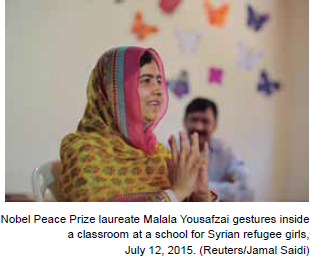
Malala Yousafzai, the youngest winner of the Nobel Peace Prize, celebrated her 18th birthday in Lebanon on Sunday by opening a school for Syrian refugee girls and called on world leaders to invest in “books not bullets”. Malala became a symbol of defiance after she was shot on a school bus in Pakistan in 2012 by the Taliban for advocating girls’ rights to education. She continued campaigning and won the Nobel in 2014.
“I decided to be in Lebanon because I believe that the voices of the Syrian refugees need to be heard and they have been ignored for so long,” Malala told Reuters in a schoolroom decorated with drawings of butterflies. The Malala Fund, a non-profit organization that supports local education projects, provided most of the funding for the school, set up by Lebanon’s Kayany Foundation in the Bekaa Valley, close to the Syrian border. The Kayany Foundation, established by Syrian Nora Joumblatt in response to Syria’s refugee crisis, has already completed three other new schools to give free education to Syrian children in Lebanon. The Malala school can welcome up to 200 girls aged 14 to 18.
“Today on my first day as an adult, on behalf of the world’s children, I demand of leaders we must invest in books instead of bullets,” Malala said in a speech. Lebanon is home to at least 1.2 million of the 4 million refugees that have fled Syria’s war to neighboring countries. There are about 500,000 Syrian school-age children in Lebanon, but only a fifth are in formal education. “We are in danger of losing generations of young Syrian girls due to the lack of education,” Joumblatt said in a speech at the opening of the school. “Desperate and displaced Syrians are increasingly seeing early marriage as a way to secure the social and financial future of their daughters. We need to provide an alternative: Keep young girls in school instead of being pressured into wedlock.”
Lebanon, which allows informal settlements on land rented by refugees, says it can no longer cope with the influx from Syria’s four-year conflict. More than one in four people living in Lebanon is a refugee. The United Nations says the number of Syrian refugees in neighboring countries is expected to reach 4.27 million by the end of the year. “In Lebanon as well as in Jordan, an increasing number of refugees are being turned back at the border,” Malala said. “This is inhuman and this is shameful.”
Her father Ziauddin said he was proud she was carrying on her activism into adulthood. “This is the mission we have taken for the last 8-9 years. A small moment for the education of girls in Swat Valley: it is spreading now all over the world,” he said.
(www.reuters.com. Adaptado.)
According to the text, Malala Yousafzai was shot because she
Questão 86 123643
FUVEST (USP) 2016About half of the world’s population is at risk of contracting dengue, according to the World Health Organization. The mosquito is found in tropical and subtropical climates around the world; however, dengue does not naturally occur in these creatures: the mosquitoes get dengue from us.
The mechanism of dengue infection is simple. Female mosquitoes bite humans because they need the protein found in our blood to produce eggs. (Male mosquitoes do not bite.) If the mosquito bites someone with dengue – and then, after the virus’s roughly eight- to 12-day replication period, bites someone else – it passes dengue into its next victim’s bloodstream.
There is no vaccine against dengue, but infecting mosquitoes with a natural bacterium called Wolbachia blocks the insects’ ability to pass the disease to humans. The microbe spreads among both male and female mosquitoes: infected females lay eggs that harbor the bacterium, and when Wolbachia-free females mate with infected males, their eggs simply do not hatch. Researchers are now releasing Wolbachia-infected females into the wild in Australia, Vietnam, Indonesia and Brazil.
Scientific American, June 2015. Adaptado.
De acordo com o texto, a infecção por dengue
Questão 39 123629
UNICAMP Conhecimentos Gerais 2016We’ve modified our behavior so we can text and walk
Texting – or checking social media or reading/responding to mail or reading the news or checking the weather or watching a video – while walking is a pretty common phenomenon. It’s so common that most people who own a mobile device have become texting walkers. Research suggests that these texters adopt protective measures to minimize the risk of accidents when walking. They’re less likely to trip because they shorten their step length, reduce step frequency, lengthen the time during which both feet are in contact with the ground, and increase obstacle clearance height. Taken together this creates an exaggerated image of walking, but it apparently slows the walker enough so that he registers some of what is happening around him and can compensate for it.
(Adaptado de http://blogs.scientificamerican.com/anthropology-inpractice/ we-ve-modified-our-behavior-so-we-can-text-and-walk/.)
Segundo o texto, “Texting walkers” são pessoas que
Questão 38 123627
UNICAMP Conhecimentos Gerais 2016If apes go extinct, so could entire forests
Bonobos eat a lot of fruit, and fruit contains seeds. Those seeds travel through a bonobo’s digestive system while bonobo itself travels around the forest. A few hours later, the seeds end up being deposited far from where the fruits were plucked. And that is where the new trees come from.
According to a paper recently published, if the bonobos disappeared, the plants would also likely go extinct, for many trees and plants species in Congo rely almost exclusively on bonobos for seed dispersal.
The bonobo has two major functions here. First of all, many seeds will not germinate well unless they have been “handled” by another species. Stomach acids and intestinal processes make the seed more able to absorb water and later sprout.
Secondly, many seeds will not succeed if they remain too close to their parental trees. The seeds that fell to the ground near their parents did not survive because they were choked off by the nearby plants. The bonobos eat about 3,5 hours every day and travel a mean of 1.2 kilometers from meal sites before defecating.
(Adaptado de http://blogs.scientificamerican.com/extinction-countdown /if-apes-go-extinct-so-could-entire-forests/.)
Qual é a explicação para o título?
06