


![[Marketing] Questao Topo - deslogado](https://storage.estuda.com.br/banners/0_6b7ebee90b03af1c560c73bb8bcce34a_banner_deslogado_70_dias.png)
Questões de Inglês
19.971 Questões
Questão 21 137596
ACAFE Medicina 2016/2Researchers have used a £1,250 system to create a range of organic compounds and inorganic clusters – some of which are used to create cancer treatments.
Longer term, the scientists say the process could be used to make customised medicines. They predict the technique will be used by pharmaceutical firms within five years, and by the public within 20.
"We are showing that you can take chemical constituents, pass them through a printer and create what is effectively a chemical synthesiser in which the reaction occurs allowing you to get out something different at the end," researcher Mark Symes told the BBC.
"We\'re extrapolating from that to say that in the future you could buy common chemicals, slot them into something that 3D prints, just press a button to mix the ingredients and filter them through the architecture and at the bottom you would get out your prescription drug."
\'Revolutionising healthcare\'
The 3D printing process involves the use of a robotically controlled syringe which builds an object out of a gel-based "ink", into which chemicals and catalysts are mixed.
"Chemists normally put chemicals in glassware to create a reaction," said Prof Lee Cronin, who came up with the idea.
"What we are doing is mixing the concept of the glassware and the chemicals together in the 3D printer to create what we call \'reactionware\'.
"It\'s almost like a cake – you print the last reactionary agent first and then build other chemical layers above, finally adding a liquid at the top. The liquid goes to layer one making a new molecule which goes to the next layer creating another and so on until at the bottom you get your prescription drug out."
Until now the researchers have used bathroom sealant to create their reactor, and the substances created have not been suitable for human consumption.
But the scientists say their next step is to switch ingredients and replicate drugs already available in pharmacies. They also hope to work with engineers to increase the printer\'s speed and resolution.
If successful, they say doctors and individuals could ultimately download pre-set recipes and even tailor medicines to their individual needs.
"This would not only place traditionally expensive chemical engineering technology within reach of typical laboratories and small commercial enterprises, but also could revolutionise access to healthcare and the chemical sciences in general in 10 the developing world," they wrote in a paper published in the Nature Chemistry journal.
Fonte: BBC News, 18/04/ 2012
Match the words underlined in the text with their correct translations into Portuguese.
( 1 ) layer ( ) alcance
( 2 ) suitable ( ) receitas
( 3 ) recipes ( ) adequado
( 4 ) available ( ) camada
( 5 ) reach ( ) disponível
The correct sequence from the top to the bottom is:
Questão 95 134473
ENEM 2ª Aplicação - 2° Dia (Azul) 2016New vaccine could fight nicotine addiction
Cigarette smokers who are having trouble quitting because of nicotine’s addictive power may some day be able to receive a novel antibody-producing vaccine to help them kick the habit. The average cigarette contains about 4 000 different chemicals that — when burned and inhaled — cause the serious health problems associated with smoking. But it is the nicotine in cigarettes that, like other addictive substances, stimulates rewards centers in the brain and hooks smokers to the pleasurable but dangerous routine. Ronald Crystal, who chairs the department of genetic medicine at Weill-Cornell Medical College in New York, where researchers are developing a nicotine vaccine, said the idea is to stimulate the smoker’s immune system to produce antibodies or immune proteins to destroy the nicotine molecule before it reaches the brain.
BERMAN, J. Disponível em: www.voanews.com. Acesso em: 2 jul. 2012.
Muitas pessoas tentam parar de fumar, mas fracassam e sucumbem ao vício. Na tentativa de ajudar os fumantes, pesquisadores da Weill-Cornell Medical College estão desenvolvendo uma vacina que
Questão 94 134470
ENEM 2ª Aplicação - 2° Dia (Azul) 2016
Anúncios publicitários buscam chamar a atenção do consumidor por meio de recursos diversos.
Nesse pôster, os números indicados correspondem ao(à)
Questão 50 134382
Unit-SE Medicina - Caderno 1 2016
Two years after being on the brink of eradication,
polio has spread to at least 10 countries in Asia, Africa
and the Middle East, prompting the World Health
Organization to declare a global public-health emergency.
In Pakistan, the nexus of the new outbreak, rumors
abound that immunization can cause infertility or worse,
and local Taliban groups have obstructed anti-polio
workers. The number of cases in the country rose 60%
last year.
Last year, polio emerged in Syria for the first time
in 15 years; experts blame the ongoing civil war. Other
conflict-torn countries, like the Central African Republic,
are considered to be at risk.
In an-effort to thwart the disease, WHO has
recommended that all residents traveling from Pakistan,
Syria and Cameroon be vaccinated. Whether that’s
enforceable remains to be seen.
The Explainer: How Polio Became a Global Health Crisis. Time, May 19, 2014. p. 8
The word “worse” (l. 6) is the irregular comparative of
Questão 39 134363
Unit-SE Medicina - Caderno 1 2016
No need to sugarcoat it: According to new
guidelines from the World Health Organization (WHO),
only 5% of a person’s total daily calories should come
from added sugar (about 26 g per day for a 2,000-calorie
diet). Their experts made the recommendation after
studying the increasing rates of obesity, tooth decay and
heart disease, all of which are linked to sugar
consumption.
But is it too extreme? In the U.S., the Centers for
Disease Control estimates that a full 13% of U.S. adults’
total caloric intake came from sugar in 2010. The main
culprit isn’t even sweets — it’s processed foods. A
tablespoon of ketchup has 4 g of sugar; a frozen pizza
may contain as much as 26 g. Expecting people to
sacrifice all that “is unrealistic,” says Keri Gans, a
registered dietitian and the author of The Small Change
Diet. “We should focus on what we should be eating and
not what we shouldn’t be.”
To that end, WHO’s original 10% restriction (about
52 g of added sugar per day for a 2,000-calorie diet) may
be “more realistic” in the U.S., according to Francesco
Branca, WHO’s director for nutrition. That would be
slightly more than the amount recommended in the
controversial guidelines the American Heart Association
released in 2009, which suggested from 30 g to 45 g per
day.
In the long run, the onus to reduce sugar
consumption may fall on the food industry. In February,
for example, the U.S. Food and Drug Administration
announced it will revamp nutrition labels to highlight
added sugars (as opposed to sugar that occurs naturally,
as in fruit), making it easier for people to gauge a product’s
healthfulness. And following the attempted “soda ban” in
New York City — which aimed to outlaw sugary beverages
in sizes over 16 oz. (473 ml) — San Francisco and
Berkeley, Calif., are trying to pass a sugary-beverage
tax in an effort to curb the 180,000 deaths worldwide that
are linked to sweetened drinks.
It may not be possible to shift our diets right away,
says Dr. Donald Hensrud, a preventive medicine and
nutrition expert with the Mayo Clinic. But by taking
advantage of food-health initiatives — like the new
labels — and eating more fresh foods, “we can change
our taste preferences” for the better. This is a key factor
45 in nutrition weight loss children.
SIFFERLIN, Alexandra. Sweet Sacrifice. Time. Mar 24, 2014.
Considering language use in the text, it’s correct to say:
Questão 42 134263
FAAP 2016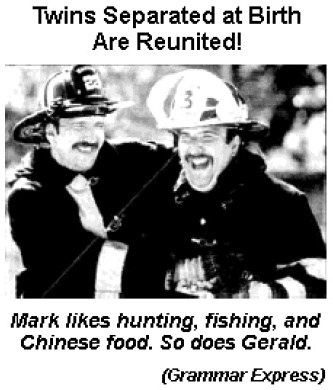
Both men:
06