


![[Marketing] Questao Topo - deslogado](https://storage.estuda.com.br/banners/0_6b7ebee90b03af1c560c73bb8bcce34a_banner_deslogado_70_dias.png)
Questões de Inglês
19.971 Questões
Questão 26 141768
UPE 3° Fase / 1° Dia SSA 2016Sexting

Sexting is the sending of provocative or sexual photos, messages or videos. They are generally sent using a mobile phone but can also include posting this type of material online. While sharing suggestive images or text messages may seem like innocent flirting or be considered funny for young people, sexting can have serious social and legal consequences. What do I need to know?
Stay calm and delete
If you have sent a picture or video you regret to a friend or your girlfriend/boyfriend ask them to delete it immediately. If it is posted online then un-tag yourself and report it so it can be removed. Ask friends you trust to help hunt down images and also delete and/or report those images. If you think it would help you could tell a trusted adult at school and they may be able to send a note to students directing them to delete any private photos or videos they have received without naming you.
Report it
If someone else has posted sexual or naked photos or videos of you online, report them to the service they posted it on. If they are at your school you can report them to a teacher if you choose to. It is not OK for them to share your image without your permission.
Try to relax and talk to someone
If the video or image has already spread online, try to stay calm. You might like to have a free and confidential talk with Kids Helpline. You can phone them on 1800 551 800 for advice and how to handle the situation. You might also want to tell your parents. It is possible they may find out some other way. They might be upset, angry or in shock, so you might like to ask a trusted friend or relative to help.
What if the police get involved?
The Police sometimes need to become involved in sexting cases where creating and/or distributing sexual images with minors constitutes the production and/or distribution of child pornography. This differs under state laws.
Where the Police are involved, it’s best to be honest. Tell them how the video/image was made and where it might have been sent/posted. They will want to know who was involved and whether there was consent from all involved. Their concern is preventing any harm to you and other young people.
Take care of yourself
Avoid looking at the video/image and any comments. Distract yourself by spending time with friends and family that you trust. Remember to stay positive. Many people have had similar experiences. Stay strong, you will be ok.
http://esafety.gov.au/esafety-information/esafety-issues/sexting. Acesso em: 27/07/15
“Sexting” in Portuguese means
Questão 29 139074
UNESP 2016/2Disparity in life spans of the rich and the poor is growing
Sabrina Tavemise
February 12, 2016

Experts have long known that rich people generally live longer than poor people. But a growing body of data shows a more disturbing pattern: Despite big advances in medicine, technology and education, the longevity gap between high-income and low-income Americans has been widening sharply.
The poor are losing ground not only in income, but also in years of life, the most basic measure of well-being. In the early 1970s, a 60-year-old man in the top half of the earnings ladder could expect to live 1.2 years longer than a man of the same age in the bottom half, according to an analysis by the Social Security Administration. Fast-forward to 2001, and he could expect to live 5.8 years longer than his poorer counterpart.
New research released this month contains even more jarring numbers. Looking at the extreme ends of the income spectrum, economists at the Brookings Institution found that for men born in 1920, there was a six-year difference in life expectancy between the top 10 percent of earners and the bottom 10 percent. For men born in 1950, that difference had more than doubled, to 14 years. For women, the gap grew to 13 years, from 4.7 years. “There has been this huge spreading out,” said Gary Burtless, one of the authors of the study.
The growing chasm is alarming policy makers, and has surfaced in the presidential campaign. During a Democratic debate, Senator Bernie Sanders and Hillary Clinton expressed concern over shortening life spans for some Americans. “This may be the next frontier of the inequality discussion,” said Peter Orszag, a former Obama administration official now at Citigroup, who was among the first to highlight the pattern. The causes are still being investigated, but public health researchers say that deep declines in smoking among the affluent and educated may partly explain the difference.
Overall, according to the Brookings study, life expectancy for the bottom 10 percent of wage earners improved by just 3 percent for men born in 1950 compared with those born in 1920. For the top 10 percent, though, it jumped by about 28 percent. (The researchers used a common measure – life expectancy at age 50 – and included data from 1984 to 2012.)
(www.nytimes.com. Adaptado.)
No trecho do quarto parágrafo “shortening life spans for some Americans”, a expressão “some Americans”, no contexto, se refere
Questão 28 139073
UNESP 2016/2Disparity in life spans of the rich and the poor is growing
Sabrina Tavemise
February 12, 2016
Experts have long known that rich people generally live longer than poor people. But a growing body of data shows a more disturbing pattern: Despite big advances in medicine, technology and education, the longevity gap between high-income and low-income Americans has been widening sharply.
The poor are losing ground not only in income, but also in years of life, the most basic measure of well-being. In the early 1970s, a 60-year-old man in the top half of the earnings ladder could expect to live 1.2 years longer than a man of the same age in the bottom half, according to an analysis by the Social Security Administration. Fast-forward to 2001, and he could expect to live 5.8 years longer than his poorer counterpart.
New research released this month contains even more jarring numbers. Looking at the extreme ends of the income spectrum, economists at the Brookings Institution found that for men born in 1920, there was a six-year difference in life expectancy between the top 10 percent of earners and the bottom 10 percent. For men born in 1950, that difference had more than doubled, to 14 years. For women, the gap grew to 13 years, from 4.7 years. “There has been this huge spreading out,” said Gary Burtless, one of the authors of the study.
The growing chasm is alarming policy makers, and has surfaced in the presidential campaign. During a Democratic debate, Senator Bernie Sanders and Hillary Clinton expressed concern over shortening life spans for some Americans. “This may be the next frontier of the inequality discussion,” said Peter Orszag, a former Obama administration official now at Citigroup, who was among the first to highlight the pattern. The causes are still being investigated, but public health researchers say that deep declines in smoking among the affluent and educated may partly explain the difference.
Overall, according to the Brookings study, life expectancy for the bottom 10 percent of wage earners improved by just 3 percent for men born in 1950 compared with those born in 1920. For the top 10 percent, though, it jumped by about 28 percent. (The researchers used a common measure – life expectancy at age 50 – and included data from 1984 to 2012.)
(www.nytimes.com. Adaptado.)
A nova pesquisa da Brookings Institution que foi divulgada
Questão 22 139065
UNESP 2016/2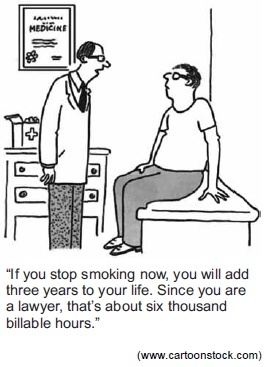
O argumento do médico se baseia em
Questão 21 139064
UNESP 2016/2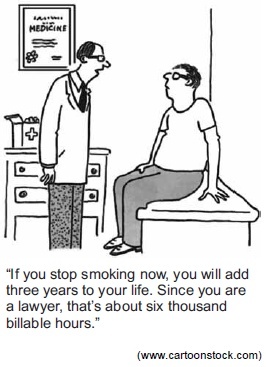
Na charge, o médico
Questão 58 138170
FACERES Medicina 2016/2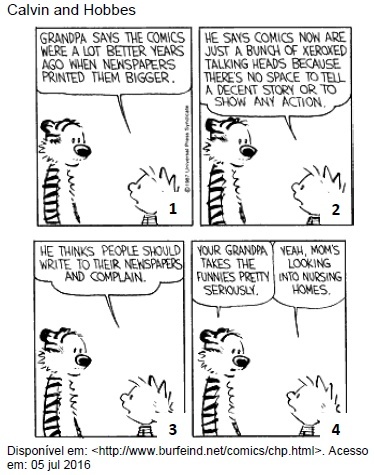
The pronoun “them” in the same stretch “Grandpa says the comics were a lot better years ago when newspapers printed them bigger” is referring to:
06