


![[Marketing] Questao Topo - deslogado](https://storage.estuda.com.br/banners/0_6b7ebee90b03af1c560c73bb8bcce34a_banner_deslogado_70_dias.png)
Questões de Inglês
19.971 Questões
Questão 17 130243
FCM PB Medicina 2017/1TEXTO II
You mean I don’t have to show up? The promise of telemedicine
“Aside from whatever a visit to the doctor costs you in money, it also costs you in time. A lot of it!
End to end, the travel and waiting time for a doctor’s appointment can take several hours — often disrupting work or school. Only 17 percent of it — 20 minutes, on average — is spent actually seeing the doctor, according to a study by the University of Pittsburgh, physician Kristin Ray and colleagues at the Harvard Medical School and the RAND Corporation.
In a year, Americans spend 2.4 billion hours making doctor visits. Valued at average wage rates, that’s worth more than $52 billion — equivalent to the total working time and income of 1.2 million people. On average, we pay $32 when visiting a doctor. But separately, the value of our time adds up to more, $43, according to Dr. Ray’s study.
For certain kinds of health care, there is a better way. Long after electronic communication and technology have revolutionized other services (like preparing taxes, booking travel and banking), emails, phone calls, video chats and other telemedicine applications are gradually supplementing or replacing some types of office visits.
Telemedicine holds the promise of giving some of our time back. And it may have other advantages. Care delivered in this way requires no travel, and if one waits at all it’s at home or work, not at a doctor’s office. In an era of FaceTime and Skype, patients are starting to expect more convenient access to doctors. The vast majority of patients report that they want to be able to communicate with their doctors by email. Perhaps for this reason, the market for telemedicine is growing rapidly.
In a passionate commentary on the establishment’s hesitancy to embrace telemedicine, David Asch, a University of Pennsylvania physician, pointed out that the inconvenience of face-to-face care limits its use, but arbitrarily and invisibly. The costs of waiting and travel time and those borne by rural populations with poor access to in-person care don’t appear on the books. “The innovation that telemedicine promises is not just doing the same thing remotely,” Dr. Asch wrote, “but awakening us to the many things that we thought required face-to-face contact but actually do not. ”
(Adapted from: http://www.nytimes.com/2016/05/17/upshot/you-mean-i-dont-have-to-show-up-the-promise-of-telemedicine.html?ref=policy)
The expression “show up” (title) is a classical case of:
Questão 79 130119
FAMERP 2017The placebo effect: amazing and real
November 2, 2015
Robert H. Shmerling

The placebo effect is a mysterious thing. I’ve long been
fascinated by the idea that something as inert and harmless
as a sugar pill could relieve a person’s pain or hasten their
recovery just by the expectation that it would. Studies use
placebos – an inactive treatment, such as a sugar pill – in
an attempt to understand the true impact of the active drug.
Comparing what happens to a group of patients taking the
active drug with the results of those taking a placebo can help
researchers understand just how good the active drug is.
The word “placebo” comes from Latin and means “I shall
please.” And “please” it does. In study after study, many
patients who take a placebo show improvement in their
symptoms or condition.
The placebo effect is for real
Recent research on the placebo effect only confirms how
powerful it can be – and that the benefits of a placebo treatment
aren’t just “all in your head.” Measureable physiological
changes can be observed in those taking a placebo, similar to
those observed among people taking effective medications.
In particular, blood pressure, heart rate, and blood test results
have been shown to improve among subsets of research
subjects who responded to a placebo.
Of course, not everyone has a therapeutic response to a
placebo. If that were the case, we wouldn’t need medications
at all. Instead, we could simply wield the power of suggestion.
Understanding why certain people improve with placebo
treatment and others do not is the “holy grail” of placebo research.
Nocebo: Placebo’s evil twin
The power of suggestion is a double-edged sword. If
you expect a treatment to help you, it’s more likely to do so.
And if you expect a treatment will be harmful, you are more
likely to experience negative effects. That phenomenon is
called the “nocebo effect” (from the Latin “I shall harm”). For
example, if you tell a person that a headache is a common
side effect of a particular medication, that person is more
likely to report headaches even if they are actually taking a
placebo. The power of expectation is formidable and probably
plays a significant role in the benefits and the side effects of
commonly prescribed medications.
(www.health.harvard.edu. Adaptado.)
No trecho do quinto parágrafo “The power of suggestion is a double-edged sword.”, a expressão em destaque equivale, em português, a
Questão 77 130117
FAMERP 2017The placebo effect: amazing and real
November 2, 2015
Robert H. Shmerling
The placebo effect is a mysterious thing. I’ve long been
fascinated by the idea that something as inert and harmless
as a sugar pill could relieve a person’s pain or hasten their
recovery just by the expectation that it would. Studies use
placebos – an inactive treatment, such as a sugar pill – in
an attempt to understand the true impact of the active drug.
Comparing what happens to a group of patients taking the
active drug with the results of those taking a placebo can help
researchers understand just how good the active drug is.
The word “placebo” comes from Latin and means “I shall
please.” And “please” it does. In study after study, many
patients who take a placebo show improvement in their
symptoms or condition.
The placebo effect is for real
Recent research on the placebo effect only confirms how
powerful it can be – and that the benefits of a placebo treatment
aren’t just “all in your head.” Measureable physiological
changes can be observed in those taking a placebo, similar to
those observed among people taking effective medications.
In particular, blood pressure, heart rate, and blood test results
have been shown to improve among subsets of research
subjects who responded to a placebo.
Of course, not everyone has a therapeutic response to a
placebo. If that were the case, we wouldn’t need medications
at all. Instead, we could simply wield the power of suggestion.
Understanding why certain people improve with placebo
treatment and others do not is the “holy grail” of placebo research.
Nocebo: Placebo’s evil twin
The power of suggestion is a double-edged sword. If
you expect a treatment to help you, it’s more likely to do so.
And if you expect a treatment will be harmful, you are more
likely to experience negative effects. That phenomenon is
called the “nocebo effect” (from the Latin “I shall harm”). For
example, if you tell a person that a headache is a common
side effect of a particular medication, that person is more
likely to report headaches even if they are actually taking a
placebo. The power of expectation is formidable and probably
plays a significant role in the benefits and the side effects of
commonly prescribed medications.
(www.health.harvard.edu. Adaptado.)
No trecho do quarto parágrafo “Instead, we could simply wield the power of suggestion.”, o termo em destaque equivale, em português, a
Questão 10 128768
Unioeste 1° Dia 2017What\\'s wrong with buying fake luxury goods?
By Bethan Bell, BBC News, 15 July 2016
Every time a new haul of fake designer goods is seized we\\'re told that the people who buy them are
ruining the reputation of brands, stealing revenue from companies, contributing to an unethical
labour market and subsidising organised crime. But is this really the case?
A BBC investigation has found over the past two years, thousands of fake goods were seized from
black markets across England.
But is there any harm in nabbing a pair of "Louboutins" from a market, or a "Chanel" handbag from
a chap selling them on a foreign beach? To the average punter it might sound a bit far-fetched that their
cash goes straight to a drugs cartel or gun-runners.
We\\'re not talking about alcohol, tobacco or medications - buying such items clearly poses a health
risk. The same can be said for toys which aren\\'t up to safety standards, and sunglasses which don\\'t have the
recommended UV protection. Nor are we talking about people who genuinely believe the goods they buy
are the real thing.
We\\'re talking about those who are happy to get knock-off designer items for knock-down prices.
The people who are well aware there may be issues about quality and copyright - but don\\'t actually mind.
After all, are the people who buy fakes for a tenner really depriving the companies that sell goods
for hundreds or even thousands of pounds? A woman who makes an impulse buy in a market almost
certainly wouldn\\'t otherwise invest in the real deal, while the wealthy buyers of the genuine brand pride
themselves on knowing the difference and having the official article.
Fonte: http://www.bbc.com/news/uk-england-36782724
Considerando o contexto, assinale a alternativa que melhor traduz o trecho “Every time a new haul of fake designer goods is seized...”.
Questão 9 128767
Unioeste 1° Dia 2017What\\'s wrong with buying fake luxury goods?
By Bethan Bell, BBC News, 15 July 2016
Every time a new haul of fake designer goods is seized we\\'re told that the people who buy them are
ruining the reputation of brands, stealing revenue from companies, contributing to an unethical
labour market and subsidising organised crime. But is this really the case?
A BBC investigation has found over the past two years, thousands of fake goods were seized from
black markets across England.
But is there any harm in nabbing a pair of "Louboutins" from a market, or a "Chanel" handbag from
a chap selling them on a foreign beach? To the average punter it might sound a bit far-fetched that their
cash goes straight to a drugs cartel or gun-runners.
We\\'re not talking about alcohol, tobacco or medications - buying such items clearly poses a health
risk. The same can be said for toys which aren\\'t up to safety standards, and sunglasses which don\\'t have the
recommended UV protection. Nor are we talking about people who genuinely believe the goods they buy
are the real thing.
We\\'re talking about those who are happy to get knock-off designer items for knock-down prices.
The people who are well aware there may be issues about quality and copyright - but don\\'t actually mind.
After all, are the people who buy fakes for a tenner really depriving the companies that sell goods
for hundreds or even thousands of pounds? A woman who makes an impulse buy in a market almost
certainly wouldn\\'t otherwise invest in the real deal, while the wealthy buyers of the genuine brand pride
themselves on knowing the difference and having the official article.
Fonte: http://www.bbc.com/news/uk-england-36782724
No texto, o autor afirma que
Questão 25 15111263
Albert Einstein 2016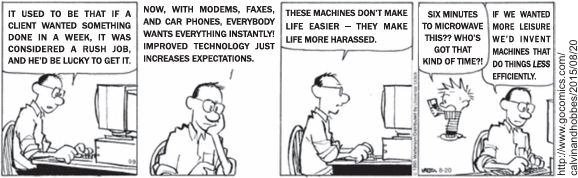
De acordo com a tirinha acima, pode-se inferir que o pai de Calvin
06