


![[Marketing] Questao Topo - deslogado](https://storage.estuda.com.br/banners/0_6b7ebee90b03af1c560c73bb8bcce34a_banner_deslogado_70_dias.png)
Questões de Inglês
19.971 Questões
Questão 12 306446
FCM PB 2017/2TEXT I
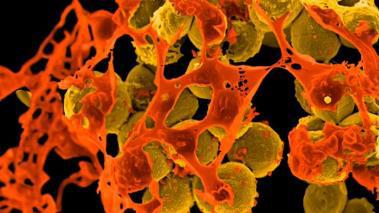
"A new crop of potential antibiotics may soon help fighting antibiotic-resistant infections, such as this batch of methicillinresistant Staphylococcus aureus bacteria.”
"Antibiotics have been taking it on the chin lately. Not only has resistance to the medications been growing, but also drug companies have been dropping antibiotic research programs because the drugs are difficult and expensive to make. Now, help is on the way. Researchers report today that they’ve found a way to churn out new members of one of the most widely used classes of antibiotics, called macrolides. The work could lead to new weapons against antibiotic-resistant infections, and possibly save millions of lives.
Macrolides, drugs that include erythromycin and azithromycin, were first developed in the 1950s. Since then they’ve become a safeguard against bacterial and fungal infections. Chemically, macrolides are giant rings containing 14 to 16 carbon atoms, with one or more sugar appendages dangling off the side. Bacteria synthesize them to fight off their neighbors. Yet, bacteria didn’t evolve to make macrolides good drugs in people. So, medicinal chemists — the group of researchers that actually build new drugs — start with the natural versions and tweak their bonds one at a time in an effort to make them safer and more effective. But, in most cases, it’s impossible to confine the changes to just one bond on a large molecule. When multiple bonds react, the result is an unwanted broad mixture of end products, none of which contain just the one specific change desired for making a better drug.
To solve that problem, Harvard University chemist Andrew Myers and colleagues adapted a divide-and-conquer strategy that they had applied to tetracycline antibiotics back in 2005. They started with three basic macrolide ring structures and broke each one down into eight molecular “modules.” They then carefully mapped out reactions needed to put the pieces back together. For two such linkers, they even invented new chemical reactions to forge the bonds. This allowed them to tinker with the modules individually, and then reassemble them. By repeating the strategy over and over, they forged more than 300 entirely new macrolides.
When given to a panel of bacterial lab cultures, several of these compounds showed potent antibiotic activity against antibiotic-resistant microbes, including methicillin resistant Staphylococcus aureus and vancomycin-resistant Enterococcus, the team reports online today in Nature. Perhaps equally important, Myers says, is that all the reactions used for the assembly produce high yields of the final products. That’s essential, he notes, because bacteria don’t produce the starting material for the new compounds. So, if any of them proves a valuable medicine, chemists will be able to synthesize large quantities of it cheaply from scratch.
“This is a great example of beautiful chemistry that will have a tangible societal benefit,” says Phil Baran, a synthetic organic chemist at the Scripps Research Institute in San Diego, California.”
(Adapted from: https://www.sciencemag.org/news/2016/05/new-way-makepowerful- antibiotics)
Select the proposition that presents the CORRECT explanation for each expression bellow, as they are used in the text.
Questão 59 303219
FPP Medicina Inverno 2017Read the text.
How to Take a Vacation in ‘La La Land’
Hotels are taking a cue from the movie musical “La La Land,” winner of six Academy Awards this year. The movie, about an aspiring actress and jazz musician falling in love in Los Angeles, has inspired them to offer new jazz- and romance-themed packages.
Several properties in the Los Angeles area are leading the trend. Fairmont Miramar Hotel & Bungalows, in Santa Monica, offers the “Escape to La La Land” package, which includes accommodations in a bungalow, a picnic lunch and a dinner for two, a map of Los Angeles marked with locations where the movie is set and two tickets to a show at the popular jazz club Herb Alpert’s Vibrato Grill & Jazz. From $1,900 a night. Valid to March 31.
At the Hollywood Roosevelt, the “Love in La La Land” package includes accommodations, a welcome amenity of a dessert, two cocktails, breakfast, a $25 Uber credit and a $50 voucher for Pacific Theaters, where guests can catch a showing of the movie. From $439 a night.
The InterContinental Los Angeles Century City has the “La La Land”-inspired “City of Stars” package: It includes accommodations in a suite; two tickets to the Grammy Museum; two tickets for a tour of Warner Bros. studios, where scenes from the movie were filmed; a hairstyling and makeup session for one; and a dinner for two at the hotel’s signature restaurant, Mari. From $619 a night. Valid through June 30.
The packages advertised are ideal for people who:
Questão 40 302141
FPP Verão Demais Cursos 2017Choose the alternative which shows synonyms of the words underlined below in the CORRECT order
Stop wasting1
How many mobile phones have you had in your life and what do you do with the old, broken ones? Most people throw them away. In fact, digital waste is a growing problem for society. Dutch designer Dave Hakken has come up2 with an amazing idea to reduce such waste. The Phoneblocks concept is a mobile phone made up3 of little blocks that can be replaced4 when they stop working. This means that you can keep your phone forever and just replace the broken parts. You can also build the ideal phone for your personal needs. The designer is trying to spread5 the word about his idea. His goal is to find 50,000 supporters so that the mobile phone industry will take notice.
Questão 39 302140
FPP Verão Demais Cursos 2017Read the text.
GOOGLE AND FIAT CHRYSLER TO BUILD 100 SELF-DRIVING MINIVANS
Anthony Cuthbertson
Google has announced a partnership with Fiat Chrysler Automobiles (FCA) that will see the two firms build a fleet of 100 self-driving minivans.
In the “first of its kind” deal, Google’s driverless technology will be integrated into a Chrysler Pacifica Hybrid minivan, marking the first time a technology company has joined forces with an automotive manufacturer to develop autonomous vehicles.
“FCA has a nimble and experienced engineering team and the Chrysler Pacifica Hybrid minivan is well-suited for Google’s self-driving technology,” John Krafcik, chief executive officer of Google’s Self-Driving Car Project, said in a statement released on Tuesday.
“The opportunity to work closely with FCA engineers will accelerate our efforts to develop a fully self-driving car that will make our roads safer and bring everyday destinations within reach for those who cannot drive.”
The deal is set to more than double Google’s fleet of self-driving test vehicles and will see both companies co-locate part of their engineering teams to a facility in southeastern Michigan. The minivans will then be tested alongside Google’s other self-driving cars on its private track in California.
Self-driving cars are anticipated to improve road safety by reducing human error as an accident factor. Of the 33,000 deaths that occur each year on U.S. roads, 94 percent are caused by driver error.
“Working with Google provides an opportunity for FCA to partner with one of the world’s leading technology companies to accelerate the pace of innovation in the automotive industry,” said Sergio Marchionne, FCA’s chief executive officer.
“The experience both companies gain will be fundamental to delivering automotive technology solutions that ultimately have far-reaching consumer benefits.”
Available in: http://www.newsweek.com/google-fiat-chrysler-self-driving-minivans-455404. Access on: May 2016.
According to the text above, one can state that
I. There will be self-driving vehicles in the future.
II. Self-driving cars will be only produced by Google and Fiat Chrysler.
III. With self-driving cars there will not be road accidents anymore.
IV. The joint venture of Google and FCA will make it possible for extensive benefits for consumers.
Questão 18 301264
UERJ 2017/2THE COST OF BEING HAWAIIAN: DEFENDING OUR IDENTITY
A beautiful Polynesian woman moves her hips from side to side, a flower adorning her ear as her
hands glide across her body in harmony with the music. She looks like a photograph come to
life. Beside her is a dark and handsome man smiling and playing the ukulele*. He sings through
his gigantic smile a beautiful love song to the dancing girl. After a time, the man stops playing
[5] and the woman stops dancing. The two stare lovingly into each other’s eyes and jump into their
canoe, disappearing into the sunset.
This misconception about the Hawaiian culture has always been around, and although I do not
profess to be an expert in Hawaiian studies by any means, I know that these ideas are only cheap
imitations and generic stereotypes created more to appeal to tourists than to perpetuate and
[10] preserve the Hawaiian way of life. The more people are exposed to these misconceptions, the
less they understand the true beauty of the Hawaiian people and the richness of their culture
steeped in politics, agriculture, aquaculture, dance, storytelling and an oral tradition that include
both extensive genealogies and mythology.
Imagine the reaction of our Hawaiian forefathers if they were to view one of the many dinner/
[15] cocktail shows that litter the pages of our tourist guides. What would they think? Would they
proudly applaud our efforts to preserve their contributions to history? Or would they laugh at
its absurdity? Is the need to be an economically viable state causing us to compromise our true
identity as Hawaiians in exchange for the luxuries that come with being a tourist destination?
As a boy, I took trips to the Big Island. Visiting there reminded me that Hawaiians had their own
[20] place in history and a proper culture complete with its own form of government, its own form
of religion and its own legal system. These discoveries about my heritage filled me with equal
portions of pride and wonderment.
The most concerning thing to me as a Hawaiian is the growing commercialization of our culture
and its possible consequences. Simplifying the culture merely for financial gain may actually
[25] cost Hawaiians more than they think. I do not dispute the fact that the tourism industry brings
in much needed revenue to the state, but how long can we tolerate the integrity of our culture
being violated simply to earn money? How much longer can we sell these fabricated ideas of the
islands before they imbue themselves upon the cultural consciousness of all Hawaiians?
I am not suggesting that we shut down every hula show that makes a profit off of reinforcing
[30] stereotypes, but that Hawaiians as a people with a rich heritage and a long cultural history need
to be more active in understanding our cultural identity. As western influence grows, we need to
take steps to preserve our culture so that our children don’t grow up believing the stereotypes
that are so readily conditioned into the mind of every tourist. Tourism will not go away, but
we need to take steps as Hawaiians to ensure our traditions are not swallowed up by these
superficial shadows.
*ukulele − Hawaiian musical instrument
pupuaoewa.org
Would they proudly applaud our efforts to preserve their contributions to history? (l. 15-16)
Considering how the author believes the Hawaiian ancestors would react, the question above could be answered in the following way
Questão 41 280323
EPCAR 2017Directions: Read the text below and answer question according to it.
Most Common Prejudices
What are some of the most common ways
people discriminate against each other? Some of the
areas where people show their intolerance are wellknown,
such as race. But others are less
[5] acknowledged1, even if more common:
Age: Ageism is more common than you think. Older
people are thought to be inflexible and stuck2 in the
past, while younger people are seen as inexperienced
and naive. One-fifth of working adults say they
[10] experience ageism in the workplace.
Class: Classism usually takes the form of
discrimination by wealthier people against those who
are less well off. However, classism goes both ways—
people of lower economic status can see the wealthy
[15] as elite snobs who, while monetarily secure, are
morally bankrupt3.
Color: Different from racism, colorism is discrimination
based only on the color of a person’s skin; how
relatively dark or light they are. Colorism takes place
[20] within and between races. It is common in multi-ethnic
and non-white societies and societies with historical
racial prejudice.
Ability: Usually called ableism, a less well-known form
of prejudice is discrimination against people with visible
[25] disabilities such as those in wheelchairs or with a
learning disability. The disabled face discrimination not
only from their peers4, but from institutions, schools,
employers, and landowners5 who are hesitant to
accommodate the disabled.
[30] Sex/Gender: Possibly the most universal and long
running prejudice is that based on a person’s gender or
sex. Historically, sexism has placed men in a more
advantageous position than women.
Weight/Size: In short, sizeism is discrimination based
[35] on a person’s body size or weight. Sizeism works with
social standards of beauty and usually takes the form
of discrimination against the overweight — anti-fat
prejudice.
Religion: Religious discrimination and persecution has
[40] been common throughout history. But prejudice based
on religious affiliation doesn’t end with organized
religion; atheists are prone6 to discrimination and being
discriminated against.
Sexual Orientation: Most commonly, prejudice based
[45] on sexual orientation includes discrimination against
those of a non-heterosexual orientation. Discrimination
against the non-heterosexual takes many forms
depending on the society. In some societies prejudice
is open and tolerated, but in most Western societies,
[50] bias7 against the non-heterosexual is more discreet.
Country of Origin: Nativism is a common form of
discrimination against immigrants to a country. Unlike
many other forms of discrimination, nativism is many
times encouraged and enforced by some public
[55] entities.
Which prejudice do you have? Which prejudice have
you experienced?
Adapted from https://aloftyexistence.wordpress.com
Glossary:
1 - acknowledged – reconhecidos (as)
2 - stuck – presos (as)
3 - bankrupt – falidos (as)
4 - peers - pares; colegas
5 - landowners – proprietários (as)
6 - prone – propensos (as)
7 - bias – julgamento ou opinião parcial
In the sentence “Usually called ableism, a less well-known form of prejudice” (lines 23 and 24), the underlined expression means
06