


![[Marketing] Questao Topo - deslogado](https://storage.estuda.com.br/banners/0_6b7ebee90b03af1c560c73bb8bcce34a_banner_deslogado_70_dias.png)
Questões de Inglês
19.971 Questões
Questão 15 309472
UFVJM 2017/2Leia o texto II para responder à questão
Texto II
CITIES DRIVE ANIMALS AND PLANTS TO EVOLVE
Species are adapting to urban pollution, traffic and shrinking habitats through changes in their genes
By Sharon Oosthoek - Apr 6, 2017

Ever seen a raccoon open a trash can in search of leftovers? Or walk across power lines to get from one rooftop to another? If so, you've witnessed an animal adapting its behavior to city life. That's been going on since people started building cities thousands of years ago. Now, biologists are seeing signs that animals and plants are also adapting in a more basic way to survive in cities. Their genes are changing.
Genes are segments of DNA that influence how an organism looks and functions. An animal or plant’s DNA is like an instruction book for how it develops and grows. Some instructions guide its reproductive habits. Others influence the way it moves. Still others might let it withstand poison. Urban pollution, traffic and shrinking wild spaces have been causing changes in these genetic instructions. And scientists have been tracking more and more signs of these genetic changes.
When genes change in response to their environment, it’s called evolution. Some of those changes may leave animals and plants better suited to their homes. It may offer new traits that increase the odds of surviving long enough to reproduce. This means the individuals will pass on these new traits to their offspring. Eventually, traits that had once been rare can now become common throughout a population.
Fonte: <https://www.sciencenewsforstudents.org/article/cities-drive-animals-and-plants-evolve> Acesso: 06/06/2017.
Segundo o texto, a evolução ocorre quando os genes:
Questão 14 309470
UFVJM 2017/2Leia o texto II para responder à questão
Texto II
CITIES DRIVE ANIMALS AND PLANTS TO EVOLVE
Species are adapting to urban pollution, traffic and shrinking habitats through changes in their genes
By Sharon Oosthoek - Apr 6, 2017
Ever seen a raccoon open a trash can in search of leftovers? Or walk across power lines to get from one rooftop to another? If so, you've witnessed an animal adapting its behavior to city life. That's been going on since people started building cities thousands of years ago. Now, biologists are seeing signs that animals and plants are also adapting in a more basic way to survive in cities. Their genes are changing.
Genes are segments of DNA that influence how an organism looks and functions. An animal or plant’s DNA is like an instruction book for how it develops and grows. Some instructions guide its reproductive habits. Others influence the way it moves. Still others might let it withstand poison. Urban pollution, traffic and shrinking wild spaces have been causing changes in these genetic instructions. And scientists have been tracking more and more signs of these genetic changes.
When genes change in response to their environment, it’s called evolution. Some of those changes may leave animals and plants better suited to their homes. It may offer new traits that increase the odds of surviving long enough to reproduce. This means the individuals will pass on these new traits to their offspring. Eventually, traits that had once been rare can now become common throughout a population.
Fonte: <https://www.sciencenewsforstudents.org/article/cities-drive-animals-and-plants-evolve> Acesso: 06/06/2017.
De acordo com o texto, o comportamento de animais e plantas tem se modificado ao longo do tempo devido:
Questão 12 309467
UFVJM 2017/2Leia o texto I para responder à questão
Texto I
FANS BEG JUSTIN BIEBER TO CANCEL HIS CONCERT IN THE WAKE OF THE MANCHESTER ATTACKS
By Alex Riccardi - Yesterday at 4:23 pm

No one should have to live in fear but right now, in the wake of the Manchester attacks, some teens and young adults are scared. And you have a good reason. Bombs went off just minutes after Ariana Grande's performance in England taking the lives of 22 people and injuring many others. But, it's important to remember that concert venues and staff try to do everything they can to keep the audience members safe.
Ariana has officially postponed her "Dangerous Woman" until at least the beginning of June, however, there's no telling if she will cancel more shows after that. In the wake of all of this, fans are encouraging Justin Bieber to pull out of his performances in the U.K. The "Sorry" singer is set to headline at the British Summertime Festival on July 2nd. But, fans don't think it's a good idea.
They have been expressing their concern on social media and even starting the trend, #nopurposetour. One fan wrote, "@scooterbraun please. We're so worried about Justin's Security.... please please cancel Justin's purpose tour #NoPurposeTour." Another fan said, "Justin, please cancel Purpose Tour, we want you to be safe, we want you alive! We love you! #prayersforManchester #NoPurposeTour." This is absolutely heartbreaking. A third Belieber wrote, "#NoPurposeTourUK @justinbieber I don't want you to die, please do something."
Justin nor his manager Scooter Braun have yet to comment on the whole thing. However, we also must note that Scooter is Ariana's manager too. He definitely has his clients' best interest and their safety in mind. Now that Ariana has canceled some of her upcoming shows, Scooter definitely had a role in that decision. While fans may be scared for Justin, we have a feeling he is in good hands. If there was any chance of a threat or immediate danger, he wouldn't do the performance. However, the music can't be stopped because of evil in this world. Katy Perry, The Chainsmokers, and Lorde have all vowed to continue doing their upcoming shows in the wake of this tragedy.
Fonte: <http://www.j-14.com/posts/justin-bieber-tour-ariana-grande-manchester-attack-133157> Acesso: 24 May 2017.
MARQUE a alternativa que, de acordo com o texto, indica o artista que adiou parte de suas apresentações por causa de um atentado terrorista.
Questão 11 309463
UFVJM 2017/2Leia o texto I para responder à questão
Texto I
FANS BEG JUSTIN BIEBER TO CANCEL HIS CONCERT IN THE WAKE OF THE MANCHESTER ATTACKS
By Alex Riccardi - Yesterday at 4:23 pm
No one should have to live in fear but right now, in the wake of the Manchester attacks, some teens and young adults are scared. And you have a good reason. Bombs went off just minutes after Ariana Grande's performance in England taking the lives of 22 people and injuring many others. But, it's important to remember that concert venues and staff try to do everything they can to keep the audience members safe.
Ariana has officially postponed her "Dangerous Woman" until at least the beginning of June, however, there's no telling if she will cancel more shows after that. In the wake of all of this, fans are encouraging Justin Bieber to pull out of his performances in the U.K. The "Sorry" singer is set to headline at the British Summertime Festival on July 2nd. But, fans don't think it's a good idea.
They have been expressing their concern on social media and even starting the trend, #nopurposetour. One fan wrote, "@scooterbraun please. We're so worried about Justin's Security.... please please cancel Justin's purpose tour #NoPurposeTour." Another fan said, "Justin, please cancel Purpose Tour, we want you to be safe, we want you alive! We love you! #prayersforManchester #NoPurposeTour." This is absolutely heartbreaking. A third Belieber wrote, "#NoPurposeTourUK @justinbieber I don't want you to die, please do something."
Justin nor his manager Scooter Braun have yet to comment on the whole thing. However, we also must note that Scooter is Ariana's manager too. He definitely has his clients' best interest and their safety in mind. Now that Ariana has canceled some of her upcoming shows, Scooter definitely had a role in that decision. While fans may be scared for Justin, we have a feeling he is in good hands. If there was any chance of a threat or immediate danger, he wouldn't do the performance. However, the music can't be stopped because of evil in this world. Katy Perry, The Chainsmokers, and Lorde have all vowed to continue doing their upcoming shows in the wake of this tragedy.
Fonte: <http://www.j-14.com/posts/justin-bieber-tour-ariana-grande-manchester-attack-133157> Acesso: 24 May 2017.
MARQUE a alternativa que apresenta o assunto principal do texto.
Questão 15 306451
FCM PB 2017/2TEXT I
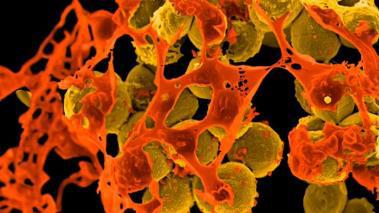
"A new crop of potential antibiotics may soon help fighting antibiotic-resistant infections, such as this batch of methicillinresistant Staphylococcus aureus bacteria.”
"Antibiotics have been taking it on the chin lately. Not only has resistance to the medications been growing, but also drug companies have been dropping antibiotic research programs because the drugs are difficult and expensive to make. Now, help is on the way. Researchers report today that they’ve found a way to churn out new members of one of the most widely used classes of antibiotics, called macrolides. The work could lead to new weapons against antibiotic-resistant infections, and possibly save millions of lives.
Macrolides, drugs that include erythromycin and azithromycin, were first developed in the 1950s. Since then they’ve become a safeguard against bacterial and fungal infections. Chemically, macrolides are giant rings containing 14 to 16 carbon atoms, with one or more sugar appendages dangling off the side. Bacteria synthesize them to fight off their neighbors. Yet, bacteria didn’t evolve to make macrolides good drugs in people. So, medicinal chemists — the group of researchers that actually build new drugs — start with the natural versions and tweak their bonds one at a time in an effort to make them safer and more effective. But, in most cases, it’s impossible to confine the changes to just one bond on a large molecule. When multiple bonds react, the result is an unwanted broad mixture of end products, none of which contain just the one specific change desired for making a better drug.
To solve that problem, Harvard University chemist Andrew Myers and colleagues adapted a divide-and-conquer strategy that they had applied to tetracycline antibiotics back in 2005. They started with three basic macrolide ring structures and broke each one down into eight molecular “modules.” They then carefully mapped out reactions needed to put the pieces back together. For two such linkers, they even invented new chemical reactions to forge the bonds. This allowed them to tinker with the modules individually, and then reassemble them. By repeating the strategy over and over, they forged more than 300 entirely new macrolides.
When given to a panel of bacterial lab cultures, several of these compounds showed potent antibiotic activity against antibiotic-resistant microbes, including methicillin resistant Staphylococcus aureus and vancomycin-resistant Enterococcus, the team reports online today in Nature. Perhaps equally important, Myers says, is that all the reactions used for the assembly produce high yields of the final products. That’s essential, he notes, because bacteria don’t produce the starting material for the new compounds. So, if any of them proves a valuable medicine, chemists will be able to synthesize large quantities of it cheaply from scratch.
“This is a great example of beautiful chemistry that will have a tangible societal benefit,” says Phil Baran, a synthetic organic chemist at the Scripps Research Institute in San Diego, California.”
(Adapted from: https://www.sciencemag.org/news/2016/05/new-way-makepowerful- antibiotics)
The expression “mapped out” (3rd paragraph) is a classical case of:
Questão 14 306449
FCM PB 2017/2TEXT I
"A new crop of potential antibiotics may soon help fighting antibiotic-resistant infections, such as this batch of methicillinresistant Staphylococcus aureus bacteria.”
"Antibiotics have been taking it on the chin lately. Not only has resistance to the medications been growing, but also drug companies have been dropping antibiotic research programs because the drugs are difficult and expensive to make. Now, help is on the way. Researchers report today that they’ve found a way to churn out new members of one of the most widely used classes of antibiotics, called macrolides. The work could lead to new weapons against antibiotic-resistant infections, and possibly save millions of lives.
Macrolides, drugs that include erythromycin and azithromycin, were first developed in the 1950s. Since then they’ve become a safeguard against bacterial and fungal infections. Chemically, macrolides are giant rings containing 14 to 16 carbon atoms, with one or more sugar appendages dangling off the side. Bacteria synthesize them to fight off their neighbors. Yet, bacteria didn’t evolve to make macrolides good drugs in people. So, medicinal chemists — the group of researchers that actually build new drugs — start with the natural versions and tweak their bonds one at a time in an effort to make them safer and more effective. But, in most cases, it’s impossible to confine the changes to just one bond on a large molecule. When multiple bonds react, the result is an unwanted broad mixture of end products, none of which contain just the one specific change desired for making a better drug.
To solve that problem, Harvard University chemist Andrew Myers and colleagues adapted a divide-and-conquer strategy that they had applied to tetracycline antibiotics back in 2005. They started with three basic macrolide ring structures and broke each one down into eight molecular “modules.” They then carefully mapped out reactions needed to put the pieces back together. For two such linkers, they even invented new chemical reactions to forge the bonds. This allowed them to tinker with the modules individually, and then reassemble them. By repeating the strategy over and over, they forged more than 300 entirely new macrolides.
When given to a panel of bacterial lab cultures, several of these compounds showed potent antibiotic activity against antibiotic-resistant microbes, including methicillin resistant Staphylococcus aureus and vancomycin-resistant Enterococcus, the team reports online today in Nature. Perhaps equally important, Myers says, is that all the reactions used for the assembly produce high yields of the final products. That’s essential, he notes, because bacteria don’t produce the starting material for the new compounds. So, if any of them proves a valuable medicine, chemists will be able to synthesize large quantities of it cheaply from scratch.
“This is a great example of beautiful chemistry that will have a tangible societal benefit,” says Phil Baran, a synthetic organic chemist at the Scripps Research Institute in San Diego, California.”
(Adapted from: https://www.sciencemag.org/news/2016/05/new-way-makepowerful- antibiotics)
A contextual synonym for “to confine” (2nd paragraph) is:
06