


![[Marketing] Questao Topo - deslogado](https://storage.estuda.com.br/banners/0_6b7ebee90b03af1c560c73bb8bcce34a_banner_deslogado_70_dias.png)
Questões de Inglês
19.971 Questões
Questão 24 337676
CESMAC Medicina 1° Dia 2017/2Read the demographics below and answer the following question based on it.

As regards the California nursing home residents demographics above it is true to state that
Questão 21 324970
CESMAC Demais cursos 2017/2
According to the graphic, it is true to assert that
Questão 17 324954
CESMAC Demais cursos 2017/2Natural tooth repair method, using Alzheimer's
drug, could revolutionise dental treatments
A new method of stimulating the renewal of living stem cells in tooth pulp using an Alzheimer’s drug has been discovered by a team of researchers at King’s College London.
Following trauma or an infection, the inner, soft pulp of a tooth can become exposed and infected. In order to protect the tooth from infection, a thin band of dentine is naturally produced and this seals the tooth pulp, but it is insufficient to effectively repair large cavities. Currently dentists use manmade cements or fillings, such as calcium and silicon-based products, to treat these larger cavities and fill holes in teeth. This cement remains in the tooth and fails to disintegrate, meaning that the normal mineral level of the tooth is never completely restored.
However, in a paper published today in Scientific Reports, scientists from the Dental Institute at King’s College London have proven a way to stimulate the stem cells contained in the pulp of the tooth and generate new dentine in large cavities, potentially reducing the need for fillings or cements.
The novel biological approach could see teeth use their natural ability to repair large cavities rather than using cements or fillings.
Significantly, one of the small molecules used by the team to stimulate the renewal of the stem cells included Tideglusib, which has previously been used in clinical trials to treat neurological disorders including Alzheimer’s disease.
Using biodegradable collagen sponges to deliver the treatment, the team applied low doses of small molecule glycogen synthase kinase (GSK-3) inhibitors to the tooth. They found that the sponge degraded over time and that new dentine replaced it, leading to complete, natural repair. Collagen sponges are commercially-available and clinicallyapproved, again adding to the potential of the treatment’s swift pick-up and use in dental clinics.
Disponível em<http://www.kcl.ac.uk/newsevents/news/newsrecords/2017/01January/Naturaltooth-repair-method-usingAlzheimer'sdrugcouldrevolutionisedentaltreatments.aspx> Acessado em 13 de abril de 2017.
In the sentence “…the inner, soft pulp of a tooth can become exposed and infected” the modal verb can expresses
Questão 13 324620
UNIMONTES 3° Etapa 2017Leia o texto que se segue, a fim de responder à questão que a ele se refere.
WAR PHOTOGRAPHER WHO SURVIVED LEUKAEMIA EXPOSED AS A FAKE
Eduardo Martins passed off photos of British surfer as himself and some of his war zone pictures were stolen.
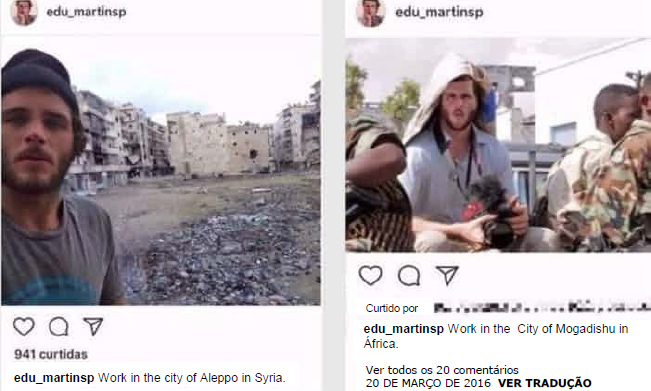
[1] The compelling photos that Eduardo Martins took from some of the world’s worst war zones earned
him a growing reputation, glowing interviews, space in some of the world’s biggest media outlets and more
than 120,000 followers on Instagram.
People loved the story of the handsome blond 32-year-old Brazilian surfer, who survived leukaemia
[5] then found new meaning in photographing conflict. His dramatic images of war zones were published by the
Wall Street Journal, Vice and the BBC.
But there was just one problem: it was a lie. An investigation by BBC Brasil has revealed Martins
stole photos of a British surfer called Max Hepworth-Povey and passed them off as himself.
The BBC’s Brazilian site first published an interview along with photos and videos supposedly shot
[10] by Martins in July, then revealed his scam after an investigation by a Lebanon-based reporter, Natasha
Ribeiro. The scale of the deception, which emerged in recent days, has sent shockwaves through Brazilian
photographic circles.
As his story began to unravel, reporters made contact with the Brazilian photographer Fernando
Costa Netto, who had been talking to Martins on the internet for over a year and had published an interview
[15] with him on the Brazilian surfing site Waves.
According to the BBC, Costa Netto inadvertently told Martins that suspicions were circulating that
he was fake – he told the Guardian he had not warned Martins. He then received a final message, which he
shared with Waves. “I am in Australia. I took the decision to pass a year in a van. I am going to cut
everything, including internet. I want to be in peace, we will see each other when I return,” he wrote. “A big
[20] hug.”
Costa Netto, who had been in touch with Martins over plans to stage an exhibition of his work, told
the Guardian in an email that he was deeply disappointed. “I have more pity than anger,” he said. “There is
a certain deception with human beings, to trick people is ugly.”
Getty Images said in a statement they had removed all the work purporting to be by Martins.
[25] “Eduardo Martins… was identified as a collaborator and content supplier for one of our partners
who has already been notified about this infraction. While we work together with all our internal
departments to urgently clarify this issue, we are removing all the material involved from the air,” a
spokesman said in an email.
In his interview with Costa Netto for Waves, published in July, Martins said he had leukaemia at 18
[30] and had spent seven years in treatment. He told Costa Netto he was currently in Mosul, Iraq, had
accompanied the Free Syrian Army in 2015 and had even been grazed by a shot in Aleppo.
“I became a conflict zone photographer,” Martins said in the interview. “I found what I really
wanted as a photographer.” [...]
Disponível em: <https://www.theguardian.com/world/2017/sep/05/war-photographer-eduardo martins-survived-leukaemiaexposed- fake>. Acesso em: 14 set. 2017. Adaptado.
No trecho “Costa Netto, who had been in touch with Martins over plans to stage an exhibition of his work, told the Guardian in an email that he was deeply disappointed.” (Linhas 21-22), o pronome “he” em destaque refere-se a:
Questão 19 318468
UNESC 2017See the numbers bellow, and choose the correct match for them:
51 – seven hundred – MCMXXX.
Questão 19 311825
ACAFE Demais Cursos 2017/2TEXTO
Brazil has declared an end to its public health emergency over the Zika virus, 18 months after a surge in cases drew headlines around the world. The mosquito-borne virus was not considered a major health threat until the 2015 outbreak revealed that Zika can lead to severe birth defects. One of those defects, microcephaly, causes babies to be born with skulls much smaller than expected.
Photos of babies with the defect spread panic around the globe as the virus was reported in dozens of countries. Many would-be travellers cancelled their trips to Zika-infected places. The concern spread even more widely when health officials said it could also be transmitted through sexual contact with an infected person.
The health scare came just as Brazil, the epicentre of the outbreak, was preparing to host the 2016 Olympics, fuelling concerns the Games could help spread the virus. One athlete, a Spanish wind surfer, said she got Zika while training in Brazil ahead of the Games.
In response to the outbreak, Brazil launched a mosquito-eradication campaign. The health ministry said those efforts have helped to dramatically reduce cases of Zika. Between January and mid-April, 95% fewer cases were recorded than during the same period last year. The incidence of microcephaly has fallen as well.
The World Health Organization (WHO) lifted its own international emergency in November, even while saying the virus remained a threat.
“The end of the emergency doesn’t mean the end of surveillance or assistance” to affected families, said Adeilson Cavalcante, the secretary for health surveillance at Brazil’s health ministry. “The health ministry and other organisations involved in this area will maintain a policy of fighting Zika, dengue and chikungunya.”
All three diseases are carried by the Aedes aegypti mosquito.
But the WHO has warned that Zika is “here to stay,” even when cases of it fall off, and that fighting the disease will be an ongoing battle.
(Fonte: Associated Press, Friday 12 May 2017 10.18 BST. Last modified on Friday 12 May 2017 22.00 BST)
The incorrect past form of the verb is:
06