


![[Marketing] Questao Topo - deslogado](https://storage.estuda.com.br/banners/0_6b7ebee90b03af1c560c73bb8bcce34a_banner_deslogado_70_dias.png)
Questões de Inglês
19.971 Questões
Questão 46 275116
UniCesumar Medicina 2018Parental mental illness is a family matter
A family-focused approach enables early identification and intervention to prevent mental illness in children and their families
Since we first wrote in the Medical Journal of Australia - MJA - about children of parents with mental illness in 1995, there have been substantial developments in our knowledge of, and responses to, these families. At that time, prevalence rates for children living with a parent with mental illness were unknown, and there was minimal identification of the needs of these children and their parents, with little research evidence on which to base interventions. This article contributes to a growing evidence base. Prevalence rates are now known, and the impact on children of parental mental illness is well recognised, as is the impact of parenting on mental illness symptoms.
The role of general practitioners is pivotal as a first point of contact for potentially affected children and their parents and families. Effective multidisciplinary relationships between GPs and community and mental health practitioners are essential. These relationships are an important component of interventions for pregnant women with severe mental illness, may involve clinical and community-based services, and may begin during pregnancy or earlier. A multidisciplinary approach at this point is an opportunity to assess the interrelationship between impending parenting responsibility and mental illness.
While assessment of risk and protective factors is advisable for children in all age groups, the developmental vulnerability of infants, toddlers and preschool children makes it a priority. As well as physical health and psychosocial functioning, assessment of the relationship between young children and their parents may lead to an intervention that enhances parents’ capacity to feel more secure in their role and enjoy their young children. This may be an individual or group intervention. Groups for parents with mental illness offer a safe environment for them to become more confident as parents, and the Positive Parenting Program has been enhanced for delivery to parents with mental illness, and has been shown to reduce the number of dysfunctional parenting strategies.
A parent’s mental illness also impacts severely on adolescents. This too has only recently begun to receive serious attention. The advent of more accessible mental health services for young people may bring this issue more strongly into focus.
Intervention programs for children often include psychoeducation, which is a core component of family-intervention programs for families where a parent has depression. Knowledge of mental health is also important in the context of goal setting for children and parents when making family care plans.
Until recently, fathers with mental illness have been overlooked, but practitioners in health and mental health services can, with positive effect, ask fathers about their parenting role, and the degree to which it may be affected by their mental illness. Grandparents who are primary care providers for their grandchildren have also been overlooked. This role can affect their physical and mental health, and social and financial status.
(Adapted from: www.mja.com.au)
Infere-se do texto que
Questão 24 260726
UNCISAL 2° Dia 2018
Considerando as imagens e o pensamento da personagem da tirinha, assinale a alternativa correta em relação às intenções dessa personagem.
Questão 45 254303
UNIFESP 2018Examine a tira.
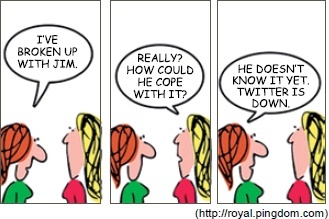
A tira evidencia que
Questão 40 254295
UNIFESP 2018Mobile milestones: how your phone
became an essential part of your life

Has any device changed our lives as much, and as quickly, as the mobile phone? There are people today for whom the world of address books, street atlases and phone boxes seems very far away, lost in the mists of time. Following, there are just some of the big milestones from the past 30 years that have made almost everything we do easier, more public and very, very fast.
• The first phones arrive – and become status symbols
Few people got the chance to use the very early mobile phones. The first call was made in New York in 1973, but handsets with a network to use were not available until 1983 in the US, and 1985 in the UK. That first British mobile phone was essentially a heavy briefcase with a receiver attached by a wire. It cost £2,000 (£5,000 in today’s prices), and gave you half an hour’s chat on an overnight charge. Making a call was not something you could do subtly, but that wasn’t the point; the first handsets were there to be seen. They sent a message that you were bold and confident with new technology, that you were busy and important enough to need a mobile phone, and were rich enough to buy one.
• Text messages spawn a whole new language
The first mobiles worked with analogue signals and could only make phone calls, but the digital ones that followed in the early 1990s could send SMS messages as well. After the first message was sent on 3 December 1992, texting took off like a rocket, even though it was still a pretty cumbersome procedure. Handsets with predictive text would make things easier, but in the 1990s you could save a lot of time by removing all excess letters from a message, often the vowels, and so txtspk ws brn. Today the average mobile phone sends more than 100 texts per month.
• Phones turn us all into photographers...
There seemed to be no good reason for the first camera phones, which began to appear in 2002, with resolutions of about 0.3 megapixels. They took grainy, blurry pictures on postage stamp-sized screens, and even these filled the phone’s memory in no time. Gradually, though, as the quality improved, the uses followed. As well as the usual photos of friends and family, they were handy for “saving” pieces of paper, and in pubs you could take a picture of the specials board and take it back to your table. Modern camera phones have changed beyond recognition in the past 20 years. The new mobile phones boast the highest resolution dual camera on a smartphone: a 16-megapixel camera and a 20-megapixel camera side-by-side. The dual camera allows users to focus on their subjects, while blurring out the background, producing professional-looking portraits.
• …and we turn ourselves into celebrities
Twenty years ago people would have thought you a little strange if you took flattering photos of yourself and your lifestyle and then distributed them to your friends – let alone to members of the public. If you used printed photographs rather than a smartphone app, they would still think so today. Yet sharing our lives on social media is now the norm, not the exception – and it was the camera phone that made it all possible. Now, some phones come with an enormous 64GB of memory, so you can capture, share and store an almost countless number of videos and pictures – well, certainly enough to keep up with the Kardashians.
(www.theguardian.com, 07.07.2017. Adaptado.)
No trecho do quarto parágrafo “and even these filled the phone’s memory”, o termo em destaque se refere a
Questão 34 254282
UNIFESP 2018Mobile milestones: how your phone
became an essential part of your life
Has any device changed our lives as much, and as quickly, as the mobile phone? There are people today for whom the world of address books, street atlases and phone boxes seems very far away, lost in the mists of time. Following, there are just some of the big milestones from the past 30 years that have made almost everything we do easier, more public and very, very fast.
• The first phones arrive – and become status symbols
Few people got the chance to use the very early mobile phones. The first call was made in New York in 1973, but handsets with a network to use were not available until 1983 in the US, and 1985 in the UK. That first British mobile phone was essentially a heavy briefcase with a receiver attached by a wire. It cost £2,000 (£5,000 in today’s prices), and gave you half an hour’s chat on an overnight charge. Making a call was not something you could do subtly, but that wasn’t the point; the first handsets were there to be seen. They sent a message that you were bold and confident with new technology, that you were busy and important enough to need a mobile phone, and were rich enough to buy one.
• Text messages spawn a whole new language
The first mobiles worked with analogue signals and could only make phone calls, but the digital ones that followed in the early 1990s could send SMS messages as well. After the first message was sent on 3 December 1992, texting took off like a rocket, even though it was still a pretty cumbersome procedure. Handsets with predictive text would make things easier, but in the 1990s you could save a lot of time by removing all excess letters from a message, often the vowels, and so txtspk ws brn. Today the average mobile phone sends more than 100 texts per month.
• Phones turn us all into photographers...
There seemed to be no good reason for the first camera phones, which began to appear in 2002, with resolutions of about 0.3 megapixels. They took grainy, blurry pictures on postage stamp-sized screens, and even these filled the phone’s memory in no time. Gradually, though, as the quality improved, the uses followed. As well as the usual photos of friends and family, they were handy for “saving” pieces of paper, and in pubs you could take a picture of the specials board and take it back to your table. Modern camera phones have changed beyond recognition in the past 20 years. The new mobile phones boast the highest resolution dual camera on a smartphone: a 16-megapixel camera and a 20-megapixel camera side-by-side. The dual camera allows users to focus on their subjects, while blurring out the background, producing professional-looking portraits.
• …and we turn ourselves into celebrities
Twenty years ago people would have thought you a little strange if you took flattering photos of yourself and your lifestyle and then distributed them to your friends – let alone to members of the public. If you used printed photographs rather than a smartphone app, they would still think so today. Yet sharing our lives on social media is now the norm, not the exception – and it was the camera phone that made it all possible. Now, some phones come with an enormous 64GB of memory, so you can capture, share and store an almost countless number of videos and pictures – well, certainly enough to keep up with the Kardashians.
(www.theguardian.com, 07.07.2017. Adaptado.)
De acordo com o texto, um dos aspectos positivos dos telefones celulares é que eles
Questão 33 254281
UNIFESP 2018Leia os quadrinhos para responder à questão
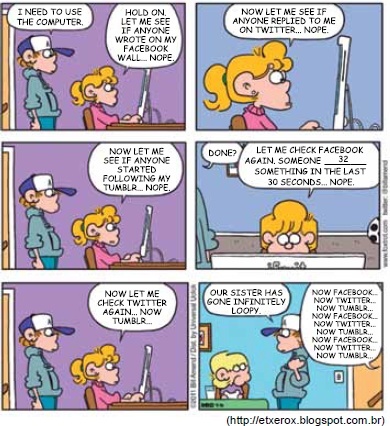
The word “loopy” can be replaced, with no meaning change, by
06