


![[Marketing] Questao Topo - deslogado](https://storage.estuda.com.br/banners/0_6b7ebee90b03af1c560c73bb8bcce34a_banner_deslogado_70_dias.png)
Questões de Inglês
19.971 Questões
Questão 57 603155
FACERES 2018/2Use the comic strip bellow to answer question:
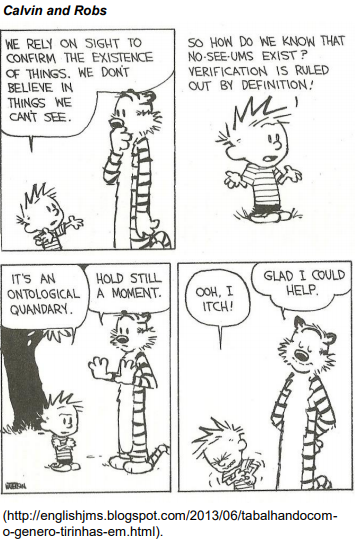
According to the comic strip, what does the stretch “We rely on sight to confirm the existence of things” mean?
Questão 56 603024
EsPCEx 2° Dia 2018Leia o texto a seguir e responda à questão.
The photography exercise book by Bert Krages
Training your eye to shoot like a pro
A while ago I was asked if I’d like to have a look at Bert Krages’ book. My initial thought was that it would pretty much be a list of ‘try this’ exercises. Well in a way it is, in that you really need to go out and try the exercises, not just read about them. In much the same way that my piano playing won’t improve by just buying more books about playing the piano…
Try the technical exercises – a desk lamp and an egg really can teach you an enormous amount about the realities of lighting, shadows and reflected light. I’ve been a pro photographer since 2004 and taking the time to do some of the exercises has been of real benefit.
A well-written book that is packed with useful images to illustrate the matters at hand. It’s nice to see the author didn’t fall into the trap of only including ‘perfect’ photos – you will look at some and think ‘I could do better than that’ – good!
It’s a book for people who want to take more photos and increase their satisfaction from doing so. Definitely one to try if you feel you’re perhaps clinging to some of the technical aspects of photography as a bit of a safety blanket, to avoid the fluffy artsy stuff.
Book Author Info.
Bert Krages is a photographer and attorney who is the author of two previous photography books, Legal Handbook for Photographers and Heavenly Bodies: The Photographer’s Guide to Astrophotography.
Adapted from http://www.northlight-images.co.uk/
In the sentence “... the author didn’t fall into the trap of only including ‘perfect’ photos...” (paragraph 3), the expression fall into the trap means
Questão 50 601996
UFN Verão 2018Let´s Talk About Diversity
Greg Parks
In the midst of significant global changes such as generational turnover, talent shortage and advancing technology, Greg Parkes, Executive General Manager at Autopia, shares the organisation’s journey towards a more diverse and inclusive workplace.
There are thousands of articles discussing the importance of diversity, while study after study proves the economic benefits of a diverse workforce to an organisation. As a result, over the last decade, the corporate world has focused more on diversity, celebrating our differences in gender, cultural background, ways of thinking and more.
The journey towards diversity
At Autopia, the importance of diversity and inclusion stems from the core of our business: our customers. Having built an organisation with a personalised, highly consultative approach, it was evident to us that our customers came from a whole range of backgrounds, and our staff should too. So, in an effort to learn how to promote diversity and inclusion within our organisation and create a positive impact in our business community, we embarked on our own diversity and inclusion journey, leading to the development of our thought leadership program.
Diversity matters: facilitating the conversation
Through Autopia’s Diversity and Inclusion thought leadership program, we have had the privilege of sharing experiences with corporate leaders from around Australia, and partnered with pivotal organisations, including UN Women National Committee of Australia and Juggle Strategies, a workplace flexibility consultancy firm. Through these partnerships, we have developed a series of White Papers for business, exploring gender and cultural diversity, as well as workplace flexibility, and best practices for promoting and implementing effective diversity and inclusion programs within a business. With the objective of generating discussion around these issues, these White Papers also aim to provide guidance for companies on their own journey of change. Along the way, and thanks to insights from our expert partners, we have learned that it is not enough to achieve a statistically diverse workforce; true inclusion comes when there is a cultural shift within the organisation. As Vernā Myers, Author and Diversity Advocate once said, “Diversity is being invited to the party; inclusion is being asked to dance.”
Undoubtedly, changing an organisation’s culture can be slow. In fact, achieving diversity and inclusion is not a one-off, set-and-forget exercise. It is an ever-evolving process that must go beyond written procedures to become part of the day-to-day life of an organisation. Achieving diversity and inclusion is a process that requires us to re-think how we do business, but one that we know can have a positive and tangible effect on productivity and performance. Working towards diversity and inclusion in the workplace is not only the right thing to do; it’s the smart thing to do.
(Fonte:http://www.hcamag.com/opinion/opinion-lets-talk-aboutdiversity-241797.aspx)
Undoubtedly é composta pelo uso de afixos. A palavra que passa pelo mesmo processo de formação de palavras é
Questão 48 601988
UFN Verão 2018Let´s Talk About Diversity
Greg Parks
In the midst of significant global changes such as generational turnover, talent shortage and advancing technology, Greg Parkes, Executive General Manager at Autopia, shares the organisation’s journey towards a more diverse and inclusive workplace.
There are thousands of articles discussing the importance of diversity, while study after study proves the economic benefits of a diverse workforce to an organisation. As a result, over the last decade, the corporate world has focused more on diversity, celebrating our differences in gender, cultural background, ways of thinking and more.
The journey towards diversity
At Autopia, the importance of diversity and inclusion stems from the core of our business: our customers. Having built an organisation with a personalised, highly consultative approach, it was evident to us that our customers came from a whole range of backgrounds, and our staff should too. So, in an effort to learn how to promote diversity and inclusion within our organisation and create a positive impact in our business community, we embarked on our own diversity and inclusion journey, leading to the development of our thought leadership program.
Diversity matters: facilitating the conversation
Through Autopia’s Diversity and Inclusion thought leadership program, we have had the privilege of sharing experiences with corporate leaders from around Australia, and partnered with pivotal organisations, including UN Women National Committee of Australia and Juggle Strategies, a workplace flexibility consultancy firm. Through these partnerships, we have developed a series of White Papers for business, exploring gender and cultural diversity, as well as workplace flexibility, and best practices for promoting and implementing effective diversity and inclusion programs within a business. With the objective of generating discussion around these issues, these White Papers also aim to provide guidance for companies on their own journey of change. Along the way, and thanks to insights from our expert partners, we have learned that it is not enough to achieve a statistically diverse workforce; true inclusion comes when there is a cultural shift within the organisation. As Vernā Myers, Author and Diversity Advocate once said, “Diversity is being invited to the party; inclusion is being asked to dance.”
Undoubtedly, changing an organisation’s culture can be slow. In fact, achieving diversity and inclusion is not a one-off, set-and-forget exercise. It is an ever-evolving process that must go beyond written procedures to become part of the day-to-day life of an organisation. Achieving diversity and inclusion is a process that requires us to re-think how we do business, but one that we know can have a positive and tangible effect on productivity and performance. Working towards diversity and inclusion in the workplace is not only the right thing to do; it’s the smart thing to do.
(Fonte:http://www.hcamag.com/opinion/opinion-lets-talk-aboutdiversity-241797.aspx)
Ao falar sobre as mudanças que acontecem na Autopia, o texto se utiliza da seguinte sentença: In the midst of significant global changes such as generational turnover, talent shortage and advancing technology…, para contextualizar o momento atual pelo qual passamos.
Com base nesse contexto, relacione a segunda coluna de acordo com a primeira, em que as palavras em Língua Inglesa se equivalem às da Língua Portuguesa. Depois, assinale a alternativa correta.
1. turnover
2. shortage
3. significant
4. midst
( ) importante
( ) rotatividade
( ) em meio a
( ) carência
Questão 13 601468
EBMSP Medicina 2018/2 The aim of mindfulness is not quieting the mind, or attempting to achieve a state of eternal calm. The goal is simple: we’re aiming to pay attention to the present moment, without judgment. Easier said than done, we know. When we notice judgments arise during our practice, we can make a mental note of them, and let them pass. Return to observing the present moment as it is. That’s the practice. The work is to just keep doing it. Results will accrue.
Disponível em: <https://www.mindful.org/what-is-mindfulness/>. Acesso em: abr. 2018. Adaptado.
The suitable definition of the phrase “Easier said than done” is
Questão 16 599736
FCMSJF - Suprema 2018/2World War I Unleashed Chemical Weapons and Changed Modern Warfare
One hundred years ago today (April 6), the United States declared war on Germany and entered into World War I (WWI), the global conflict that initiated the first widespread use of chemical weapons in warfare.
The scope of WWI’s chemical weaponry was unlike anything seen on the battlefield before. Over the course of the war — which lasted from July 28, 1914, to Nov. 11, 1918 — about 3,000 chemicals were investigated for military use, and 50 toxic agents were deployed on battlefields across Europe, killing an estimated 90,000 to 100,000 people and leaving 1.3 million people injured, reported Chemical & Engineering News (CEN), the magazine of the American Chemical Society.
Though chemical weapons were responsible for only about 1 percent of the Great War’s dead, they provided the 20th century with a dangerous new weapon of mass destruction, according to experts. And the terror they inspired ensured that this new chapter in modern warfare would be an ugly one.
Thousands of casualties
But chemical attacks during wartime were usually very localized, with limited range. That changed on April 22, 1915, when the German army released close to 170 metric tons of chlorine gas from nearly 6,000 cylinders buried in defensive trenches in Ypres, Belgium. Chlorine gas is yellow-green and smells like bleach; when it makes contact with moist body tissues, it produces an acid that can cause severe tissue damage, according to the Centers for Disease Control and Prevention (CDC).
Minutes after the gas was released, 1,000 French and Algerian soldiers were dead, and nearly 4,000 more were injured, Gerard J. Fitzgerald, a researcher in the Department of History and Art History at George Mason University in Virginia, wrote in a study published in April 2008 in the American Journal of Public Health.
Witness accounts of chemical attacks and their aftermath were horrific. A British observer at Ypres described French soldiers stumbling off the battlefield “blinded, coughing, chests heaving, faces an ugly purple color, lips speechless with agony,” Fitzgerald reported in his study.
Banning chemical agents
The specter of poison gas inspired an international agreement after WWI ended — the 1925 Geneva Protocol — which banned chemical and biological weapons during war.
According to the treaty, “the use in war of asphyxiating, poisonous or other gases, and of all analogous liquids, materials or devices, has been justly condemned by the general opinion of the civilized world,” and their prohibition “shall be universally accepted as a part of International Law, binding alike the conscience and the practice of nations.”
Global leaders continue to condemn the use of chemical weapons. In 1993, the United Nations banned mustard gas and other toxic agents through the Chemical Weapons Convention, prohibiting “the development, production, acquisition, stockpiling, retention, transfer or use of chemical weapons,” the Organisation for the Prohibition of Chemical Weapons (OPCW), reported.
And in 2013, the OPCW received the Nobel Peace Prize for its work as chemical weapons “watchdogs,” — for mobilizing nations to cease producing and storing lethal chemical weapons, and targeting cached weapons for safe disposal, with the ultimate goal of eliminating them completely.
But poisonous agents still pose a silent and deadly threat. Just this Tuesday (April 4), a chemical bombing in Syria claimed the lives of at least 70 people, many of them children, following an air attack that dropped bombs in Idlib Province, the New York Times reported. While the composition of the lethal gas is still unknown, it is thought to be a type of nerve agent, which disrupts neuron signals and can interfere with involuntary muscle movements, such as respiration.
Original article on Live Science.
The word witness means:
06