


![[Marketing] Questao Topo - deslogado](https://storage.estuda.com.br/banners/0_6b7ebee90b03af1c560c73bb8bcce34a_banner_deslogado_70_dias.png)
Questões de Inglês
19.971 Questões
Questão 55 687376
FIP-Moc Medicina 2018/1
The idiomatic expression:
Questão 54 687369
FIP-Moc Medicina 2018/1A Hard Day's Night
The Beatles
It's been a hard day's night
And I've been workin' like a dog
It's been a hard day's night
I should be sleepin' like a log
But when I get home to you
I find the things that you do
You make me feel alright
You know I work all day
To get your money to buy your things
And it's worth it just to hear you say
You're gonna give me everything
So why on earth should I moan?
'Cause when I get you alone
You know I feel okay
When I'm home
Everything seems to be right
When I'm home
Feeling you holding me tight
Tight, yeah
Available at: https://www.letras.mus.br/the-beatles/235/. Accessed on: October, 1st, 2017. Adapted.
It’s inferred that:
Questão 49 678102
FIP-Moc Medicina 2018/2I Want To Break Free
Queen
Compositor: John Deacon
I want to break free
I want to break free
I want to break free from your lies
You're so self satisfied I don't need you
I've got to break free
God knows, God knows I want to break free.
I've fallen in love
I've fallen in love for the first time
And this time I know it's for real
I've fallen in love,
God knows, God knows I've fallen in love.
It's strange but it's true, yeah
I can't get over the way you love me like you do
But I have to be sure
When I walk out that door
Oh how I want to be free, baby
(...)
Available at: https://www.vagalume.com.br/queen/i-want-tobreak-free.html. Accessed on March, 20th 2018. Adapted.
The author:
Questão 56 664960
UP Demais Cursos 2018/1O texto a seguir é referência para a questão.
Fish may be actively seeking out plastic debris in the oceans as the tiny pieces appear to smell similar to their natural prey, new research suggests.
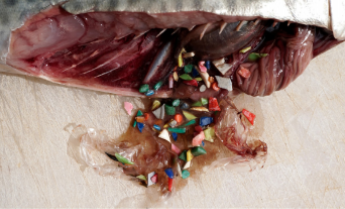
Photograph: Paulo Oliveira
The fish confuse plastic for an edible substance because microplastics in the oceans pick up a covering of biological material, such as algae, that mimics the smell of food, according to the study published on Wednesday in the journal Proceedings of the Royal Society.
Scientists presented schools of wild-caught anchovies with plastic debris taken from the oceans, and with clean pieces of plastic that had never been in the ocean. The anchovies responded to the odours of the ocean debris in the same way as they do to the odours of the food they seek.
The scientists said this was the first behavioural evidence that the chemical signature of plastic debris was attractive to a marine organism, and reinforces other work suggesting the odour could be significant.
The finding demonstrates an additional danger of plastic in the oceans, as it suggests that fish are not just ingesting the tiny pieces by accident, but actively seeking them out.
Matthew Savoca, of the National Oceanic and Atmospheric Administration and lead author of the study, told the Guardian: “When plastic floats at sea its surface gets colonised by algae within days or weeks, a process known as biofouling. Previous research has shown that this algae produces and emits DMS, an algal based compound that certain marine animals use to find food. [The research shows] plastic may be more deceptive to fish than previously thought. If plastic both looks and smells like food, it is more difficult for animals like fish to distinguish it as not food”.
Plastic debris in the oceans, ranging from the microscopic to large visible pieces, is recognised as a growing problem as it does not readily degrade and hundreds of thousands of tonnes are dumped in the sea annually. Larger pieces have been found in the intestines of whales and seabirds, where they are thought to be potentially fatal, while the smallest pieces have been detected in the guts of even juvenile fish and molluscs. Numerous species of fish eaten by humans have been found to contain plastic, and the effect of eating these on human health is still unknown.
Efforts to reduce marine plastic have so far had little effect: microbeads widely used in cosmetics and other products have been banned in the US, the UK and other countries, but they only solve part of the problem, which is mainly caused by dumping of plastic rubbish. There could be more plastic than fish in the sea by 2050, campaigners have warned.
HARVEY, Fiona. “Fish mistaking plastic debris in ocean for food”. In The Guardian.16 August 2017. Adapted from . Acesso em 16/08/2017.
According to the text, biofouling is:
Questão 36 652369
UP Medicina 2018/1O texto a seguir é referência para a questão.
The UN Refugee Agency’s annual Global Trends study found that 65.6 million people were forcibly displaced worldwide at the end of 2016 – a total bigger than the population of the United Kingdom and about 300,000 more than last year.
It noted that the pace at which people are becoming displaced remains very high. On average, 20 people were driven from their homes every minute last year, or one every three seconds.
In each of the past five years, annual increases to the global displacement total have been in the millions. While the 2016 total is high – representing an enormous number of people needing protection worldwide – it also shows that growth in displacement slowed last year.
The total figure includes 40.3 million people uprooted within the borders of their own countries, about 500,000 fewer than in 2015. Meanwhile, the total number seeking asylum globally was 2.8 million.
However, the total seeking safety across international borders as refugees topped 22.5 million, the highest number seen since UNHCR was founded in 1950 in the aftermath of the Second World War.
The conflict in Syria, was the world’s biggest producer of refugees (5.5 million). However in 2016 the biggest new factor was South Sudan, where the disastrous break-off of peace efforts in July of that year contributed to an outflow of 737,400 people by the end of the year. That number has continued to rise during the first half of 2017.
Nyawet Tut, a South Sudanese mother of five in her 30s, described the situation:
“My husband was killed in the war which, in addition to the shortage of food, made me decide to leave my home, everything, behind,” she told UNHCR staff during an interview at a temporary way station in Ethiopia.
In terms of overall displacement, Syria still accounts for the biggest numbers, with 12 million people (65 per cent of the population) displaced internally or living outside the country as refugees.
Particularly heartbreaking is the plight of children, who make up half the world’s refugees, and continue to bear a disproportionate burden of the suffering, mainly because of their heightened vulnerability.
Tragically, 75,000 asylum claims were received from children travelling alone or separated from their parents, among them youngsters like Tareq, 16, who dodged armed combatants to walk out of Syria into neighbouring Turkey.
“There was no future where we lived”, he told UNHCR. “There was no university and no work. There were troops grabbing young children like me, and they send them to war, and they get killed. I wanted to study”.
Last year, much of the news coverage focused on refugee resettlement to developed countries, including efforts by some states to restrict access and even erect border barriers.
However, figures in the report showed that, worldwide, most refugees – 84 per cent – were in developing or middle-income countries at the end of 2016, with one in every three (4.9 million people) being hosted by the world’s least developed countries.
This huge imbalance reflects several things including the lack of consensus internationally when it comes to hosting refugees, and the proximity of many poor countries to regions of conflict.
It also illustrates the need for countries and communities supporting refugees and other displaced people to be properly resourced and supported, the absence of which can cause instability, have consequences for life-saving humanitarian work or lead to secondary displacement.
(Adaptado: <http://www.unhcr.org/news/stories/2017/6/5941561f4/forced-displacement-worldwide-its-highest-decades. html> Acesso em 16/08/2017)
De acordo com o texto, qual foi a situação responsável por produzir mais refugiados até hoje?
Questão 27 650722
FITS 2018/1TEXTO:
It is said that your body can’t use the protein from
beans unless you eat them with rice. Proteins — which
our bodies need to make everything from new muscle
to hormones — are made up of different combinations
[5] of 20 amino acids. Thing is, our bodies can make only
11 of these amino acids; we must get the other nine
from food. Animal-based protein-rich foods like eggs
and meat provide all nine of these “essential” amino
acids, but nearly all plant foods are low in at least one.
[10] Experts used to say that to get what your body
needs to make proteins, you needed to pair plant-based
foods with complementary sets of amino acids — like
rice and beans. Now they know that you don’t have to
eat those foods at the same meal. “If you get a variety
[15] of foods throughout the day, they all go into the ‘basket’
of amino acids that are available for the body to use,”
says Winston J. Craig, Ph.D., R.D., nutrition department
chair at Andrews University in Berrien Springs,
Michigan.
www.eatingwell.com/article/16296/the-13-biggets-nutrition-and-foodmyths- busted/. Adaptado.
Considering language use in the text, it’s correct to say:
06