


![[Marketing] Questao Topo - deslogado](https://storage.estuda.com.br/banners/0_6b7ebee90b03af1c560c73bb8bcce34a_banner_deslogado_70_dias.png)
Questões de Inglês
19.971 Questões
Questão 19 776176
USS (Univassouras) 2018/1EYE SCAN THAT DETECTS PROTEIN IN RETINA COULD AID IN QUICKER ALZHEIMER’S DIAGNOSES, NEW STUDY REPORTS
In the future, doctors may diagnose Alzheimer’s disease by scanning a patient’s eyes — thanks to new
evidence that telltale plaques of amyloid-beta are present not only in the brain, but also in the retina.
Researchers at Cedars-Sinai Medical Center in Los Angeles have developed a method to noninvasively
detect amyloid deposits in the eye, potentially allowing for a diagnosis even before symptoms
[5] appear. Their report, “Retinal amyloid pathology and proof-of-concept imaging trial in Alzheimer’s
disease,” described the results of a small proof-of-concept clinical trial that tested an eye imaging
method specifically developed for the study. The work appeared in the journal JCI Insight.
“The findings suggest that the retina may serve as a reliable source for Alzheimer’s disease diagnosis,”
Maya Koronyo-Hamaoui, the study’s principal investigator and associate professor at Cedars-Sinai,
[10] said in a press release.
Until recently, the only way to positively diagnose Alzheimer’s was by analyzing a patient’s brain
after death to detect the diagnostic feature of the disease: aggregates of amyloid-beta in the
brain. More recently, researchers started using a brain imaging method called positron emission
tomography (PET) to visualize the plaque in living people. But the method requires the use of a
[15] radioactive tracer, and is neither cheap nor adapted for repeated use.
In 2011, the team discovered that — just as the eye is considered to be a mirror of the soul — the
eye’s retina was a mirror of the brain, at least in terms of amyloid deposits.
In the new study, researchers built on these insights by developing a method to track changes by
eye imaging. They did so with curcumin, the main component of the spice turmeric. Curcumin,
[20] which study participants drank, entered the amyloid plaque and lit up in the eye scan.
“One of the major advantages of analyzing the retina is the repeatability, which allows us to monitor
patients and potentially the progression of their disease,” said Koronyo-Hamaoui.
In the study process, the research team discovered that amyloid deposits were also present in
peripheral areas of the retina, which they had previously overlooked. Moreover, the amount of
[25] amyloid plaque in the retina correlated with the amyloid burden in specific brain regions.
“Now we know exactly where to look to find the signs of Alzheimer’s disease as early as possible,”
said research associate Yosef Koronyo, first author on the study.
Added Dr. Keith L. Black, chair of Cedars-Sinai’s Department of Neurosurgery and director of the
Maxine Dunitz Neurosurgical Institute: “Our hope is that eventually the investigational eye scan
[30] will be used as a screening device to detect the disease early enough to intervene and change the
course of the disorder with medications and lifestyle changes.”
MAGDALENA KEGEL Adaptado de alzeihmersnewstoday. com, 21/08/2017.
Moreover, the amount of amyloid plaque in the retina correlated with the amyloid burden in specific brain regions. (l. 24-25)
The underlined word is used to show addition.
The fragment which includes another expression also used to express addition is
Questão 59 687399
FIP-Moc Medicina 2018/1STUDENT GETS MODELING OFFERS THANKS TO CHANCE PHOTOS
A photograph of a New Hampshire college student that went viral on social media is bringing her dreams of becoming a model closer to reality.
Anok Yai grew up in Manchester, New Hampshire, and is a sophomore at Plymouth State University. The Boston Globe reports that a photographer took a photo of her for his Instagram account about a week ago while she was at a homecoming event at Howard University in Washington. He said he was photographing people with nice outfits.
The photo had been viewed more than 11,000 times by Sunday, and Yai said last week she’s heard from three modeling agencies.
The biochemistry student says she’s always been interested in fashion and art, but modeling was a dream she didn’t think would ever happen.
Available at:http://nypost.com/2017/10/29/student-gets-modeling-offers-thanks-to-chance-photo/. Accessed on: November, 1st 2017.
The student’s dream is closer to reality because she:
Questão 55 687376
FIP-Moc Medicina 2018/1
The idiomatic expression:
Questão 54 687369
FIP-Moc Medicina 2018/1A Hard Day's Night
The Beatles
It's been a hard day's night
And I've been workin' like a dog
It's been a hard day's night
I should be sleepin' like a log
But when I get home to you
I find the things that you do
You make me feel alright
You know I work all day
To get your money to buy your things
And it's worth it just to hear you say
You're gonna give me everything
So why on earth should I moan?
'Cause when I get you alone
You know I feel okay
When I'm home
Everything seems to be right
When I'm home
Feeling you holding me tight
Tight, yeah
Available at: https://www.letras.mus.br/the-beatles/235/. Accessed on: October, 1st, 2017. Adapted.
It’s inferred that:
Questão 49 678102
FIP-Moc Medicina 2018/2I Want To Break Free
Queen
Compositor: John Deacon
I want to break free
I want to break free
I want to break free from your lies
You're so self satisfied I don't need you
I've got to break free
God knows, God knows I want to break free.
I've fallen in love
I've fallen in love for the first time
And this time I know it's for real
I've fallen in love,
God knows, God knows I've fallen in love.
It's strange but it's true, yeah
I can't get over the way you love me like you do
But I have to be sure
When I walk out that door
Oh how I want to be free, baby
(...)
Available at: https://www.vagalume.com.br/queen/i-want-tobreak-free.html. Accessed on March, 20th 2018. Adapted.
The author:
Questão 56 664960
UP Demais Cursos 2018/1O texto a seguir é referência para a questão.
Fish may be actively seeking out plastic debris in the oceans as the tiny pieces appear to smell similar to their natural prey, new research suggests.
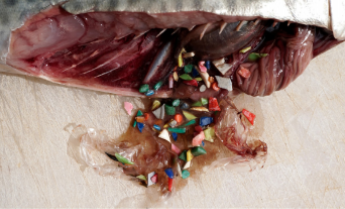
Photograph: Paulo Oliveira
The fish confuse plastic for an edible substance because microplastics in the oceans pick up a covering of biological material, such as algae, that mimics the smell of food, according to the study published on Wednesday in the journal Proceedings of the Royal Society.
Scientists presented schools of wild-caught anchovies with plastic debris taken from the oceans, and with clean pieces of plastic that had never been in the ocean. The anchovies responded to the odours of the ocean debris in the same way as they do to the odours of the food they seek.
The scientists said this was the first behavioural evidence that the chemical signature of plastic debris was attractive to a marine organism, and reinforces other work suggesting the odour could be significant.
The finding demonstrates an additional danger of plastic in the oceans, as it suggests that fish are not just ingesting the tiny pieces by accident, but actively seeking them out.
Matthew Savoca, of the National Oceanic and Atmospheric Administration and lead author of the study, told the Guardian: “When plastic floats at sea its surface gets colonised by algae within days or weeks, a process known as biofouling. Previous research has shown that this algae produces and emits DMS, an algal based compound that certain marine animals use to find food. [The research shows] plastic may be more deceptive to fish than previously thought. If plastic both looks and smells like food, it is more difficult for animals like fish to distinguish it as not food”.
Plastic debris in the oceans, ranging from the microscopic to large visible pieces, is recognised as a growing problem as it does not readily degrade and hundreds of thousands of tonnes are dumped in the sea annually. Larger pieces have been found in the intestines of whales and seabirds, where they are thought to be potentially fatal, while the smallest pieces have been detected in the guts of even juvenile fish and molluscs. Numerous species of fish eaten by humans have been found to contain plastic, and the effect of eating these on human health is still unknown.
Efforts to reduce marine plastic have so far had little effect: microbeads widely used in cosmetics and other products have been banned in the US, the UK and other countries, but they only solve part of the problem, which is mainly caused by dumping of plastic rubbish. There could be more plastic than fish in the sea by 2050, campaigners have warned.
HARVEY, Fiona. “Fish mistaking plastic debris in ocean for food”. In The Guardian.16 August 2017. Adapted from . Acesso em 16/08/2017.
According to the text, biofouling is:
06