


![[Marketing] Questao Topo - deslogado](https://storage.estuda.com.br/banners/0_6b7ebee90b03af1c560c73bb8bcce34a_banner_deslogado_70_dias.png)
Questões de Inglês
19.971 Questões
Questão 63 13030159
UECE 2ª fase 1º dia 2018/2A Master Storyteller from 19th-Century
Brazil, Heir to the Greats and
Entirely Sui Generis
By Parul Sehgal
In a famous Hindu parable, three
blind men encounter an elephant for the
first time and try to describe it, each
touching a different part. “An elephant is
[05] like a snake,” says one, grasping the
trunk. “Nonsense; an elephant is a fan,”
says another, who holds an ear. “A tree
trunk,” insists a third, feeling his way
around a leg.
[10] In the Anglophone world, a similar
kind of confusion surrounds Joaquim
Maria Machado de Assis (1839-1908),
the son and sly chronicler of Rio de
Janeiro whom Susan Sontag once called
[15] “the greatest writer ever produced in
Latin America.” To Stefan Zweig,
Machado was Brazil’s answer to Dickens.
To Allen Ginsberg, he was another
Kafka. Harold Bloom called him a
[20] descendant of Laurence Sterne, and
Philip Roth compared him to Beckett.
Others cite Gogol, Poe, Borges and
Joyce. In the foreword to “The Collected
Stories of Machado de Assis,” published
[25] this month, the critic Michael Wood
invokes Henry James, Henry Fielding,
Chekhov, Sterne, Nabokov and Calvino
— all in two paragraphs.
To further complicate matters,
[30] Machado has always reminded me of
Alice Munro. What’s going on here?
What kind of writer induces such
rapturous and wildly inconsistent
characterizations? What kind of writer
[35] can star in so many different fantasies?
The protean, stubbornly
unclassifiable Machado was born into
poverty, the mixed-race grandson of
freed slaves. He had no formal education
[40] or training; like Twain, his
contemporary, he got his start as a
printer’s apprentice. Out of a regimen of
ferocious self-education, he established
himself, initially as a writer of slender
[45] romances for and about the women of
the ruling elite.
But in 1879, his style changed —
or rather, it arrived. Prolonged illness
(Machado was epileptic), and the near
[50] loss of his sight, snapped him to
attention. The gentle romantic
blossomed into a wicked ironist whose
authorial intrusions, jump cuts and sheer
mischief influenced American
[55] experimentalists like John Barth and
Donald Barthelme.
Five novels produced in this
period — including his masterpiece, “The
Posthumous Memoirs of Brás Cubas”
[60] (1881) — cemented his reputation. If
this collection of 76 stories (culled from
more than 200) cannot rise to their
ranks, it still offers a different and
valuable vantage point — especially for
[65] readers who like to keep an eye on the
life as well as the art.
“The Collected Stories” reveals
the arc of Machado’s career, from the
straightforward love stories to the
[70] cerebral and unpredictable later works.
One story is told from the point of view
of a needle. Political satire begins to
appear. In one tale, a dictator, bald
since youth, decrees that all his subjects
[75] must also shave their heads, arguing
that the “moral unity of the state
depended on all heads looking the
same.”
Machado’s stories pulse with life.
[80] The endings are frequently murky and
strange, often abruptly truncated. The
title of an early work characterizes them
well: “Much Heat, Little Light.” Certain
preoccupations persist: alluring widows,
[85] naïve young men, a fondness for
coincidence. Machado remained
fascinated by femininity and the
strictures governing the lives of women
— it’s why he reminds me of Munro. Like
[90] chess pieces, Rio’s well-born ladies could
make only a few authorized moves
(Machado was a chess fanatic), but
everything was theirs to win or lose.
Above all looms the figure of the
[95] bibliomane. “This is my family,” one
says, pointing to his bookshelf. These
are characters shaped by their reading,
sometimes even physically (“his head
jutted forward slightly from his long
[100] habit”).
It’s a curious feature of Machado’s
stories that Brazil is so absent. There are
few landmarks, few mentions of the
weather. But there are allusions to
[105] Molière and Goethe. Novels and authors
are the signposts. Like his characters,
Machado was a creature of literature;
ink ran in his veins. Though he never
roved far from his hometown he read
[110] widely, claiming all of culture, all of
Europe — giving his work that
remarkably open, cosmopolitan feel.
This creation of a personal
cartography — of anchoring himself in
[115] the life of the mind — might explain one
of the lingering frustrations with
Machado’s work: namely, his refusal to
write more explicitly about slavery. He
might not have dared; slavery ended in
[120] Brazil only in 1888. His stories stay
trained, sometimes monotonously, on
the elite, slaves flitting through in
silence.
Yet Machado is always writing
[125] about liberation in his way, which to him
begins with the freedom — the
obligation — to think. Few fiction writers
have written so affectionately about
ideas, as if they were real people; he is
[130] always describing how ideas emerge and
move, the way they can lose their way
and get caught in a crush with others.
The way they can appear “fully formed
and beautiful” at times, or grow
[135] “pregnant” with other ideas.
Ideas and fixations elevate and
distort in these stories. In one, a man
consumed by his pet bird becomes “pure
canary.” In another, a father intent on
[140] grooming his son to become “a bigwig”
demands he cultivate the necessary
vapidity: “I forbid you to arrive at any
conclusions that have not already been
reached by others. Avoid anything that
[145] has about it so much as a whiff of
reflection, originality or the like.”
To Machado, your identity and the
contours of your world are formed not
just by your circumstances but by what
[150] you think about habitually. You are what
you contemplate, so choose wisely.
These stories are a spectacular place to
start.
From: www.nytimes.com/June 6, 2018
As to his characters, we can say
Questão 61 13029271
UECE 2ª fase 1º dia 2018/2A Master Storyteller from 19th-Century
Brazil, Heir to the Greats and
Entirely Sui Generis
By Parul Sehgal
In a famous Hindu parable, three
blind men encounter an elephant for the
first time and try to describe it, each
touching a different part. “An elephant is
[05] like a snake,” says one, grasping the
trunk. “Nonsense; an elephant is a fan,”
says another, who holds an ear. “A tree
trunk,” insists a third, feeling his way
around a leg.
[10] In the Anglophone world, a similar
kind of confusion surrounds Joaquim
Maria Machado de Assis (1839-1908),
the son and sly chronicler of Rio de
Janeiro whom Susan Sontag once called
[15] “the greatest writer ever produced in
Latin America.” To Stefan Zweig,
Machado was Brazil’s answer to Dickens.
To Allen Ginsberg, he was another
Kafka. Harold Bloom called him a
[20] descendant of Laurence Sterne, and
Philip Roth compared him to Beckett.
Others cite Gogol, Poe, Borges and
Joyce. In the foreword to “The Collected
Stories of Machado de Assis,” published
[25] this month, the critic Michael Wood
invokes Henry James, Henry Fielding,
Chekhov, Sterne, Nabokov and Calvino
— all in two paragraphs.
To further complicate matters,
[30] Machado has always reminded me of
Alice Munro. What’s going on here?
What kind of writer induces such
rapturous and wildly inconsistent
characterizations? What kind of writer
[35] can star in so many different fantasies?
The protean, stubbornly
unclassifiable Machado was born into
poverty, the mixed-race grandson of
freed slaves. He had no formal education
[40] or training; like Twain, his
contemporary, he got his start as a
printer’s apprentice. Out of a regimen of
ferocious self-education, he established
himself, initially as a writer of slender
[45] romances for and about the women of
the ruling elite.
But in 1879, his style changed —
or rather, it arrived. Prolonged illness
(Machado was epileptic), and the near
[50] loss of his sight, snapped him to
attention. The gentle romantic
blossomed into a wicked ironist whose
authorial intrusions, jump cuts and sheer
mischief influenced American
[55] experimentalists like John Barth and
Donald Barthelme.
Five novels produced in this
period — including his masterpiece, “The
Posthumous Memoirs of Brás Cubas”
[60] (1881) — cemented his reputation. If
this collection of 76 stories (culled from
more than 200) cannot rise to their
ranks, it still offers a different and
valuable vantage point — especially for
[65] readers who like to keep an eye on the
life as well as the art.
“The Collected Stories” reveals
the arc of Machado’s career, from the
straightforward love stories to the
[70] cerebral and unpredictable later works.
One story is told from the point of view
of a needle. Political satire begins to
appear. In one tale, a dictator, bald
since youth, decrees that all his subjects
[75] must also shave their heads, arguing
that the “moral unity of the state
depended on all heads looking the
same.”
Machado’s stories pulse with life.
[80] The endings are frequently murky and
strange, often abruptly truncated. The
title of an early work characterizes them
well: “Much Heat, Little Light.” Certain
preoccupations persist: alluring widows,
[85] naïve young men, a fondness for
coincidence. Machado remained
fascinated by femininity and the
strictures governing the lives of women
— it’s why he reminds me of Munro. Like
[90] chess pieces, Rio’s well-born ladies could
make only a few authorized moves
(Machado was a chess fanatic), but
everything was theirs to win or lose.
Above all looms the figure of the
[95] bibliomane. “This is my family,” one
says, pointing to his bookshelf. These
are characters shaped by their reading,
sometimes even physically (“his head
jutted forward slightly from his long
[100] habit”).
It’s a curious feature of Machado’s
stories that Brazil is so absent. There are
few landmarks, few mentions of the
weather. But there are allusions to
[105] Molière and Goethe. Novels and authors
are the signposts. Like his characters,
Machado was a creature of literature;
ink ran in his veins. Though he never
roved far from his hometown he read
[110] widely, claiming all of culture, all of
Europe — giving his work that
remarkably open, cosmopolitan feel.
This creation of a personal
cartography — of anchoring himself in
[115] the life of the mind — might explain one
of the lingering frustrations with
Machado’s work: namely, his refusal to
write more explicitly about slavery. He
might not have dared; slavery ended in
[120] Brazil only in 1888. His stories stay
trained, sometimes monotonously, on
the elite, slaves flitting through in
silence.
Yet Machado is always writing
[125] about liberation in his way, which to him
begins with the freedom — the
obligation — to think. Few fiction writers
have written so affectionately about
ideas, as if they were real people; he is
[130] always describing how ideas emerge and
move, the way they can lose their way
and get caught in a crush with others.
The way they can appear “fully formed
and beautiful” at times, or grow
[135] “pregnant” with other ideas.
Ideas and fixations elevate and
distort in these stories. In one, a man
consumed by his pet bird becomes “pure
canary.” In another, a father intent on
[140] grooming his son to become “a bigwig”
demands he cultivate the necessary
vapidity: “I forbid you to arrive at any
conclusions that have not already been
reached by others. Avoid anything that
[145] has about it so much as a whiff of
reflection, originality or the like.”
To Machado, your identity and the
contours of your world are formed not
just by your circumstances but by what
[150] you think about habitually. You are what
you contemplate, so choose wisely.
These stories are a spectacular place to
start.
From: www.nytimes.com/June 6, 2018
According to the text, Machado de Assis’s writing style went through a significant change
Questão 55 11529939
APMBB 2018How cities can better prevent fires
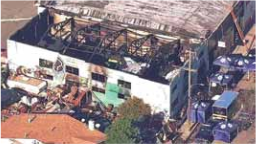
August 29, 2018
America’s deadliest building fire for more than a decade struck Oakland, California, on December 2nd 2016, killing 36 people attending a dance party in a warehouse that had become a cluttered artist collective. The disaster highlights an open secret: many cities lack resources to inspect for fire risk all the structures that they should. Even though the Oakland building had no fire sprinklers and at least ten people lived there illegally, no inspector had visited in about 30 years. How might cities make better use of the inspectors they do have?
A handful of American cities have begun to seek help from a new type of analytics software. By crunching diverse data collected by government bodies and utilities, the software works out which buildings are most likely to catch fire and should therefore be inspected first. Plenty of factors play a role. Older, wooden buildings, unsurprisingly, pose more risk, as do those close to past fires and leaks of gas or oil. Poverty also pushes up fire risk, especially if lots of children, who may be attracted to mischief, live nearby. More telling are unpaid taxes, foreclosure proceedings and recorded complaints of mould, rats, crumbling plaster, accumulating rubbish, and domestic fights, all of which hint at property neglect. A building’s fire risk also increases the further it is from its owner’s residence.
Predictive software designed at Harvard that Portland, Oregon, will soon begin using will do that. Perhaps more importantly, the city’s fire chief noticed that buildings marked as being the biggest risks are clustered in areas lacking good schools, public transport, health care and food options. Healthier, happier people start fewer fires, he concluded. He now lobbies officials to reduce Portland’s pockets of deteriorated areas.
(The Economist. www.economist.com/the-economist-explains /2018/08/29/how-cities-can-better-prevent-fires. Adaptado)
According to the first paragraph,
Questão 16 10741861
USCS Medicina e Odontologia 2018/2Leia o texto para responder à questão.
Sickle cell anemia1 – past and present stories
Thousands of years ago, a special child was born in the Sahara. At the time, this was not a desert; it was a green belt of savannas, woodlands, lakes and rivers. Bands of hunter-gatherers prospered there, catching fish and hippos. A genetic mutation had altered the child’s hemoglobin, the molecule in red blood cells that carries oxygen through the body. It was not harmful; there are two copies of every gene, and the child’s other hemoglobin gene was normal. The child survived, had a family and passed down the mutation to future generations.
As the greenery turned to desert, the descendants of the hunter-gatherers became farmers, and moved to other parts of Africa. The mutation endured over generations, and for good reason. People who carried one mutated gene were protected against one of the biggest threats to humans in the region: malaria.
There was just one problem with this genetic advantage: From time to time, two descendants of that child would meet and start a family. Some of their children inherited two copies of the mutant hemoglobin gene instead of one. These children could no longer produce normal hemoglobin; as a result, their red cells became defective and blocked their blood vessels. The condition, now known as ‘sickle cell anemia’, leads to extreme pain, difficulty with breathing, kidney failure and even strokes.
Today, over 250 generations later, the mutation has been inherited by millions of people. While the majority of carriers live in Africa, many others live in southern Europe, the Near East and India. Those carriers have about 300,000 children each year with sickle cell anemia.
How humans got the sickle cell mutation is a saga that emerges from new research carried out at the Center for Research on Genomics and Global Health. The researchers analyzed the genomes of nearly 3,000 people to reconstruct the genetic history of the disease. They conclude that the mutation arose roughly 7,300 years ago in West Africa. Later, migrants spread the mutation across much of Africa and then to other parts of the world. Wherever people suffered from malaria, the protective gene developed thrived — but brought sickle cell anemia with it.
Today, sickle cell anemia remains a heavy burden on public health. In many poor countries, most children with the disease still die young. In the United States, the average life span of sufferers has been extended into the early 40s. According to the researchers, an improved understanding of the history of sickle cell anemia could lead to better medical care at a global level.
(Carl Zimmer. www.nytimes.com, 08.03.2018. Adaptado.)
1sickle cell anemia: anemia falciforme.
No trecho do último parágrafo “In many poor countries, most children with the disease still die young”, a expressão sublinhada pode ser traduzida por
Questão 13 10741856
USCS Medicina e Odontologia 2018/2Leia o texto para responder à questão.
Sickle cell anemia1 – past and present stories
Thousands of years ago, a special child was born in the Sahara. At the time, this was not a desert; it was a green belt of savannas, woodlands, lakes and rivers. Bands of hunter-gatherers prospered there, catching fish and hippos. A genetic mutation had altered the child’s hemoglobin, the molecule in red blood cells that carries oxygen through the body. It was not harmful; there are two copies of every gene, and the child’s other hemoglobin gene was normal. The child survived, had a family and passed down the mutation to future generations.
As the greenery turned to desert, the descendants of the hunter-gatherers became farmers, and moved to other parts of Africa. The mutation endured over generations, and for good reason. People who carried one mutated gene were protected against one of the biggest threats to humans in the region: malaria.
There was just one problem with this genetic advantage: From time to time, two descendants of that child would meet and start a family. Some of their children inherited two copies of the mutant hemoglobin gene instead of one. These children could no longer produce normal hemoglobin; as a result, their red cells became defective and blocked their blood vessels. The condition, now known as ‘sickle cell anemia’, leads to extreme pain, difficulty with breathing, kidney failure and even strokes.
Today, over 250 generations later, the mutation has been inherited by millions of people. While the majority of carriers live in Africa, many others live in southern Europe, the Near East and India. Those carriers have about 300,000 children each year with sickle cell anemia.
How humans got the sickle cell mutation is a saga that emerges from new research carried out at the Center for Research on Genomics and Global Health. The researchers analyzed the genomes of nearly 3,000 people to reconstruct the genetic history of the disease. They conclude that the mutation arose roughly 7,300 years ago in West Africa. Later, migrants spread the mutation across much of Africa and then to other parts of the world. Wherever people suffered from malaria, the protective gene developed thrived — but brought sickle cell anemia with it.
Today, sickle cell anemia remains a heavy burden on public health. In many poor countries, most children with the disease still die young. In the United States, the average life span of sufferers has been extended into the early 40s. According to the researchers, an improved understanding of the history of sickle cell anemia could lead to better medical care at a global level.
(Carl Zimmer. www.nytimes.com, 08.03.2018. Adaptado.)
1sickle cell anemia: anemia falciforme.
No trecho do quinto parágrafo “but brought sickle cell anemia with it”, o termo sublinhado refere-se a
Questão 11 10741846
USCS Medicina e Odontologia 2018/2Leia o texto para responder à questão.
Sickle cell anemia1 – past and present stories
Thousands of years ago, a special child was born in the Sahara. At the time, this was not a desert; it was a green belt of savannas, woodlands, lakes and rivers. Bands of hunter-gatherers prospered there, catching fish and hippos. A genetic mutation had altered the child’s hemoglobin, the molecule in red blood cells that carries oxygen through the body. It was not harmful; there are two copies of every gene, and the child’s other hemoglobin gene was normal. The child survived, had a family and passed down the mutation to future generations.
As the greenery turned to desert, the descendants of the hunter-gatherers became farmers, and moved to other parts of Africa. The mutation endured over generations, and for good reason. People who carried one mutated gene were protected against one of the biggest threats to humans in the region: malaria.
There was just one problem with this genetic advantage: From time to time, two descendants of that child would meet and start a family. Some of their children inherited two copies of the mutant hemoglobin gene instead of one. These children could no longer produce normal hemoglobin; as a result, their red cells became defective and blocked their blood vessels. The condition, now known as ‘sickle cell anemia’, leads to extreme pain, difficulty with breathing, kidney failure and even strokes.
Today, over 250 generations later, the mutation has been inherited by millions of people. While the majority of carriers live in Africa, many others live in southern Europe, the Near East and India. Those carriers have about 300,000 children each year with sickle cell anemia.
How humans got the sickle cell mutation is a saga that emerges from new research carried out at the Center for Research on Genomics and Global Health. The researchers analyzed the genomes of nearly 3,000 people to reconstruct the genetic history of the disease. They conclude that the mutation arose roughly 7,300 years ago in West Africa. Later, migrants spread the mutation across much of Africa and then to other parts of the world. Wherever people suffered from malaria, the protective gene developed thrived — but brought sickle cell anemia with it.
Today, sickle cell anemia remains a heavy burden on public health. In many poor countries, most children with the disease still die young. In the United States, the average life span of sufferers has been extended into the early 40s. According to the researchers, an improved understanding of the history of sickle cell anemia could lead to better medical care at a global level.
(Carl Zimmer. www.nytimes.com, 08.03.2018. Adaptado.)
1sickle cell anemia: anemia falciforme.
In the fragment from the first paragraph “the molecule in red blood cells that carries oxygen through the body”, the underlined word can be replaced, without any change in meaning, by
06