


![[Marketing] Questao Topo - deslogado](https://storage.estuda.com.br/banners/0_6b7ebee90b03af1c560c73bb8bcce34a_banner_deslogado_70_dias.png)
Questões de Inglês
19.971 Questões
Questão 12 14795112
UEMG 2025“One of the most interesting things to see in Brazil is the place where two rivers meet but do not mix. They are the “White” Solimões River and the “black” Negro River. They flow next to each other for six kilometers (3.7 miles) in the Amazonas State, but the colors of the water don’t mix because of different temperatures and speed – The Solimões River is faster and cooler than the Negro River. After several kilometers, the two rivers become part of the lower Amazon River”
Fonte: https://www.liveworksheets.com › download-pdf.
De acordo com o texto:
Questão 10 14795101
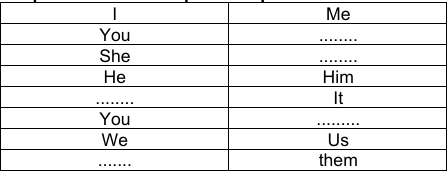
UEMG 2025Complete o quadro com os respectivos pronomes.
Questão 46 14794861
UFU 1 Fase 2025/2The U.S. Centers for Disease Control and Prevention and the National Oceanic and Atmospheric Administration’s National Weather Service launched a new website in April to forecast when people are especially at risk.
Thermometer readings and accompanying humidity levels aren’t the only factors determining safety when it comes to heat, says Aaron Bernstein, director of the National Center for Environmental Health at the CDC. Other important elements include elevated nighttime temperatures, which prevent the body from cooling down; whether hot days are outside of traditionally warm seasons; the duration of the heat (many days versus just one or two); and whether temperatures breach the top 5 percent of the record-high days for a given location.
“A hundred degrees in Boston is not the same as 100 degrees in Houston, when it comes to how heat affects health,” Bernstein says. The disparity flows in part because New England residents are not as accustomed to avoiding the outdoors during the hottest part of the day and because fewer likely have air conditioning in their homes, among other factors. The new forecast tool, called HeatRisk, takes all this into consideration when grading health impacts from heat across the U.S. The tool uses a five-color code ranging from green (no risk) to magenta (extreme risk).
Another important feature is it forecasts seven days. Currently, heat advisories from the National Weather Service are issued just 12 hours before dangerous temperature conditions emerge.
Disponível em: https://www.nationalgeographic.com/. Acesso em: 08 fev. 2025.
According to the text,
I. Americans are probably the ones who suffer the most from extreme heat.
II. Thermometer readings and humidity levels help determine safety in hot conditions.
III. New England residents avoid the outdoors because they have air conditioning at home.
IV. Heat Risk has proved to be an adequate tool to help people avoid heat exposition.
V. Present warnings issued only 12 hours before dangerous temperature conditions are less effective.
Assinale a alternativa que apresenta apenas asserções CORRETAS.
Questão 45 14794856
UFU 1 Fase 2025/2Archaeologists who spent years poring over images of stars and leaves have declared that a cluster of rock-art sites in Venezuela is the center of an ancient and previously unknown culture. 20 prehistoric sites have been identified bearing the motifs, all located in hard-to-access areas of Venezuela’s vast Canaima National Park.
Consisting of pictograms either drawn in red ocher, a natural pigment, or incised into the rock as petroglyphs (rock carvings), the images grace remote boulders, cliff walls, and even rocks located among rapids. They appear only faintly to the naked eye. After extensively photographing the rock art, which was then digitally enhanced using a tool called DStretch, the team learned much more about their style and coloring. They are still waiting to carry out dating studies. Similar art in Venezuela was produced in the early part of the Archaic period of South American history (10,000–3,000 B.C.).
The works studied bear strong stylistic connections with more recent art in neighboring Brazil, the Guianas, and Colombia. According to the archaeologists, this indicates that the newly found cluster in Venezuela was the focal center for a Canaima cultural tradition.
With its tabletop mountains rising thousands of feet above jungles and savannas, Canaima National Park is a challenging terrain to penetrate. Fortunately, innovative tools such as remote sensing and VR technologies can virtually transport researchers into the landscape and lead to the discovery of new sites. Having identified sites in this way, the team then needed a helicopter to physically reach the isolated rock-shelters, which otherwise would have taken a round-trip journey of several weeks on foot. Once in the field, the team deployed drones to get a clearer understanding of the topography and how this remote landscape would have shaped the lives of hunter artists.
Disponível em: https://www.nationalgeographic.com/. Acesso em: 1 fev. 2025.
Sobre a arte rupestre na Venezuela poder ser o sinal de uma cultura antiga perdida, é INCORRETO afirmar que
Questão 46 14773701
UNIFENAS Tarde 2025/2Read the text below.
The future of AI in medicine
The Keck School of Medicine of USC is embracing the power of AI for scientific discovery and health care delivery.
Artificial intelligence (AI) promises to revolutionize medicine, giving us a better understanding of health and disease and the ability to make more decisions based on data.
“It’s not that AI will replace the physician,” said Carolyn Meltzer, MD, dean of the Keck School of Medicine of USC. “It’s that the physician who uses AI will replace the physician who does not use AI.” With the power of AI turning data into knowledge, the Keck School is poised to make major advances on some of the grandest health challenges. With AI, vast amounts of data on everything from genetics and lifestyle to ambient pollution and socioeconomic factors will empower researchers and clinicians to zero in on a patient’s unique risk of disease and the best course of prevention or treatment. A strong partnership with the Viterbi School of Engineering and a diverse surrounding community provide the ingredients for science that may ultimately help millions around the globe.
“This type of knowledge is leading us to the verge of understanding the molecular basis for humankind’s most pressing diseases, which then could lead to cures,” said Steven Shapiro, MD, USC’s senior vice president for health affairs.
To realize this promise, researchers and clinicians must be mindful of inherent bias in many current data sets and intentional in eliminating barriers to diverse populations participating in research.
“Sometimes we have the absence of data on some populations that may not have the social environmental support to have those data points,” said Meltzer. “So this is something we really need to think about.”
At the Keck School, students, clinicians and researchers are ready to deliver on that promise, using AI as one of their tools in taking on the world’s toughest health challenges.
“This is what Keck is about: bold thinking, igniting discovery—and not always following the expected path,” Meltzer said.
Available at: https://keck.usc.edu/news/the-future-of-ai-in-medicine/ . Accessed on March 30th, 2025.
“To realize this promise, researchers and clinicians must be mindful of inherent bias in many current data sets and intentional in eliminating barriers to diverse populations participating in research”.
The use of must in the sentence above indicates
Questão 45 14771284
UECE Específicas 2 Fase 1 Dia 2025/1Alice Munro
[1] Alice Munro (born July 10, 1931,
Wingham, Ontario, Canada—died May 13,
2024, Port Hope, Ontario) was a Canadian
short-story writer who gained international
[5] recognition with her exquisitely drawn
narratives. The Swedish Academy dubbed her a
“master of the contemporary short story”
when it awarded her the Nobel Prize for
Literature in 2013. Munro’s work is noted for
[10] its precise imagery and narrative style, which is
at once lyrical, compelling, economical, and
intense, revealing the depth and complexities
in the emotional lives of everyday people.
Munro was raised on what she called
[15] “this collapsing enterprise of
a fox and mink farm, just beyond the most
disreputable part of town.” Her mother, a
teacher, played a significant role in her life, as
did her great-aunt and her grandmother. She
[20] attended the University of Western Ontario but
left after two years of studying English and
journalism. At age 20, in 1951, she married her
first husband, James Munro, and moved
to Vancouver. She moved again in 1963,
[25] to Victoria, where the couple started a
bookstore and together raised three daughters.
After her first marriage ended in 1972, she
returned to Ontario and settled in Clinton, near
her childhood home, where she lived with her
[30] second husband (married 1976).
Munro had begun writing stories as a
teenager, and she persevered in her attempt to
establish herself as a writer despite years of
rejection from publishers and the limitations
[35] imposed on her career by the responsibilities
of marriage and motherhood. Her first
collection of stories was published as Dance of
the Happy Shades (1968). It is one of three of
her collections—the other two being Who Do
[40] You Think You Are? (1978; also published
as The Beggar Maid: Stories of Flo and Rose)
and The Progress of Love (1986)—awarded the
annual Governor General’s Literary Award for
fiction. Lives of Girls and Women (1971) was
[45] conceived as a novel but developed into a
series of interrelated coming-of-age stories.
Like much of her fiction, the tales capture the
social and cultural milieu of her native
southwestern Ontario. Munro embraced the
[50] mystery, intimacy, and tension of the ordinary
lives of both men and women, rooted in the
uncharted and ambivalent landscape of what
affectionately came to be known as “Munro
country.”
[55] Her later volumes include Something
I’ve Been Meaning to Tell You (1974), The
Moons of Jupiter (1982), Friend of My
Youth (1990), A Wilderness Station (1994),
and The Love of a Good Woman (1998). The
[60] latter volume received
both Canada’s esteemed Giller Prize (later the
Scotiabank Giller Prize) and the National Book
Critics Circle Award in the U.S. Her book Open
Secrets (1994) contains stories that range in
[65] setting from the semicivilized hills of southern
Ontario to the mountains of Albania.
In Runaway (2004) Munro explores the depths
of ordinary lives through the use of temporal
shifts and realistically rendered reminiscences;
[70] it also was awarded the Giller Prize. The View
from Castle Rock (2007) combines history,
family memoir, and fiction into narratives of
questionable inquiries and obscure replies. In
2009 Munro won the Man Booker International
[75] Prize; that same year she published the short
story collection Too Much Happiness.
Like much of her oeuvre, the stories
in Dear Life (2012) were unified by
examinations of sex, love, and death. Four of
[80] the stories in the collection were explicitly
framed as fictionalized autobiography meant
to encapsulate the aging Munro’s feelings
about her life. She told an interviewer
that Dear Life, her 14th collection, would be
[85] her last. She issued several compilations of
previously published material,
including Selected Stories (1996) and Family
Furnishings: Selected Stories, 1995-
2014 (2014).
[90] Munro’s short story about the
domestic erosions of Alzheimer disease, “The
Bear Came over the Mountain,” originally
published in Hateship, Friendship, Courtship,
Loveship, Marriage (2001), was made into the
[95] critically acclaimed film Away from Her (2006),
directed by Sarah Polley and starring Julie
Christie and Gordon Pinsent with Michael
Murphy and Olympia Dukakis. Other
film adaptations of Munro’s work
[100] include Hateship Loveship (2013), which was
based on the title story of her 2001 collection,
and Almodóvar’s Julieta (2016), a mystery-
drama inspired by several stories in Runaway.
With the exception of Canadian-born
[105] American author Saul Bellow (who won the
prize in 1976), Munro was the first Canadian—
as well as the 13th woman—to be named the
Nobel literature laureate.
Adapted from: https://www.britannica.com
As to Munro's achievements, the text mentions that
06