


![[Marketing] Questao Topo - deslogado](https://storage.estuda.com.br/banners/0_6b7ebee90b03af1c560c73bb8bcce34a_banner_deslogado_70_dias.png)
Questões de Inglês
19.971 Questões
Questão 45 1302910
EsPCEx 2° Dia 2019Leia o texto a seguir e responda à questão.
Teaching English in the Brazilian countryside
“In Brazil, countryside youth want to learn about new places, new cultures and people. However, they think their everyday lives are an obstacle to that, because they imagine that country life has nothing to do with other parts of the world”, says Rafael Fonseca. Rafael teaches English in a language school in a cooperative coffee cultivation in Paraguaçu. His learners are the children of rural workers.
Rafael tells us that the objective of the project being developed in the cooperative is to give the young people more opportunities of growth in the countryside, and that includes the ability to communicate with international buyers. “In the future, our project may help overcome the lack of succession in countryside activities because, nowadays, rural workers’ children become lawyers, engineers, teachers, and sometimes even doctors, but those children very rarely want to have a profession related to rural work”, says Rafael.
“That happens”, he adds, “because their parents understand that life in the countryside can be hard work and they do not want to see their children running the same type of life that they have. Their children also believe that life in the country does not allow them to have contact with other parts of the world, meet other people and improve cultural bounds. The program intends to show them that by means of a second language they can travel, communicate with new people and learn about new cultures as a means of promoting and selling what they produce in the country, and that includes receiving visitors in their workplace from abroad.”
Rafael’s strategy is to contextualize the English language and keep learners up-to-date with what happens in the global market. “Integrating relevant topics about countryside living can be transformative in the classroom. The local regional and cultural aspects are a great source of inspiration and learning not only for the young, but for us all.”
Adapted from http://www.cambridge.org/elt/blog/2019/01/21/teaching-english-in-the-brazilian-classroom/
In the sentence “... our project may help overcome the lack of succession in countryside activities...” (paragraph 2), the word overcome means
Questão 9 1302728
EBMSP Medicina 2019/1
According to this quote by Martin Luther King Jr.
Questão 58 1265123
UVV 2019/1The question refer to the comic strip below.
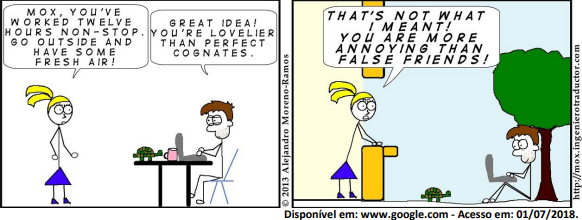
When the woman says “That’s not what I meant!” she voices
Questão 12 1259115
FGV-SP Economia - 1ºFase - LEI/FIS/QUI/LPO - BLOCO 02 2019Read the text in order to answer question.
How to fix inequality
Introduction
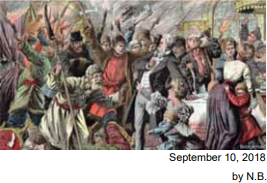
In an age of widening inequality, the Stanford professor Walter Scheidel believes he has cracked the code on how to overcome it in his book “The Great Leveler”. The Economist’s Open Future initiative asked Mr Scheidel to reply to a number of questions.
1. The Economist: Is society incapable of tackling income inequality peacefully?
Walter Scheidel: No, but history shows that there are limits. There is a big difference between maintaining existing arrangements that successfully check inequality — Scandinavia is a good example — and significantly reducing it. The latter requires real change and that is always much harder to do: think of America or Britain, not to mention Brazil, China or India. The modern welfare state does a reasonably good job of compensating for inequality before taxes and transfers. However, for more substantial levelling to occur, the established order needs to be shaken up: the greater the shock to the system, the easier it becomes to reduce privilege at the top.
2. The Economist: Are we really living in an implacable period of wealth inequality — or was the relatively equal society that followed the Second World War the real aberration?
Walter Scheidel: When we view history over the long run, we can see that this experience was certainly a novelty. We now know that modernisation as such does not reliably reduce inequality. Many things had to come together to make this happen, such as very high income and estate taxes, strong labour unions, and intrusive regulations and controls. Since the 1980s, liberalisation and globalisation have allowed inequality to rise again. Even so, wealth concentration in Europe is nowhere near as high as it was a century ago. Like Europe, America, meanwhile, is getting there — which shows that it all depends on where you look.
3. The Economist: How do artificial intelligence and automation fit in to your thinking? Will they be a calamity for employment and thus for equality? Or might they unleash extraordinary productivity and improvements in living standards that actually narrow inequality?
Walter Scheidel: Ideally, we would like education to keep up with technological change to make sure workers have the skills they need to face this challenge. But in practice, there will always be losers, and even basic-income schemes can take us only so far. At the end of the day, someone owns the robots. As long as the capitalist world system is in place, it is hard to see how even huge productivity gains from greater automation would benefit society evenly instead of funnelling even more income and wealth to those who are in the best position to pocket these gains.
(The Economist. http://bit.do/eysic. Adaptado)
In the excerpt from the third question made by The Economist “Or might they unleash extraordinary productivity and improvements in living standards that actually narrow inequality?”, the word in bold can be correctly replaced, without meaning change, by
Questão 5 1252612
ENEM 1° Dia (Amarela) 2019In this life
Sitting on a park bench
Thinking about a friend of mine
He was only twenty-three
Gone before he had his time.
It came without a warning
Didn't want his friends to see him cry
He knew the day was dawning
And I didn't have a chance to say goodbye. .
MADONNA. Erotica. Estados Unidos: Maverick, 1992.
A canção, muitas vezes, é uma forma de manifestar sentimentos e emoções da vida cotidiana.
Por exemplo, o sofrimento retratado nessa canção foi causado
Questão 4 1252603
ENEM 1° Dia (Amarela) 2019LETTER TO THE EDITOR: Sugar fear-mongering unhelpful
By The Washington Times Tuesday, June 25, 2013
In his recent piece “ls obesity a disease?” (Web, June 19), Dr. Peter Lind refers to high-fructose com syrup and other “manufactured sugars” as “poison” that will “guarantee storage of fat in the body.” Current scientific research strongly indicates that obesity results from excessive calorie intake combined with a sedentary lifestyle. The fact is Americans are consuming more total calories now than ever before. According to the U.S. Department of Agriculture, our total per-capita daily caloric intake increased by 22 percent from 2,076 calories per day in 1970 to 2,534 calories per day in 2010 — an additional 458 calories, only 34 of which come from increased added sugar intake. A vast majority of these calories come from increased fats and flour/ cereals. Surprisingly, the amount of caloric sweeteners (ie. sugar, high-fructose, corn syrup, honey, etc.). Americans consume has actually decreased over the past decade. We need to continue to study the obesity epidemic to see what more can be done, but demonizing one specific ingredient accomplishes nothing and raises unnecessary fears that get in the way of real solutions.
JAMES M. RIPPE
Shrewsbury, Mass.
Disponível em: www.washingtontimes.com. Acesso em: 29 jul. 2013 (adaptado).
Ao abordar o assunto “obesidade”, em uma seção de jornal, o autor
06