


![[Marketing] Questao Topo - deslogado](https://storage.estuda.com.br/banners/0_6b7ebee90b03af1c560c73bb8bcce34a_banner_deslogado_70_dias.png)
Questões de Inglês
19.971 Questões
Questão 16 1407889
UEMA PAES 2019Leia o texto a seguir para responder à questão.
TEXTO
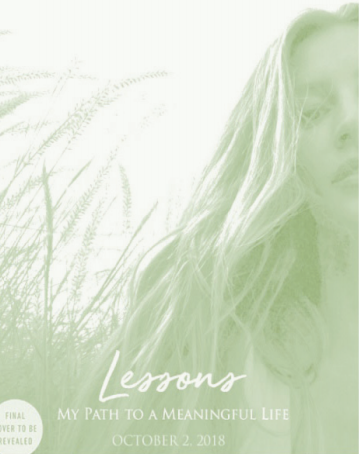
Supermodel Gisele Búndchen took to Instagram on Wednesday to announce her new book, “Lessons: My Path to a Meaningful Life; sharing series of photos from her childhood, modeling career and family.
In this tell-all book, she tells about her life and the lessons she learned along the way. “Im excited to announce the publication of my book, “Lessons: My Path to a Meaningful Life” Looking back on some of the experiences I have lived through these past 37 years, what I've learned, the values that guided me and the tools that have helped me become who | am, has been a profound and transformative experience” the 37-year-old star wrote
“I'm happy I get to share with you my journey through many of the ups and downs that made me who I am today!” she concluded. Bundchen began her modeling career at the age of 14. Since then, she has appeared in more than 2000 magazine covers, 600 campaign ads, and walked in over 800 fashion shows for the top brands in the world. She was the highest paid supermodel for 15 years and decided to retire from the runway in 2015. She's married to the famous quarterback, Tom Brady, and has two children, son Benjamin, 8, and daughter Vivian,5.
Fonte: https://omgcheckitout.com/gisele-bundchen-announces-new-book-lessons-path-meaningful-life
O texto tem por objetivo
Questão 55 1405353
UNIFOR Medicina 2019.1This happened two or three years ago in Indonesia on a business trip... and I was invited to the Area Manager’s house for dinner, which was lovely. I met his wife and children. The kids were terribly sweet. Especially his son was only ten years old. He was so cute! Anyway, I patted the boy on his head … and I noticed that everybody looked embarrassed. I knew I’d done something wrong, but I didn’t know what it was. I learnt afterwards that in Indonesia you must never touch someone’s head, because it’s rude. Anyway, my hosts were really nice and I had an enjoyable evening. In fact, I saw them again earlier this year. Their son is a lot taller now and I can’t even touch his head.
O narrador desse comentário mostra-se impressionado com o fato de, na Indonésia,
Questão 20 1403943
EAM 2019Complete the paragraph below, about Scotland, with the missing articles.
For many vears, Scotland was poor country. But now things are better for most people. There is oil and gas in sea between Scotland and Norway. Edinburgh is important place for money, and there are big banks there, like the Royal Bank of Scotland. Tourists visit this beautiful country and they bring money to Scotland too. Many people love living and working there, and more than 20 million visitors go to Scotland each year.
Now, mark the correct option from top to bottom:
Questão 18 1403928
EAM 2019Read text and answer question.
TEXT

Loch Ness is a lake (or 'loch' in Scottish Gaelic) located in the Highlands of Scotland, near Inverness. People say there is a monster in it, which is called Nessie.
In 1933, George Spicer described that he saw Nessie and it was a “dragon”. It was 4 feet high, 25 feet long and had a long neck.
In 1934, Robert Kenneth Williams took the first photo of the Loch Ness Monster's neck and head. This photo was published in the Daily Mail newspaper in April 1934. Around 1994, the photo was declared to be a hoax.
In 1934, Edward Mountain sent an expedition to Loch Ness from 9 am to 6 pm every day, for 5 weeks. They never found any evidence of the Monster.
In 2003, the BBC TV network made a show that did a detailed search of Loch Ness. They found nothing and concluded that the Monster was a myth.
In the sentence "People say there is a monster in it, which is called Nessie” (lines 2 and 3), the pronoun “it'' refers to
Questão 20 1374883
USS (Univassouras) 2019/2WHAT IS STRESS?
Hans Selye defined stress as the body’s nonspecific response to any demand, whether it is caused by or
results in pleasant or unpleasant stimuli. It is essential to differentiate between the unpleasant or harmful
variety of stress termed distress, which often connotes disease, and eustress, which often connotes
euphoria. During both eustress and distress, the body undergoes virtually the same non-specific responses
[5] to the various positive or negative stimuli acting upon it. However, eustress causes much less damage
than distress. This demonstrates conclusively that it is how an individual accepts stress that determines
ultimately whether the person can adapt successfully to change. Selye hypothesized a General Adaptation
or Stress Syndrome; this General Stress Syndrome affects the whole body. Stress always manifests itself by
a syndrome, a sum of changes, not by simply one change.
[10] There are three components to the General Stress Syndrome. The first stage, which is termed the alarm
stage, represents a mobilization of the body’s defensive forces. In other words, the body is preparing for
the “fight or flight” syndrome. This involves a number of hormones and chemical excreted at high levels,
as well as an increase in heart rate, blood pressure, perspiration, respiration rate, etc. In the second phase
— the stage of resistance — the body becomes adaptive to the challenge and even begins to resist it.
[15] The length of this stage of resistance is dependent upon the body’s innate and stored adaptation energy
reserves and upon the intensity of the stressor. Just as any machine wears out even if it has been properly
maintained, so do living organisms that sooner or later become the victim of this constant wear and tear.
The acquired adaptation is lost if the individual is subject to still greater exposure to the stressor. The
organism enters into the third and final stage —the exhaustion stage — and then dies because it has used
[20] up its resources of adaptation energy. Thankfully, few people ever experience this last stage!
Stress diseases are maladies caused principally by errors in the body’s general adaptation process. They
will not occur when all the body’s regulatory processes are properly checked and balanced. They will not
develop when adaptation is facilitated by improved perception and interpretation. The biggest problems
with derailing the General Stress Syndrome and causing disease is an absolute excess, deficiency,
[25] or disequilibrium in the amount of adaptive hormones — for example, corticoid, ACTH, and growth
hormones produced during stress. Unfortunately, if stress is induced chronically, our defense response
lowers its resistance since fewer antibodies are produced and an inflammatory response dwindles.
Stress is a natural physical and mental reaction to life experiences. Everyone expresses stress from time
to time. Anything from everyday responsibilities like work and family to serious life events such as a
[30] new diagnosis, war, or the death of a loved one can trigger stress. For immediate, short-term situations,
stress can be beneficial to your health. It can help you cope with potentially serious situations. Your body
responds to stress by releasing hormones that increase your heart and breathing rates and ready your
muscles to respond.
Yet if your stress response doesn’t stop firing, and these stress levels stay elevated far longer than is
[35] necessary for survival, it can take a toll on your health.
Excerpt from the text What is Stress?. The American Institute of Stress stress.org, 17/03/2019.
This text is part of the article What is stress?, published on the website of The American Institute of Stress (AIS).
The main objective of this part of the text is to:
Questão 20 1374577
USS (Univassouras) 2019/1WHY THE REFUSAL TO VACCINATE YOUR CHILDREN IS DANGEROUS FOR YOUR ENTIRE COMMUNITY
January 30, 2018 […]
Let’s get a few things out of the way before we begin, so we have a better chance of understanding one
another: I’m a pediatrician who works in a hospital. It’s true that sick kids pay my bills, but I would much
rather that kids never got sick, even if it meant losing my job. (I’m adaptable. I’m sure I’d be OK.)
I’m also a person who thinks that when young people become seriously ill from diseases that might have
[5] otherwise been prevented, it’s a tragedy. Pertussis outbreaks in this country are on the rise; paralytic
polio quickly returned to Syria after immunization rates dropped due to the war; the measles outbreak
currently taking young lives in Europe may now do the same in Texas. When children die of these diseases,
it’s unconscionable.
I am, as you might have guessed, pro-vaccine. I am amazingly grateful that my own children are growing
[10] up in an era in which it is highly unlikely that I will have to watch them die. One hundred years ago, it was
ordinary to lose a child before they reached the age of five. Can you imagine? I don’t even want to. That’s
me, in a nutshell. What about you?
Statistically speaking, I know that you are smart and educated people. You love your children as much
as I love mine. You want what’s best for them. You are not and do not want to be confused with the
[15] unhinged anti-vax bloggers who believe vaccines are part of a government conspiracy to intentionally
injure children. […] You’re normal and rational enough to know that while there is formaldehyde in some
vaccines, it’s also present in pears, which your children have probably enjoyed in both puréed and solid
forms. And you are not, no matter what I say, going to vaccinate your son or daughter just because I think
you should. […]
[20] You understand that these are real and lethal illnesses. Roald Dahl was not lying when he described how
his daughter Olivia, seemingly on the mend from measles, suddenly had trouble moving her hands and
told him she felt “all sleepy.” Hours later, she was dead.
Medicine has progressed in leaps and bounds since Olivia died in 1962, but even so, treatment for measles
remains supportive — there are no medicines that can cure the virus itself, and the more severe cases will
[25] still result in death. […]
Do what you believe is best for your family, but if that means not vaccinating, I’m imploring you to keep it
to yourself. Otherwise, you are putting your children at increased risk. Steer clear of private schools where
immunization rates are so low that infections would spread right through the entire community like wildfire.
Don’t click on articles by anti-vax conspiracy theorists just so you can feel validated in your worldview.
[30] My children don’t enjoy getting jabbed, but they get their shots with a normal degree of grumbling. […] I
hope enough people in your community feel the same as I do and will create a protective bubble around
your own children, even if you’re not willing to do so for theirs. Appreciate that gift for what it is. Don’t
poke the bubble, or it might pop. Instead, consider saying thank you.
Sincerely,
Meghan MacLean Weir, MD
Meghan MacLean Weir is a pediatrician and the author of Between Expectations: Lessons From a Pediatric Residency and the upcoming novel The Book of Essie.
www.lennyletter.com
In the last paragraph, the author uses the metaphor of a bubble to conclude her text.
The bubble metaphor implies that
06