


![[Marketing] Questao Topo - deslogado](https://storage.estuda.com.br/banners/0_6b7ebee90b03af1c560c73bb8bcce34a_banner_deslogado_70_dias.png)
Questões de Inglês
19.971 Questões
Questão 19 39188
UFMT 2009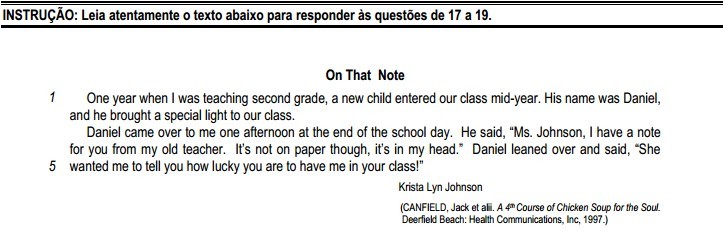
Em relação aos recursos lingüísticos utilizados no texto, assinale a afirmativa correta.
Questão 18 39186
UFMT 2009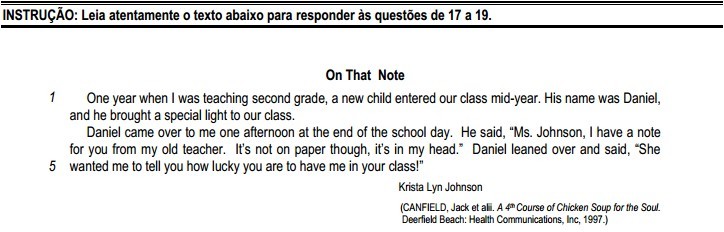
INSTRUÇÃO: Leia atentamente o texto abaixo para responder à questão.
On That Note
[1] One year when | was teaching second grade, a new child entered our class mid-year. His name was Daniel,
and he brought a special light to our class.
Daniel came over to me one afternoon at the end of the school day. He said, “Ms. Johnson, | have a note
for you from my old teacher. It's not on paper though, it's in my head.” Daniel leaned over and said, “She
[5] wanted me to tell you how lucky you are to have me in your class!"
Krista Lyn Johnson
(CANFIELD, Jack et ali. A 4º Course of Chicken Soup for the Soul Deerheid Beach: Heaih Communications. inc, 1997.)
A fala de Daniel revela que ele pretende
Questão 6 14038228
UEG Conhecimentos Gerais 2008/2TEXTO
Leia o poema abaixo. A questão faz referência a ele.
TRUE BEAUTY IS NOT SEEN
(Glaedr the poet)
Where does the true beauty lie?
Within the heart, not the eye
The eye deceives and the eye is blind
It is the soul where answers you will find
Not to search beyond the skin; a disgrace
The beauty within, not upon a face
But what is beauty? It is falsely termed
Beauty is not born, Beauty it is earned
Carry the true beauty within your heart
Never from your lips let anger depart
Within people you trust, always confide
And always search for the beauty, that lies inside
Disponível em: http://www.poemhunter.com/poem/true-beauty-is-not-seen/. Acesso em: 17 mar. 2008.
De acordo com este poema, É INCORRETO afirmar:
Questão 48 2338987
EMESCAM Prova 2 2008/1Reaching the poor with eye services. Experiences from the family practice unit, Manaus County, Brazil
Paulo Roberto de Magalhães Silva
Blindness is often concentrated in poor areas and socially deprived communities, making blindness prevention a social and political challenge. The blindness prevention program at the Family Practice Unit in Manaus County, Brazil, has developed a model to reach patients through the public health system. The approach aims to detect patients in the community and refer them to ophthalmologists based at the clinic. Two ophthalmologists work with family practitioners and community health workers to whom they provide training on how to screen and refer patients. Barriers such as distance, culture, costs, and lack of information are broken down with this approach.
Between the years 2000 and 2003, 15.129 patients were seen at the ophthalmology service of the Family Practice Programme in the city of Manaus. The projection for the year 2004 is 8.640 consultations among the four centers distributed at the north, south, east and west areas of the city. In 2003, 110 diabetic patients sent by family practitioners and community health workers were evaluated, demonstrating the need to improve the screening of diabetic patients in the city. Refractive errors were the reason for consultation in 80 per cent of the patients during 2000-2003. Conjunctivitis, eyelid problems, cataract, and glaucoma were other frequent causes of consultation. Only 6.8 per cent of the patients seen at the unit were referred to the general hospital for further diagnosis and treatment.
Demand for eye care services in this area has increased continuously since the start of this programme. The location of the unit in the community, the focus of the clinic on the poor, and the emphasis on information, seem to have created an efficient and popular service. Brazil has about 50 million people assigned to these Family Practice Units by the Public Health System. If each unit had an ophthalmology service like Manaus, Brazil could make a great impact on prevention of blindness at the community level. The model might also be applicable to other countries.
De acordo com o texto acima...
De todos os pacientes examinados na clínica, __________.
Questão 42 2338926
EMESCAM Prova 2 2008/1Reaching the poor with eye services. Experiences from the family practice unit, Manaus County, Brazil
Paulo Roberto de Magalhães Silva
Blindness is often concentrated in poor areas and socially deprived communities, making blindness prevention a social and political challenge. The blindness prevention program at the Family Practice Unit in Manaus County, Brazil, has developed a model to reach patients through the public health system. The approach aims to detect patients in the community and refer them to ophthalmologists based at the clinic. Two ophthalmologists work with family practitioners and community health workers to whom they provide training on how to screen and refer patients. Barriers such as distance, culture, costs, and lack of information are broken down with this approach.
Between the years 2000 and 2003, 15.129 patients were seen at the ophthalmology service of the Family Practice Programme in the city of Manaus. The projection for the year 2004 is 8.640 consultations among the four centers distributed at the north, south, east and west areas of the city. In 2003, 110 diabetic patients sent by family practitioners and community health workers were evaluated, demonstrating the need to improve the screening of diabetic patients in the city. Refractive errors were the reason for consultation in 80 per cent of the patients during 2000-2003. Conjunctivitis, eyelid problems, cataract, and glaucoma were other frequent causes of consultation. Only 6.8 per cent of the patients seen at the unit were referred to the general hospital for further diagnosis and treatment.
Demand for eye care services in this area has increased continuously since the start of this programme. The location of the unit in the community, the focus of the clinic on the poor, and the emphasis on information, seem to have created an efficient and popular service. Brazil has about 50 million people assigned to these Family Practice Units by the Public Health System. If each unit had an ophthalmology service like Manaus, Brazil could make a great impact on prevention of blindness at the community level. The model might also be applicable to other countries.
De acordo com o texto acima...
Em Manaus, foi desenvolvida uma estratégia para __________.
Questão 42 2326100
EMESCAM Prova 2 2008/2F.D.A. Panel Votes to Continue Use of Anemia Drugs
ANDREW POLLACK
A federal advisory panel, in response to mounting safety concerns, called Thursday for additional restrictions on the use of anemia drugs by cancer patients.
The recommendation by a committee that advises the Food and Drug Administration could lead to an additional decline in sales for the drugs: Aranesp, made by Amgen, and Procrit, made by Johnson & Johnson.
But the manufacturers avoided the outcome they most feared — a recommendation that the drugs not be used by any cancer patients. That probably would have cost each company at least $1 billion in sales.
"They dodged the really big bullet, but they still took some damage," said Geoffrey C. Porges, a biotechnology analyst at Sanford C. Bernstein & Co.
The F.D.A. is expected to revise the drugs' labels in consultation with the manufacturers. The agency does not have to adhere to the recommendations of its committees, though it usually does.
Patients take the drugs to counter the anemia caused by chemotherapy. The meeting was held because clinical trials have suggested the drugs might worsen some cancers. However, those studies involved doses higher than those typically used by patients.
The companies argued that it was not clear the drugs were dangerous and that they should remain available because they help patients avoid blood transfusions, which carry their own risks.
From: Times Digest, March 14, 2008.
De acordo com o texto acima...
A decisão tomada foi: __________.
06