


![[Marketing] Questao Topo - deslogado](https://storage.estuda.com.br/banners/0_6b7ebee90b03af1c560c73bb8bcce34a_banner_deslogado_70_dias.png)
Questões de Inglês
19.971 Questões
Questão 43 48791
ESPM 2009/2
A BETTER DEAL ON MALARIA
Novartis is breaking even selling Coartem. But it chose to lose money to save more lives.
For the past nine years, the drug company Novartis has been selling Coartem, one of the most effective antimalarials on the market, to public-health officials in the developing world at a loss totaling more than $253 million - not counting the millions spent on Research & Development. That’s added up, the firm reports, to more than 550,000 lives saved. In late January, the company unveiled the first pediatric dose of Coartem – less bitter and easier to swallow than the adult version - which is expected to help in the battle against a disease that kills more than 700,000 children under 5 each year. (…) “Novartis could be making a lot more money making hypertension or diabetes medications that the people in the U.S. and Europe would buy,” says Awa Coll-Seck, executive director of Roll Back Malaria, a global partnership founded with the goal of halving the world’s malaria cases by 2010. “Instead, it’s investing real funds in finding medicines that will never be profitable.”
Though malaria is both preventable and curable, many of those in the developing world struggle to get affordable treatment, particularly in sub-Saharan Africa, where the mosquito-borne disease is most prevalent.(Time, March 9, 2009)
According to the text, “affordable” most likely refers to:
Questão 49 48717
ESPM 2009/1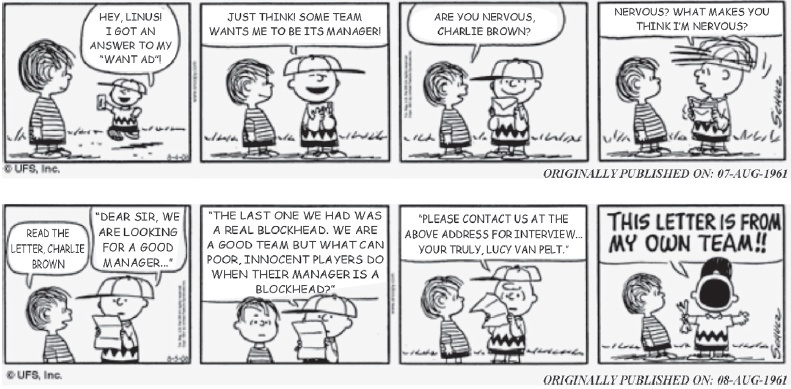
According to the first comic strip it is wrong to state that
Questão 48 48716
ESPM 2009/1Everyone knows industry needs oil.
Now people are worrying about water, too
“Water is the oil of the 21st century,” declares Andrew Liveris, the chief executive of Dow, a chemical company. Like oil, water is a critical lubricant of the global economy. And as with oil, supplies of water – at least, the clean, easily accessible sort – are coming under enormous strain because of the growing global population and an emerging middleclass in Asia that hankers for the water-intensive life enjoyed by people in the West.
Oil prices have fallen from their recent peaks, but concerns about the availability of freshwater show no sign of abating. Goldman Sachs, an investment bank, estimates that global water consumption is doubling every 20 years, which it calls an “unsustainable” rate of growth. Water, unlike oil, has no substitute. Climate change is altering the patterns of freshwater availability in complex ways that can lead to more frequent and severe droughts.
Untrammeled industrialization, particularly in poor countries, is contaminating rivers and aquifers. America’s generous subsidies for biofuels have increased the harvest of water-intensive crops that are now used for energy as well as food. And heavy subsidies for water in most parts of the world mean it is often grossly underpriced - and hence squandered.
All of this poses a problem, first and foremost, for human welfare. At the annual World Water Week conference in Stockholm this week, delegates focused on measures to extend access to clean water and sanitation to the world’s poor. But it also poses a problem for industry. “For business, water is not discretionary,” says Dominic Waughray of the World Economic Forum, a think-tank. “Without it, industry and the global economy falter.”
Water is an essential ingredient in many of the products that line supermarket shelves. JPMorgan, a bank, reckons that five big food and beverage giants-Nestlé, Unilever, Coca-Cola, Anheuser-Busch and Danone – consume almost 575 billion litres of water a year, enough to satisfy the daily water needs of every person on the planet.(The Economist, August 23rd-29th 2008)
When Dominic Waughray says: “Without it, industry and the global economy falter.” he most likely means that without water:
Questão 46 48714
ESPM 2009/1Everyone knows industry needs oil.
Now people are worrying about water, too
“Water is the oil of the 21st century,” declares Andrew Liveris, the chief executive of Dow, a chemical company. Like oil, water is a critical lubricant of the global economy. And as with oil, supplies of water – at least, the clean, easily accessible sort – are coming under enormous strain because of the growing global population and an emerging middleclass in Asia that hankers for the water-intensive life enjoyed by people in the West.
Oil prices have fallen from their recent peaks, but concerns about the availability of freshwater show no sign of abating. Goldman Sachs, an investment bank, estimates that global water consumption is doubling every 20 years, which it calls an “unsustainable” rate of growth. Water, unlike oil, has no substitute. Climate change is altering the patterns of freshwater availability in complex ways that can lead to more frequent and severe droughts.
Untrammeled industrialization, particularly in poor countries, is contaminating rivers and aquifers. America’s generous subsidies for biofuels have increased the harvest of water-intensive crops that are now used for energy as well as food. And heavy subsidies for water in most parts of the world mean it is often grossly underpriced - and hence squandered.
All of this poses a problem, first and foremost, for human welfare. At the annual World Water Week conference in Stockholm this week, delegates focused on measures to extend access to clean water and sanitation to the world’s poor. But it also poses a problem for industry. “For business, water is not discretionary,” says Dominic Waughray of the World Economic Forum, a think-tank. “Without it, industry and the global economy falter.”
Water is an essential ingredient in many of the products that line supermarket shelves. JPMorgan, a bank, reckons that five big food and beverage giants-Nestlé, Unilever, Coca-Cola, Anheuser-Busch and Danone – consume almost 575 billion litres of water a year, enough to satisfy the daily water needs of every person on the planet.
(The Economist, August 23rd-29th 2008)
According to the text:
Questão 45 48713
ESPM 2009/1Everyone knows industry needs oil.
Now people are worrying about water, too
“Water is the oil of the 21st century,” declares Andrew Liveris, the chief executive of Dow, a chemical company. Like oil, water is a critical lubricant of the global economy. And as with oil, supplies of water – at least, the clean, easily accessible sort – are coming under enormous strain because of the growing global population and an emerging middleclass in Asia that hankers for the water-intensive life enjoyed by people in the West.
Oil prices have fallen from their recent peaks, but concerns about the availability of freshwater show no sign of abating. Goldman Sachs, an investment bank, estimates that global water consumption is doubling every 20 years, which it calls an “unsustainable” rate of growth. Water, unlike oil, has no substitute. Climate change is altering the patterns of freshwater availability in complex ways that can lead to more frequent and severe droughts.
Untrammeled industrialization, particularly in poor countries, is contaminating rivers and aquifers. America’s generous subsidies for biofuels have increased the harvest of water-intensive crops that are now used for energy as well as food. And heavy subsidies for water in most parts of the world mean it is often grossly underpriced - and hence squandered.
All of this poses a problem, first and foremost, for human welfare. At the annual World Water Week conference in Stockholm this week, delegates focused on measures to extend access to clean water and sanitation to the world’s poor. But it also poses a problem for industry. “For business, water is not discretionary,” says Dominic Waughray of the World Economic Forum, a think-tank. “Without it, industry and the global economy falter.”
Water is an essential ingredient in many of the products that line supermarket shelves. JPMorgan, a bank, reckons that five big food and beverage giants-Nestlé, Unilever, Coca-Cola, Anheuser-Busch and Danone – consume almost 575 billion litres of water a year, enough to satisfy the daily water needs of every person on the planet.(The Economist, August 23rd-29th 2008)
When Andrew Liveris declares “Water is the oil of the 21st century,” he most likely means that:
Questão 38 48575
UFMG 1ª Fase 2009Salt
What substance is essential to life but can damage your health
if taken in excess? What has been used as money and has been
the cause of bitter warfare? What is so important to our culture
that references to it abound in every language around the globe?
[5] Nothing less than salt — that white granular seasoning found on
virtually every dining table.
Although current nutritional advice warns against consuming
too much salt, without it we would die. In addition, salt is one
of the most effective and widely used food preservatives and its
[10] industrial uses are innumerable. Indeed, salt is vitally important to
agriculture, snow and ice control, water conditioning, the chemical
industry, metals production — to name just a few!
Salt has a fascinating history and references to it are common
since writing began. Some 2,700 years BC the Peng-Tzao-Kan-Mu
[15] was published in China. This is probably the earliest known treatise
on pharmacology. A major portion of this writing is devoted to
a discussion of more than 40 kinds of salt. The treatise includes
descriptions of two methods of extracting salt and adapting it to a
usable form. The ancient Chinese methods for obtaining salt are
[20] amazingly similar to processes still in use today.
Salt has also been of crucial economic importance. In some
parts of the world, salt was minted into coins and deemed to be as
valuable as gold. The ancient Greeks traded salt for slaves, giving
rise to the phrase “not worth his salt” to describe someone who
[25] is lazy or does not work hard. The beautiful Italian city of Venice
was built on revenue from the salt trade. Roman soldiers were
partially paid in the mineral known as “salarium argentum”, out
of which comes the common English word “salary”. References
to salt abound in languages around the globe, especially where
[30] salt is important to food. From the Latin “sal”, for example, come
such words for preserved foods as “sauce” and “sausage”.
Costin, Helen. Modern English Digest, 2005. v. 3, p. 8-11. (Adapted)
From the text, we can infer that salt
06