


![[Marketing] Questao Topo - deslogado](https://storage.estuda.com.br/banners/0_6b7ebee90b03af1c560c73bb8bcce34a_banner_deslogado_70_dias.png)
Questões de Inglês
19.971 Questões
Questão 39 1366607
UFAL 2009Man versus machine
Attempts to develop speech-recognition technology appear to be based on the questionable assumption that nearly every caller would opt to speak to a real person rather than a machine (Hello, HAL, “by John Searbrook, June 23rd). However, an infinitely patient machine can be available twenty-four hours a day, every day, and it poses no social risks, such as self-consciousness or embarrassment. In a test we conducted, pitting machine against real-person conversation, participants completed a brief personality survey and were then asked to choose one of three ways to organize their thoughts about their survey experience: interacting online with participants, interacting with chatterbots, or private typing. We found that while most of our participants – forty-two per cent – chose real person interaction, thirty-eight per cent chose machine (chatterbot) conversation. Follow-up experiments and analyses showed that the machine preference was stable and could not be attributed to participants’ mood, to their perception of textmessaging difficulty, or to the novelty of a chatterbot. Some of us would rather stick to automation, whatever its limitations.
(The New Yorker, August 4, 2008, p. 5)
The author asserts that most people would rather stick to automation
Questão 37 1366605
UFAL 2009Man versus machine
Attempts to develop speech-recognition technology appear to be based on the questionable assumption that nearly every caller would opt to speak to a real person rather than a machine (Hello, HAL, “by John Searbrook, June 23rd). However, an infinitely patient machine can be available twenty-four hours a day, every day, and it poses no social risks, such as self-consciousness or embarrassment. In a test we conducted, pitting machine against real-person conversation, participants completed a brief personality survey and were then asked to choose one of three ways to organize their thoughts about their survey experience: interacting online with participants, interacting with chatterbots, or private typing. We found that while most of our participants – forty-two per cent – chose real person interaction, thirty-eight per cent chose machine (chatterbot) conversation. Follow-up experiments and analyses showed that the machine preference was stable and could not be attributed to participants’ mood, to their perception of textmessaging difficulty, or to the novelty of a chatterbot. Some of us would rather stick to automation, whatever its limitations.
(The New Yorker, August 4, 2008, p. 5)
Machines
Questão 36 1366604
UFAL 2009Man versus machine
Attempts to develop speech-recognition technology appear to be based on the questionable assumption that nearly every caller would opt to speak to a real person rather than a machine (Hello, HAL, “by John Searbrook, June 23rd). However, an infinitely patient machine can be available twenty-four hours a day, every day, and it poses no social risks, such as self-consciousness or embarrassment. In a test we conducted, pitting machine against real-person conversation, participants completed a brief personality survey and were then asked to choose one of three ways to organize their thoughts about their survey experience: interacting online with participants, interacting with chatterbots, or private typing. We found that while most of our participants – forty-two per cent – chose real person interaction, thirty-eight per cent chose machine (chatterbot) conversation. Follow-up experiments and analyses showed that the machine preference was stable and could not be attributed to participants’ mood, to their perception of textmessaging difficulty, or to the novelty of a chatterbot. Some of us would rather stick to automation, whatever its limitations.
(The New Yorker, August 4, 2008, p. 5)
The development of speech-recognition technology
Questão 10 1361145
AFA 2009Read the cartoon and answer question according to it.
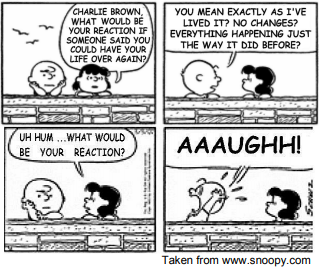
The cartoons also show that Charlie Brown
Questão 31 1336726
IFAL 2009/2“Sedentarism is an independent risk factor for coronary heart disease, osteoporosis, and cancer. However, it still lacks a consensual definition. Also unclear are the activities that differentiate active from sedentary people. In previous reports, sedentarism has been defined according to total energy expenditure or according to energy expended in walking, climbing stairs, and engaging in sports; in performing leisure-time activities, and in performing vigorous activities. Occupational activities have usually not been evaluated, despite their importance. To improve the possibility of comparisons across studies, we must establish a definition of sedentarism that will allow universal use.
A report of the US surgeon general suggests that such a definition may be based on total energy expenditure: an increase in daily energy expenditure of approximately 150 kcal is associated with substantial health benefits, and the activity does not need to be vigorous to produce benefits. We used this conclusion as a basis for defining active persons as those expending at least 150 kcal per day in moderateintensity activities; individuals expending less than this amount were defined as sedentary.
However, the amount of kilocalories expended depends on an individual’s basal metabolism rate and on the duration and intensity of the activity. For example, approximately 150 kcal will be expended during 40 minutes of brisk walking for an average adult woman but only 30 minutes for an average adult man. The surgeon general’s report defines moderate-intensity activities as those expending 3 to 5 metabolic equivalents, which is approximately 3 to 5 times the basal metabolism rate. For example, walking normally and engaging in household work expend 3 times the basal metabolism rate, while walking briskly and playing table tennis expend 4 times the basal metabolism rate. In the present study, we defined moderate activities as those expending 4 times or more the basal metabolism rate.
It is currently recommended that every adult accumulate 30 minutes or more of moderate- intensity physical activity on most- and preferably all-days of the week. However, the moderate activities that would involve the greatest adherence among people older than 35 years still need to be determined.
The present study had 2 goals. The first was to formulate, independent of the method used to calculate daily energy expenditure, a precise definition of sedentarism that would be applicable to individuals of all ages and basal metabolism rates and to both sexes. The second goal was to identify moderate- and high-intensity activities performed by active people that could be suggested in preventive guidelines. The rationale is that activities most frequently performed by active people can reasonably be adopted by a large fraction of their sedentary peers.”
(fonte : http: //www.ajph.org/cgi/reprint/89/6/862.pdf)
Tick the sentence that is true, according to the text:
Questão 30 1336724
IFAL 2009/2“Sedentarism is an independent risk factor for coronary heart disease, osteoporosis, and cancer. However, it still lacks a consensual definition. Also unclear are the activities that differentiate active from sedentary people. In previous reports, sedentarism has been defined according to total energy expenditure or according to energy expended in walking, climbing stairs, and engaging in sports; in performing leisure-time activities, and in performing vigorous activities. Occupational activities have usually not been evaluated, despite their importance. To improve the possibility of comparisons across studies, we must establish a definition of sedentarism that will allow universal use.
A report of the US surgeon general suggests that such a definition may be based on total energy expenditure: an increase in daily energy expenditure of approximately 150 kcal is associated with substantial health benefits, and the activity does not need to be vigorous to produce benefits. We used this conclusion as a basis for defining active persons as those expending at least 150 kcal per day in moderateintensity activities; individuals expending less than this amount were defined as sedentary.
However, the amount of kilocalories expended depends on an individual’s basal metabolism rate and on the duration and intensity of the activity. For example, approximately 150 kcal will be expended during 40 minutes of brisk walking for an average adult woman but only 30 minutes for an average adult man. The surgeon general’s report defines moderate-intensity activities as those expending 3 to 5 metabolic equivalents, which is approximately 3 to 5 times the basal metabolism rate. For example, walking normally and engaging in household work expend 3 times the basal metabolism rate, while walking briskly and playing table tennis expend 4 times the basal metabolism rate. In the present study, we defined moderate activities as those expending 4 times or more the basal metabolism rate.
It is currently recommended that every adult accumulate 30 minutes or more of moderate- intensity physical activity on most- and preferably all-days of the week. However, the moderate activities that would involve the greatest adherence among people older than 35 years still need to be determined.
The present study had 2 goals. The first was to formulate, independent of the method used to calculate daily energy expenditure, a precise definition of sedentarism that would be applicable to individuals of all ages and basal metabolism rates and to both sexes. The second goal was to identify moderate- and high-intensity activities performed by active people that could be suggested in preventive guidelines. The rationale is that activities most frequently performed by active people can reasonably be adopted by a large fraction of their sedentary peers.”
(fonte : http: //www.ajph.org/cgi/reprint/89/6/862.pdf)
Tick the sentence that is true, according to the text:
06