


![[Marketing] Questao Topo - deslogado](https://storage.estuda.com.br/banners/0_6b7ebee90b03af1c560c73bb8bcce34a_banner_deslogado_70_dias.png)
Questões de Inglês
19.971 Questões
Questão 50 8866563
UFMA 2009Green Light for New Particle Accelerator
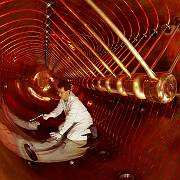
One way to figure
out what might have
happened during the Big
Bang — that massive
[5] explosion of matter and
energy that physicists
think might have marked
the birth of the universe —
is to spend hours in front
[10] of a chalkboard working
through massively complicated formulae.
The other, of course, is to go out and create a
Big Bang yourself. That is the route to be taken by
German researchers along with their particle physics
[15] colleagues from over a dozen countries around the
world. On Wednesday, those participating in the
project will sign an agreement which will eventually
result in the construction of a massive new particle
accelerator in the western German city of Darmstadt.
[20] The goal is to discover new data about the birth of our
universe.
"The substance we will be making resembles
that in the first microseconds of the Big Bang, when it
was a million times hotter than the center of the sun.
[25] We're talking a million times 10 million degrees
Celsius", says Horst Stöcker, scientific director of the
German Society for Heavy Ion Research (GSI).
The project will cost a total of €1.2 billion ($1.7
billion) with the German government set to pick up 65
[30] percent of the price tag. The rest will come from the
state of Hesse and from the project's international
partners, which include Russia, India, Italy, Poland
and China among others. The accelerator itself will
have a circumference of over a kilometer and will be
[35] built 17 meters underground.
http://www.spiegel.de/international/germany/0,1518,druck-515900,00.html
Considering that “Hotter than” is the comparative of “Hot”, what are the comparative forms of the following adjectives: massive, complicated, new?
Questão 40 7551164
UFGD 2009Leia o texto a seguir.
“The cultural wealth of the world is its diversity in dialogue”
The UNESCO Universal Declaration on Cultural Diversity was adopted unanimously in a most unusual context. It came in the wake of the events of 11September 2001, at the UNESCO General Conference, which was the meeting for its 31st session, was the first ministerial-level meeting to be held after those terrible events. It was an opportunity for States to reaffirm their conviction that intercultural dialogue is the best guarantee of peace and to reject outright the theory of the inevitable clash of cultures and civilizations. Such a wideranging instrument is a first for the international community. It raises cultural diversity to the level of “the common heritage of humanity”,“as necessary for humankind as biodiversity is for nature” and makes its defence an ethical imperative indissociable from respect for the dignity of the individual. The Declaration aims both to preserve cultural diversity as a living, and thus renewable treasure that must not be perceived as being unchanging heritage but as a process guaranteeing the survival of humanity; and to prevent segregation and fundamentalism which, in the name of cultural differences, would sanctify those differences and so counter the message of the Universal Declaration of Human Rights. The Universal Declaration makes it clear that each individual must acknowledge not only otherness in all its forms but also the plurality of his or her own identity, within societies that are themselves plural. Only in this way can cultural diversity be preserved as an adaptive process and as a capacity for expression, creation and innovation. The debate between those countries which would like to defend cultural goods and services “which, as vectors of identity, values and meaning, must not be treated as mere commodities or consumer goods”, and those which would hope to promote cultural rights has thus been surpassed, with the two approaches brought together by the Declaration, which has highlighted the causal link uniting two complementary attitudes. One cannot exist without the other.The Declaration, accompanied by the main lines of an action plan, can be an outstanding tool for development, capable of humanizing globalization. Of course, it lays down not instructions but general guidelines to be turned into groundbreaking policies by Member States in their specific contexts, in partnership with the private sector and civil society. This Declaration, which sets against inward-looking fundamentalism, is the prospect of a more open, creative and democratic world, and also, now, one of the founding texts of the new ethics promoted by UNESCO in the early twenty-first century. My hope is that one day it may acquire the same force as the Universal Declaration of Human Rights.
Koïchiro Matsuura
Director-General
Disponível em: <http://unesdoc.unesco.org/images/0012/001271/127160m.pdf>. Acesso em: 09/12/2008.
Escolha a alternativa que contenha os melhores correspondentes em português para as seguintes palavras: outright, wide-ranging, imperative, goods, outstanding, policies.
Questão 36 7342966
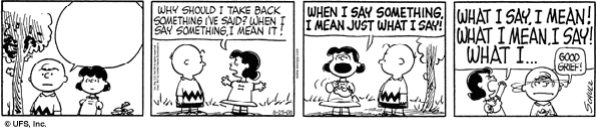
UNITAU Demais cursos 2009Leia a história em quadrinhos abaixo e assinale a alternativa que indica o texto que pode corretamente preencher o balão do primeiro quadro:
Quadro - A
Questão 35 7342963
UNITAU Demais cursos 2009Dark Knight Shift: Why Batman Could Exist--But Not for Long
Q&A with movement researcher E. Paul Zehr
By JR Minkel
Batman is the most down-to-earth of all the superheroes. He has no special powers from being born on a distant world or bitten by a radioactive spider. All that protects him from the Joker and other Gotham City villains are his wits and a physique shaped by years of training—combined with the vast fortune to reach his maximum potential and augment himself with Batmobiles, Batcables and other Bat-goodies, of course. In the 2005 blockbuster Batman Begins, vengeful Bruce Wayne (played by Christian Bale) hones his killer instincts in the streets for seven years before landing himself in a Bhutanese prison, where he falls in with the mysterious League of Shadows, who teach him the way of the ninja. The Dark Knight, the next movie in the Batman franchise, opens in theaters Friday. To investigate whether someone like Bruce Wayne could physically transform himself into a one-man wrecking crew, ScientificAmerican.com turned to E. Paul Zehr, associate professor of kinesiology and neuroscience at the University of Victoria in British Columbia and a 26-year practitioner of Chito-Ryu karate-do. Zehr's book, Becoming Batman: The Possibility of a Superhero (The John Hopkins University Press), due out in October, tackles our very question. An edited transcript of the conversation follows.
What have comic books and movies told us about Batman's physical abilities?
There's a quote from Neal Adams, the great Batman illustrator, who said Batman would win, place or show in every event in the Olympics. Probably if I were Batman's handler, I'd put him in the decathlon. Although Batman is shown in the comics as being the fastest and the strongest and all these other things, in reality you can't actually be all of that at once. To be Batman properly, what you really need to do is be exceptionally good at many different things. It's when you take all the pieces and put them together that you get the Batman.
What's most plausible about portrayals of Batman's skills?
You could train somebody to be a tremendous athlete and to have a significant martial arts background, and also to use some of the gear that he has, which requires a lot of physical prowess. Most of what you see there is feasible to the extent that somebody could be trained to that extreme. We're seeing that kind of thing in less than a month in the Olympics.
What's less realistic?
A great example is in the movies where Batman is fighting multiple opponents and all of a sudden he's taking on 10 people. If you just estimate how fast somebody could punch and kick, and how many times you could hit one person in a second, you wind up with numbers like five or six. This doesn't mean you could fight four or five people. But it's also hard for four or five people to simultaneously attack somebody, because they get in each other's way. More realistic is a couple of attackers.
http:// www.sciam.com/article.cfm?id+dark-knight-shift-why-bat , acesso em 16 de set., 2008
De acordo com o texto, a característica menos realista do Batman é:
Questão 33 7342952
UNITAU Demais cursos 2009Dark Knight Shift: Why Batman Could Exist--But Not for Long
Q&A with movement researcher E. Paul Zehr
By JR Minkel
Batman is the most down-to-earth of all the superheroes. He has no special powers from being born on a distant world or bitten by a radioactive spider. All that protects him from the Joker and other Gotham City villains are his wits and a physique shaped by years of training—combined with the vast fortune to reach his maximum potential and augment himself with Batmobiles, Batcables and other Bat-goodies, of course. In the 2005 blockbuster Batman Begins, vengeful Bruce Wayne (played by Christian Bale) hones his killer instincts in the streets for seven years before landing himself in a Bhutanese prison, where he falls in with the mysterious League of Shadows, who teach him the way of the ninja. The Dark Knight, the next movie in the Batman franchise, opens in theaters Friday. To investigate whether someone like Bruce Wayne could physically transform himself into a one-man wrecking crew, ScientificAmerican.com turned to E. Paul Zehr, associate professor of kinesiology and neuroscience at the University of Victoria in British Columbia and a 26-year practitioner of Chito-Ryu karate-do. Zehr's book, Becoming Batman: The Possibility of a Superhero (The John Hopkins University Press), due out in October, tackles our very question. An edited transcript of the conversation follows.
What have comic books and movies told us about Batman's physical abilities?
There's a quote from Neal Adams, the great Batman illustrator, who said Batman would win, place or show in every event in the Olympics. Probably if I were Batman's handler, I'd put him in the decathlon. Although Batman is shown in the comics as being the fastest and the strongest and all these other things, in reality you can't actually be all of that at once. To be Batman properly, what you really need to do is be exceptionally good at many different things. It's when you take all the pieces and put them together that you get the Batman.
What's most plausible about portrayals of Batman's skills?
You could train somebody to be a tremendous athlete and to have a significant martial arts background, and also to use some of the gear that he has, which requires a lot of physical prowess. Most of what you see there is feasible to the extent that somebody could be trained to that extreme. We're seeing that kind of thing in less than a month in the Olympics.
What's less realistic?
A great example is in the movies where Batman is fighting multiple opponents and all of a sudden he's taking on 10 people. If you just estimate how fast somebody could punch and kick, and how many times you could hit one person in a second, you wind up with numbers like five or six. This doesn't mean you could fight four or five people. But it's also hard for four or five people to simultaneously attack somebody, because they get in each other's way. More realistic is a couple of attackers.
http:// www.sciam.com/article.cfm?id+dark-knight-shift-why-bat , acesso em 16 de set., 2008
Assinale a alternativa cuja informação não está contida no texto.
Questão 31 7342945
UNITAU Demais cursos 2009Dark Knight Shift: Why Batman Could Exist--But Not for Long
Q&A with movement researcher E. Paul Zehr
By JR Minkel
Batman is the most down-to-earth of all the superheroes. He has no special powers from being born on a distant world or bitten by a radioactive spider. All that protects him from the Joker and other Gotham City villains are his wits and a physique shaped by years of training—combined with the vast fortune to reach his maximum potential and augment himself with Batmobiles, Batcables and other Bat-goodies, of course. In the 2005 blockbuster Batman Begins, vengeful Bruce Wayne (played by Christian Bale) hones his killer instincts in the streets for seven years before landing himself in a Bhutanese prison, where he falls in with the mysterious League of Shadows, who teach him the way of the ninja. The Dark Knight, the next movie in the Batman franchise, opens in theaters Friday. To investigate whether someone like Bruce Wayne could physically transform himself into a one-man wrecking crew, ScientificAmerican.com turned to E. Paul Zehr, associate professor of kinesiology and neuroscience at the University of Victoria in British Columbia and a 26-year practitioner of Chito-Ryu karate-do. Zehr's book, Becoming Batman: The Possibility of a Superhero (The John Hopkins University Press), due out in October, tackles our very question. An edited transcript of the conversation follows.
What have comic books and movies told us about Batman's physical abilities?
There's a quote from Neal Adams, the great Batman illustrator, who said Batman would win, place or show in every event in the Olympics. Probably if I were Batman's handler, I'd put him in the decathlon. Although Batman is shown in the comics as being the fastest and the strongest and all these other things, in reality you can't actually be all of that at once. To be Batman properly, what you really need to do is be exceptionally good at many different things. It's when you take all the pieces and put them together that you get the Batman.
What's most plausible about portrayals of Batman's skills?
You could train somebody to be a tremendous athlete and to have a significant martial arts background, and also to use some of the gear that he has, which requires a lot of physical prowess. Most of what you see there is feasible to the extent that somebody could be trained to that extreme. We're seeing that kind of thing in less than a month in the Olympics.
What's less realistic?
A great example is in the movies where Batman is fighting multiple opponents and all of a sudden he's taking on 10 people. If you just estimate how fast somebody could punch and kick, and how many times you could hit one person in a second, you wind up with numbers like five or six. This doesn't mean you could fight four or five people. But it's also hard for four or five people to simultaneously attack somebody, because they get in each other's way. More realistic is a couple of attackers.
http:// www.sciam.com/article.cfm?id+dark-knight-shift-why-bat , acesso em 16 de set., 2008
Qual o objetivo do artigo acima?
06