


![[Marketing] Questao Topo - deslogado](https://storage.estuda.com.br/banners/0_6b7ebee90b03af1c560c73bb8bcce34a_banner_deslogado_70_dias.png)
Questões de Inglês
19.971 Questões
Questão 85 42672
UFG 2010/1
Read the cartoon.

Since the man moved to the USA he has
Questão 82 42666
UFG 2010/1Leia o texto.
S. Fred Singer has recently published a book, The Great Global Warming Swindle, based on sound science and interviews with real climate scientists. The main scientific argument presented in the book is that there is no proof that the current warming is caused by a rise of greenhouse gases from human activity. Ice core records from the past 650,000 years show that temperature increases have preceded – not resulted from – increases in CO2 by hundreds of years, suggesting that the warming of the oceans is an important source of the rise in atmospheric CO2.
Disponível em: <http://www.ourcivilisation.com/aginatur/swindle.htm>. Acesso em: 30 set. 2009. [Adaptado].
Glossary:
swindle: farsa
sound: confiáveis
Which statement supports the argument presented in the book?
Questão 21 42129
UERJ 2010/1Spider-Man 4 (2011) - Preview
If you’re a serious Spider-Man fan, you’ve probably been wondering when
the producers are finally going to let Dylan Baker become the super-villain
we’ve all been waiting for. Yes, the one-armed college professor who
appears in all three Spider-Man films (for about 90 seconds at a time) is the
[5] guy who eventually gets turned into man-sized Lizard with a true hatred for
Spider-Man.
According to one source, not only will Baker finally become The Lizard in
Spider-Man 4, but we’ll also have to contend with a certain villain known
as Carnage. Director Sam Raimi who directed all the previous movies in the
[10] franchise will be back in the director’s chair.
There has been much speculation about who the next villains might be. In previous interviews, director
Raimi was secretive about the actors who would play the role of The Sinister Six and Electro. Expect
this to be a closely guarded secret for a while to come.
Apparently there’s also talk of getting Black Cat into the Spider-Man 4 mix because, if a record
[15] breaking opening weekend tells you one thing, it’s that you can never have too many villains in your
Spidey sequels. Venom will probably not be returning. Word has it that this character will have its own
live-action movie title – screenwriters are already at work on this.
Spider-Man 4 would have to go a little bit “darker” than its predecessors to accurately capture the
Carnage story, which focuses on a serial killer called Cletus Kasady. Despite rumors about the next
movie, it seems that both Maguire and Kirstin Dunst, as his girlfriend Mary Jane, will return.
Spider-Man 4 Director: Sam Raimi U.S. Opening Date: May 2011

Spider-Man 4 would have to go a little bit “darker” than its predecessors to accurately capture the Carnage story, (ℓ. 18-19)
The preview writer’s opinion is that the upcoming movie should evoke the following sensation:
Questão 17 42125
UERJ 2010/1Why do we need “alternative reality fiction”?
As editor for a magazine on “speculative” fiction, I happen to need one. Though,
being a self-reflective sort of person, I found myself asking why. One person in
our associate page discussions asked why not just call it a magazine for “fiction”?
It’s a valid argument on a philosophical level. It’s a nightmare on a practical level.
[5] Without some way to modify the term “fiction” with greater specificity, readers
will assume general fiction. Without putting some parameters on the types of
fiction we publish and review, submissions would be a nightmare. One of the
most common reasons we reject short stories for publication is simply that they
don’t meet our basic themes. They are not science fiction, fantasy, horror or
[10] historical fiction.
If umbrella terms are so objectionable, then the next step is toward the more specific. Should we
expand the scope of the genre Science Fiction and also include Fantasy, Horror and Historical?
This is certainly a difficult task. Quite frankly, though, I read all of these genres, and I’m not keen on
being in the role to separate them. What makes one book science fiction, and another fantasy? What
[15] makes one book horror, and another historical? These four genres of fiction cannot so efficiently be
separated from one another. Of course, these are not the only genres that get mixed up together in
cross-genre works. For example, historical romances have long been a standard of the monolithic
modern romance genre.
Science fiction, fantasy, horror and historical fiction share an essential common thread – they all
[20] attract readers who seek fiction that transports them to a milieu removed from everyday life. On the
one hand, it’s an issue of setting, but more importantly, I believe, it’s an issue of approach. Readers
of these genres seek to see and writers seek to show our own world through a radically different
lens. They share an ambition to experience the eternal themes of life and humanity from new angles,
in new forms, impossible in realistic fiction. They want their fiction to answer the question “what if”,
[25] not just the question “what is”. They want to see how human, or human-like, characters react to and
manipulate circumstances that are alien to our everyday lives.
I found my best solution to the “umbrella term” issue – the title “alternative reality fiction”. Whether all
these genres are “speculative”, we will leave that question up to you. But there is no doubt that they
all aspire to create alternative realities for readers to experience. Is this term somewhat artificial and
[30] arbitrary? Do I expect it to catch on with readers? The answer is “of course not”. I expect “science
fiction”, “fantasy” and “horror” to remain the staples of the common lexicon. What I am looking to
accomplish with the term “alternative reality fiction” is simply to acknowledge that these non-realistic
genres have more in common with one another than they do with other genres. Above all, I think
the term is useful, precisely because of the most important commonality among these genres: their
readers.
S.K. Slevinski

As editor for a magazine on “speculative” fiction, I happen to need one. (ℓ. 1)
In the fragment, the author expresses his need to read speculative fiction.
This necessity indicates the author’s lack of:
Questão 16 42124
UERJ 2010/1Why do we need “alternative reality fiction”?
As editor for a magazine on “speculative” fiction, I happen to need one. Though,
being a self-reflective sort of person, I found myself asking why. One person in
our associate page discussions asked why not just call it a magazine for “fiction”?
It’s a valid argument on a philosophical level. It’s a nightmare on a practical level.
[5] Without some way to modify the term “fiction” with greater specificity, readers
will assume general fiction. Without putting some parameters on the types of
fiction we publish and review, submissions would be a nightmare. One of the
most common reasons we reject short stories for publication is simply that they
don’t meet our basic themes. They are not science fiction, fantasy, horror or
[10] historical fiction.
If umbrella terms are so objectionable, then the next step is toward the more specific. Should we
expand the scope of the genre Science Fiction and also include Fantasy, Horror and Historical?
This is certainly a difficult task. Quite frankly, though, I read all of these genres, and I’m not keen on
being in the role to separate them. What makes one book science fiction, and another fantasy? What
[15] makes one book horror, and another historical? These four genres of fiction cannot so efficiently be
separated from one another. Of course, these are not the only genres that get mixed up together in
cross-genre works. For example, historical romances have long been a standard of the monolithic
modern romance genre.
Science fiction, fantasy, horror and historical fiction share an essential common thread – they all
[20] attract readers who seek fiction that transports them to a milieu removed from everyday life. On the
one hand, it’s an issue of setting, but more importantly, I believe, it’s an issue of approach. Readers
of these genres seek to see and writers seek to show our own world through a radically different
lens. They share an ambition to experience the eternal themes of life and humanity from new angles,
in new forms, impossible in realistic fiction. They want their fiction to answer the question “what if”,
[25] not just the question “what is”. They want to see how human, or human-like, characters react to and
manipulate circumstances that are alien to our everyday lives.
I found my best solution to the “umbrella term” issue – the title “alternative reality fiction”. Whether all
these genres are “speculative”, we will leave that question up to you. But there is no doubt that they
all aspire to create alternative realities for readers to experience. Is this term somewhat artificial and
[30] arbitrary? Do I expect it to catch on with readers? The answer is “of course not”. I expect “science
fiction”, “fantasy” and “horror” to remain the staples of the common lexicon. What I am looking to
accomplish with the term “alternative reality fiction” is simply to acknowledge that these non-realistic
genres have more in common with one another than they do with other genres. Above all, I think
the term is useful, precisely because of the most important commonality among these genres: their
readers.
S.K. Slevinski
There is a lot of controversy in relation to the classification of fictional genres.
In his discussion about non-realistic genres, the author attemps to:
Questão 32 41503
UFAC 1° Dia 2010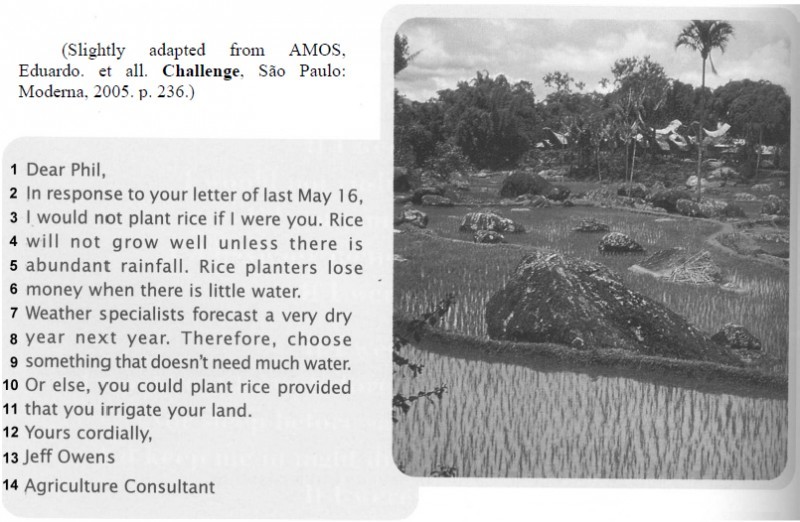
In the letter, Jeff Owens uses an informal manner to open and close his message. The most appropriated level of language in formal style to write the opening Dear Phil (line 1) and the closing Your Cordially (line 12) would be:
06