


![[Marketing] Questao Topo - deslogado](https://storage.estuda.com.br/banners/0_6b7ebee90b03af1c560c73bb8bcce34a_banner_deslogado_70_dias.png)
Questões de Inglês
19.971 Questões
Questão 37 90849
UEFS Caderno 1 2010/1TEXTO:
Multitasking harmful to productivity

Scientists have found that focusing on multiple
media sources, such as email, phone, the internet, and
television, all at once does not make you more efficient.
In fact, multitaskers find it harder to concentrate.
5 Researchers at Stanford University in the United
States divided a group of over 250 students into light or
heavy media multitaskers. Light multitaskers focus on
just one or two sources at a time — listening to music
while working for example. Heavy multitaskers watch
10 online videos, surf the web, talk or text on their mobiles,
and write or read, all at the same time. Lead researcher
Cliff Nass wanted to see how this would affect the way
their brains work. “You would think that people who are
multitasking with all these media at once would be great
15 at ignoring irrelevant information. However, we discovered
they are suckers for irrelevant information, so they’re
much worse than low multitaskers at ignoring the
irrelevant”, says Nass.
Not only that, but multitaskers are worse at
20 organizing and sorting information, and worse at switching
from one task to another. The findings have left the
scientists with something of a mystery — why do people
multitask at all? They say that in an increasingly
demanding work environment, expecting staff to be
25 constantly available by email and instant message while
doing their jobs may actually mean that productivity falls.
MULTITASKING, harmful to productivity. Disponível em: . Acesso em: 2 jan. 2010.
Considering language usage in the text, it’s correct to say:
Questão 30 90842
UEFS Caderno 1 2010/1TEXTO:
Multitasking harmful to productivity
Scientists have found that focusing on multiple
media sources, such as email, phone, the internet, and
television, all at once does not make you more efficient.
In fact, multitaskers find it harder to concentrate.
5 Researchers at Stanford University in the United
States divided a group of over 250 students into light or
heavy media multitaskers. Light multitaskers focus on
just one or two sources at a time — listening to music
while working for example. Heavy multitaskers watch
10 online videos, surf the web, talk or text on their mobiles,
and write or read, all at the same time. Lead researcher
Cliff Nass wanted to see how this would affect the way
their brains work. “You would think that people who are
multitasking with all these media at once would be great
15 at ignoring irrelevant information. However, we discovered
they are suckers for irrelevant information, so they’re
much worse than low multitaskers at ignoring the
irrelevant”, says Nass.
Not only that, but multitaskers are worse at
20 organizing and sorting information, and worse at switching
from one task to another. The findings have left the
scientists with something of a mystery — why do people
multitask at all? They say that in an increasingly
demanding work environment, expecting staff to be
25 constantly available by email and instant message while
doing their jobs may actually mean that productivity falls.
MULTITASKING, harmful to productivity. Disponível em: . Acesso em: 2 jan. 2010.
This article is mainly about people who
Questão 29 90841
UEFS Caderno 1 2010/1TEXTO:
Can animals predict natural disasters?
The tsunami disaster killed over 30,000 people in
Sri Lanka. However, almost all local elephants, deer and
other wild animals survived the monstrous attack of the
tidal waves. It’s worth mentioning that only one wild boar
5 of 2,000 animals of an Indian reserve was killed in the
2004 tsunami disaster.
According to US biologists, 14 sharks, which were
kept under regular observation for several years, had
left their usual places of living 12 hours before Charlie
10 hurricane hit Florida. The sharks disappeared in deep
waters of the ocean and returned only two weeks later,
although they have never left their natural habitat before.
Animals obviously know something that humans
can never comprehend or learn. The 2004 tsunami
15 disaster made scientists look deeper into the mystery.
Researchers have already proved that different animal
species living all over the world possess the surprising
ability to envisage natural catastrophes.
Unlike humans, wild animals can perceive a lot
20 more information about the world around them. Their
senses are a lot better, they can sense vibrations at
huge distances; even a slight change in the atmospheric
pressure will not remain unnoticed for animals. Their major
advantage is an ability to read and see natural warnings,
25 which helps them avoid the storm of nature.
Scientists also noticed that wild animals have a
much better reaction to imminent dangers in comparison
with domestic animals. Domestic animals live under the
strong influence of human culture, which is made of a
30 system of rules, taboos and physiological delicacies. It
is not ruled out that a human being used to be as sensitive
to natural changes as wild animals are now. Ancient
people probably had this animal instinct as well: perhaps
they knew where to run and hide in order to save
35 themselves from earthquakes or volcano eruptions.
CAN, animals predict natural disasters? Disponível em:
The only phrase in which a degree of comparison has not been used is
Questão 23 90835
UEFS Caderno 1 2010/1TEXTO:
Can animals predict natural disasters?
The tsunami disaster killed over 30,000 people in
Sri Lanka. However, almost all local elephants, deer and
other wild animals survived the monstrous attack of the
tidal waves. It’s worth mentioning that only one wild boar
5 of 2,000 animals of an Indian reserve was killed in the
2004 tsunami disaster.
According to US biologists, 14 sharks, which were
kept under regular observation for several years, had
left their usual places of living 12 hours before Charlie
10 hurricane hit Florida. The sharks disappeared in deep
waters of the ocean and returned only two weeks later,
although they have never left their natural habitat before.
Animals obviously know something that humans
can never comprehend or learn. The 2004 tsunami
15 disaster made scientists look deeper into the mystery.
Researchers have already proved that different animal
species living all over the world possess the surprising
ability to envisage natural catastrophes.
Unlike humans, wild animals can perceive a lot
20 more information about the world around them. Their
senses are a lot better, they can sense vibrations at
huge distances; even a slight change in the atmospheric
pressure will not remain unnoticed for animals. Their major
advantage is an ability to read and see natural warnings,
25 which helps them avoid the storm of nature.
Scientists also noticed that wild animals have a
much better reaction to imminent dangers in comparison
with domestic animals. Domestic animals live under the
strong influence of human culture, which is made of a
30 system of rules, taboos and physiological delicacies. It
is not ruled out that a human being used to be as sensitive
to natural changes as wild animals are now. Ancient
people probably had this animal instinct as well: perhaps
they knew where to run and hide in order to save
35 themselves from earthquakes or volcano eruptions.
CAN, animals predict natural disasters? Disponível em:
The text says scientists have found out that
Questão 22 90834
UEFS Caderno 1 2010/1TEXTO:
Can animals predict natural disasters?
The tsunami disaster killed over 30,000 people in
Sri Lanka. However, almost all local elephants, deer and
other wild animals survived the monstrous attack of the
tidal waves. It’s worth mentioning that only one wild boar
5 of 2,000 animals of an Indian reserve was killed in the
2004 tsunami disaster.
According to US biologists, 14 sharks, which were
kept under regular observation for several years, had
left their usual places of living 12 hours before Charlie
10 hurricane hit Florida. The sharks disappeared in deep
waters of the ocean and returned only two weeks later,
although they have never left their natural habitat before.
Animals obviously know something that humans
can never comprehend or learn. The 2004 tsunami
15 disaster made scientists look deeper into the mystery.
Researchers have already proved that different animal
species living all over the world possess the surprising
ability to envisage natural catastrophes.
Unlike humans, wild animals can perceive a lot
20 more information about the world around them. Their
senses are a lot better, they can sense vibrations at
huge distances; even a slight change in the atmospheric
pressure will not remain unnoticed for animals. Their major
advantage is an ability to read and see natural warnings,
25 which helps them avoid the storm of nature.
Scientists also noticed that wild animals have a
much better reaction to imminent dangers in comparison
with domestic animals. Domestic animals live under the
strong influence of human culture, which is made of a
30 system of rules, taboos and physiological delicacies. It
is not ruled out that a human being used to be as sensitive
to natural changes as wild animals are now. Ancient
people probably had this animal instinct as well: perhaps
they knew where to run and hide in order to save
35 themselves from earthquakes or volcano eruptions.
CAN, animals predict natural disasters? Disponível em:
About the sharks mentioned in the text, it’s correct to say that they
Questão 40 90610
UEFS Caderno 1 2010/2TEXTO:
Jurassic fossil discovery
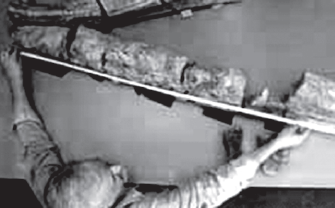
A 150-million-year-old fossilized skull belonging to
a creature called a pliosaur has been unearthed along
the Jurassic Coast in Dorset in England.
While dinosaurs roamed the land, pliosaurs terrorized
5 the oceans. These giant, crocodile-shaped creatures
were fearsome hunters, their immense jaws and
razor-sharp teeth made easy work of passing prey. Now
an 8ft-long skull has been found in Dorset by a local
fossil collector. And scientists say it could be one of the
10 biggest ever found, belonging to a creature that would
have measured up to 50ft long.
Paleontologist Richard Forrest has been examining
the specimen. He says: ‘To get a whole skull like this is
like Christmas and Easter and everything rolled into one,
15 because we actually can see, yes this really was an
absolutely enormous animal, and realistically, probably
the most powerful predator that ever lived.’
The fossilized skull has now been bought by Dorset
County Council using Heritage Lottery Funds. They plan
20 to eventually put it on public display.
MORELLE, Rebecca. Jurassic fossil discovery. Disponível em: . Acesso em: 30 maio 2010.
Based on the text, the words have opposite meanings in
06