


![[Marketing] Questao Topo - deslogado](https://storage.estuda.com.br/banners/0_6b7ebee90b03af1c560c73bb8bcce34a_banner_deslogado_70_dias.png)
Questões de Inglês
19.971 Questões
Questão 50 4504478
UFGD 2019Read the text and answer the question.
Some of the most important decisions you will make in your lifetime will occur while you feel stressed and anxious.
From medical decisions to financial and professional ones, we are often required to weigh up information under stressful conditions. Take for example expectant parents who need to make a series of important choices during pregnancy and labour – when many feel stressed. Do we become better or worse at processing and using information under such circumstances?
My colleague Neil Garrett, now at the Princeton Neuroscience Institute in New Jersey, and I ventured from the safety of our lab to fire stations in the state of Colorado to investigate how the mind operates under high stress.
...When you experience stressful events, whether personal (waiting for a medical diagnosis) or public (political turmoil), a physiological change is triggered that can cause you to take in any sort of warning and become fixated on what might go wrong. A study using brain imaging to look at the neural activity of people under stress revealed that this ‘switch’ was related to a sudden boost in a neural signal important for learning(known as a prediction error), specifically in response to unexpected signs of danger (such as faces expressing fear). This signal relies on dopamine – a neurotransmitter found in the brain – and, under stress, dopamine function is altered by another molecule called corticotropin-releasing factor.
...The fact that stress increases the likelihood that we will focus more on alarming messages, together with the fact that it spreads like a tsunami, can create collective fear that is not always justified. This is because after a stressful public event, such as a terrorist attack or political turmoil, there is often a wave of alarming information in traditional and social media, which individuals absorb well, but that can exaggerate existing danger.
Disponível em: http://www.bbc.com/future/story/20180613-why-stressed-mindsare-better-at-processing-things Acesso em: 19 ago. 2018
The article discusses “Why stressed minds are more decisive”. Which sentence best explain this question, according to the text.
Questão 16 4060898
UNIVAG 2019/1Leia o texto para responder à questão.
Airborne particles cause more than 3m early deaths a year
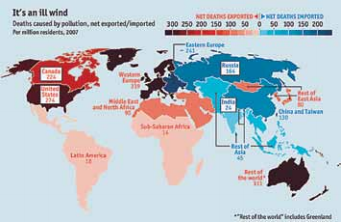
Governments are worried over traffic and other local nuisances that create filthy air. But research just published in Nature by Zhang Qiang, of Tsinghua University in Beijing, and an international team including environmental economists, physicists and disease experts, suggests the problem has a global dimension, too. Dr Zhang’s analysis estimates that in 2007 — the first year for which complete industrial, epidemiological and trade data were available when the team started work — more than 3m premature deaths around the world were caused by emissions of fine particulate matter (known as PM2.5, because the particles in question are less than 2.5 microns across).
Of these, the team reckon just under an eighth were associated with pollutants released in a part of the world different from that in which the death occurred, thanks to transport of such particles from place to place by the wind. Almost twice as many (22% of the total) were a consequence of goods and services that were produced in one region (often poor) and then exported for consumption in another (often rich, and with more meticulous environmental standards for its own manufacturers).
In effect, such rich countries are exporting air pollution, and its associated deaths, as they import goods. As far as China is concerned, that phenomenon is probably abating. Chinese coal consumption has been on the wane since 2013, so premature deaths there from toxic air are now probably dropping. But other industrialising countries, such as India, may yet see an increase.
(www.economist.com, 01.04.2017. Adaptado.)
No trecho do terceiro parágrafo “so premature deaths there from toxic air are now probably dropping”, o termo sublinhado equivale, em português, a
Questão 12 4060865
UNIVAG 2019/1Leia o texto para responder à questão.
Airborne particles cause more than 3m early deaths a year
Governments are worried over traffic and other local nuisances that create filthy air. But research just published in Nature by Zhang Qiang, of Tsinghua University in Beijing, and an international team including environmental economists, physicists and disease experts, suggests the problem has a global dimension, too. Dr Zhang’s analysis estimates that in 2007 — the first year for which complete industrial, epidemiological and trade data were available when the team started work — more than 3m premature deaths around the world were caused by emissions of fine particulate matter (known as PM2.5, because the particles in question are less than 2.5 microns across).
Of these, the team reckon just under an eighth were associated with pollutants released in a part of the world different from that in which the death occurred, thanks to transport of such particles from place to place by the wind. Almost twice as many (22% of the total) were a consequence of goods and services that were produced in one region (often poor) and then exported for consumption in another (often rich, and with more meticulous environmental standards for its own manufacturers).
In effect, such rich countries are exporting air pollution, and its associated deaths, as they import goods. As far as China is concerned, that phenomenon is probably abating. Chinese coal consumption has been on the wane since 2013, so premature deaths there from toxic air are now probably dropping. But other industrialising countries, such as India, may yet see an increase.
(www.economist.com, 01.04.2017. Adaptado.)
O trecho do primeiro parágrafo “known as PM2.5, because the particles in question are less than 2.5 microns across” é uma
Questão 11 4060848
UNIVAG 2019/1Leia o texto para responder à questão.
Airborne particles cause more than 3m early deaths a year
Governments are worried over traffic and other local nuisances that create filthy air. But research just published in Nature by Zhang Qiang, of Tsinghua University in Beijing, and an international team including environmental economists, physicists and disease experts, suggests the problem has a global dimension, too. Dr Zhang’s analysis estimates that in 2007 — the first year for which complete industrial, epidemiological and trade data were available when the team started work — more than 3m premature deaths around the world were caused by emissions of fine particulate matter (known as PM2.5, because the particles in question are less than 2.5 microns across).
Of these, the team reckon just under an eighth were associated with pollutants released in a part of the world different from that in which the death occurred, thanks to transport of such particles from place to place by the wind. Almost twice as many (22% of the total) were a consequence of goods and services that were produced in one region (often poor) and then exported for consumption in another (often rich, and with more meticulous environmental standards for its own manufacturers).
In effect, such rich countries are exporting air pollution, and its associated deaths, as they import goods. As far as China is concerned, that phenomenon is probably abating. Chinese coal consumption has been on the wane since 2013, so premature deaths there from toxic air are now probably dropping. But other industrialising countries, such as India, may yet see an increase.
(www.economist.com, 01.04.2017. Adaptado.)
O título do texto reflete a ideia apresentada no trecho:
Questão 44 4049468
UNICID 2019Leia o texto para responder à questão.
Healthy Heart in the Amazon

How to maintain a healthy heart is a surprisingly contentious question. Diet and exercise are crucial, everyone agrees – but the ideal specifics and the relationships among them remain mysterious. Some experts recommend avoiding dietary fats; others endorse fat and low carbohydrates. The impact of high levels of inflammation on heart disease is disputed. And almost no one can agree about how much (or what type of) exercise is optimal.
Nevertheless, a study published last month in The Lancet points the way to resolving some of these issues by focusing on the Tsimane, a group of subsistence farmers and hunters living in Bolivia along a tributary of the Amazon River. Anthropologists have learned a lot about the lives of the Tsimane since they began studying them 15 years ago. The men typically spend seven hours or so of every day hunting, fishing or poling their canoes to towns to sell and procure food. The women devote almost as much time to gathering nuts and farming rice, corn and plantains. Men and women cover roughly eight miles each, or 17,000 steps, each day. Their diet is heavy on carbs: 72 percent of their daily calories derive from unprocessed starches, 14 percent from saturated and unsaturated fats and 14 percent from protein. Many Tsimane experience frequent infections and show chronically elevated levels of inflammation.
For the Lancet study, anthropologists teamed with cardiologists who drew blood from 705 Tsimane men and women between the ages of 40 and 94. The researchers also conducted cardiac scans, enabling them to score the presence of atherosclerosis, a disease characterized by plaque buildup inside a person’s cardiac arteries. A score of 0 meant essentially no detectable disease; 1 to 99, low levels; and 400 or greater would be high. Eighty-five percent of the volunteers scored 0; only 3 percent exceeded 99. Even among those older than 75, only 8 percent exceeded 99. A single person scored higher than 399. As a group, the Tsimane had scores less than one-fifth those of people in the United States or Europe. They exhibited even less atherosclerosis than Japanese women, previously thought to have the world’s healthiest arteries. In general, the Tsimane developed the first signs of atherosclerosis almost 25 years later than their counterparts in the industrialized West.
The implications of these findings are complex, says Hillard Kaplan, an anthropologist at the University of New Mexico in Albuquerque and the study’s co-author. They raise questions about the effect of fats and carbohydrates on the heart and also about the cardiac impacts of inflammation, which does not contribute noticeably to atherosclerosis among the Tsimane. But Kaplan says the study indicates how essential it is to be very active physically – the Tsimane were in almost constant motion every day.
(Gretchen Reynolds. www.nytimes.com, 06.04.2017. Adaptado.)
No trecho inicial do segundo parágrafo “Nevertheless, a study published last month in The Lancet points the way”, o termo sublinhado tem sentido equivalente, em português, a
Questão 41 4049389
UNICID 2019Leia o texto para responder à questão.
Healthy Heart in the Amazon
How to maintain a healthy heart is a surprisingly contentious question. Diet and exercise are crucial, everyone agrees – but the ideal specifics and the relationships among them remain mysterious. Some experts recommend avoiding dietary fats; others endorse fat and low carbohydrates. The impact of high levels of inflammation on heart disease is disputed. And almost no one can agree about how much (or what type of) exercise is optimal.
Nevertheless, a study published last month in The Lancet points the way to resolving some of these issues by focusing on the Tsimane, a group of subsistence farmers and hunters living in Bolivia along a tributary of the Amazon River. Anthropologists have learned a lot about the lives of the Tsimane since they began studying them 15 years ago. The men typically spend seven hours or so of every day hunting, fishing or poling their canoes to towns to sell and procure food. The women devote almost as much time to gathering nuts and farming rice, corn and plantains. Men and women cover roughly eight miles each, or 17,000 steps, each day. Their diet is heavy on carbs: 72 percent of their daily calories derive from unprocessed starches, 14 percent from saturated and unsaturated fats and 14 percent from protein. Many Tsimane experience frequent infections and show chronically elevated levels of inflammation.
For the Lancet study, anthropologists teamed with cardiologists who drew blood from 705 Tsimane men and women between the ages of 40 and 94. The researchers also conducted cardiac scans, enabling them to score the presence of atherosclerosis, a disease characterized by plaque buildup inside a person’s cardiac arteries. A score of 0 meant essentially no detectable disease; 1 to 99, low levels; and 400 or greater would be high. Eighty-five percent of the volunteers scored 0; only 3 percent exceeded 99. Even among those older than 75, only 8 percent exceeded 99. A single person scored higher than 399. As a group, the Tsimane had scores less than one-fifth those of people in the United States or Europe. They exhibited even less atherosclerosis than Japanese women, previously thought to have the world’s healthiest arteries. In general, the Tsimane developed the first signs of atherosclerosis almost 25 years later than their counterparts in the industrialized West.
The implications of these findings are complex, says Hillard Kaplan, an anthropologist at the University of New Mexico in Albuquerque and the study’s co-author. They raise questions about the effect of fats and carbohydrates on the heart and also about the cardiac impacts of inflammation, which does not contribute noticeably to atherosclerosis among the Tsimane. But Kaplan says the study indicates how essential it is to be very active physically – the Tsimane were in almost constant motion every day.
(Gretchen Reynolds. www.nytimes.com, 06.04.2017. Adaptado.)
De acordo com o primeiro parágrafo, há um consenso de que o mais importante para ter o coração saudável é
06