


![[Marketing] Questao Topo - deslogado](https://storage.estuda.com.br/banners/0_6b7ebee90b03af1c560c73bb8bcce34a_banner_deslogado_70_dias.png)
Questões de Inglês
19.971 Questões
Questão 58 5417896
FACERES 2019/1Use the comic strip bellow to answer question
FoxTrot

(Disponivel em https://www.foxtrot.com/2015/07/19/too-cool. Acesso em 01/07/2019)
According to the comic strip, in which degree is the adjective expressed in “Not only am I the owner of the coolest RC toy known to man…”:
Questão 12 5364334
FAG Medicina 2019/2Text
Put Working Memory to Work in Learning
Working memory involves the conscious processing and managing of information required to carry out complex cognitive tasks such as learning, reasoning, and comprehension. It has been described as the brain's conductor. Memory has long been viewed as a key aspect of learning, but as the emphasis in educational standards has shifted away from rote memorization and toward the knowledge and skills needed to process new information, working memory is increasingly taking center stage.
There is an explosion of research today with the aim of understanding how this important function works and how to enhance it. However, the term working memory was first used more than 50 years ago to describe the role of recall in planning and carrying out behavior. In the 1970s and '80s, British psychologist Alan Baddeley and colleagues developed a model of working memory that brings together how the brain accepts sensory input, processes both visual-spatial and verbal data, and accesses long-term memory; and how all of that input is processed by a function they referred to as central executive.
Working Memory in the Brain Central executive monitors and coordinates input and decides which information we will focus our attention on. As with other cognitive processes that power executive function, the home base of working memory is in the prefrontal cortex. Researchers have detected increased activation in this area at the front of the brain when people are involved in thinking and problem solving that engages working memory. Other areas of the brain that support working memory are the hippocampus, which is involved in long-term memory storage and spatial orientation, and Broca's area, located on the left side of the frontal lobes and involved in language processing and verbal fluency
Working memory is involved in a variety of learning and daily living tasks, such as reading, problem solving, and navigation. As such, it is sometimes referred to as the "brain's workhorse."
In fact, Tracy and Ross Alloway, in their book The Working Memory: Train Your Brain to Function Stronger, Smarter, Faster, contend that working memory is a better predictor than IQ of how well students will perform academically: "IQ is what you know. Working memory is what you can do with what you know"
Thus, working memory is a key cognitive skill for students and their teachers. As an educator, you know well how you must be able to maintain the mental skillfulness and agility to process many variables in everyday teaching practice, such as students' pri or knowledge, the primary purpose and goal of a lesson, sequence of learning activities, time constraints, interruptions throughout the school day, and on and on.
Students activate their working memory as they figure out the meaning of new words they encounter while reading, and as they decide which mathematical functions they will need to apply to a problem that their teacher has just jotted on the whiteboard.
Fonte: Disponível em: http://www.edutopia.org/blog/put-working-memory-to-work-donna-wilson-marcus-conyers.
Segundo o texto, pesquisas recentes acerca da memória de trabalho pretendem.
Questão 14 5329965
UFVJM 2019.2Leia este texto para responder a questão
Texto
History of Human Rights
Originally, people had rights only because of their membership in a group, such as a family. Then, in 539 BC, Cyrus the Great, after conquering the city of Babylon, did something totally unexpected—he freed all slaves to return home. Moreover, he declared people should choose their own religion. The Cyrus Cylinder, a clay tablet containing his statements, is the first human rights declaration in history.
The idea of human rights spread quickly to India, Greece and eventually Rome. The most important advances since then have included:
1215: The Magna Carta - gave people new rights and made the king subject to the law.
1628: The Petition of Right - set out the rights of the people.
1776: The United States Declaration of Independence - proclaimed the right to life, liberty and the pursuit of happiness.
1789: The Declaration of the Rights of Man and of the Citizen - a document of France, stating that all citizens are equal under the law.
1948: The Universal Declaration of Human Rights - the first document listing the 30 rights to which everyone is entitled.
Fonte: Disponível em< https://www.youthforhumanrights.org/what-are-human-rights/background-of-human-rights.html >. Acesso em: 17 de setembro de 2019.(Adaptado)
Glossário:
Conquering: conquistar
Clay tablet: bloco de argila
Spread: espalhou
Pursuit of: em busca de
O texto tem como principal ideia
Questão 13 5329955
UFVJM 2019.2Leia o texto abaixo e responda a questão.
Texto
What Are Human Rights?
While some dictionaries define the word right as "a privilege," when used in the context of "human rights," we are talking about something more basic.
Every person is entitled to certain fundamental rights, simply by the fact of being human. These are called "human rights" rather than a privilege (which can be taken away at someone’s whim).
They are "rights" because they are things you are allowed to be, to do or to have. These rights are there for your protection against people who might want to harm or hurt you. They are also there to help us get along with each other and live in peace.
Many people know something about their rights. Generally they know they have the right to food and a safe place to stay. They know they have a right to be paid for the work they do. But there are many other rights.
When human rights are not well known by people, abuses such as discrimination, intolerance, injustice, oppression and slavery can arise.
Born out of the atrocities and enormous loss of life during World War II, the United Nations Universal Declaration of Human Rights was signed in 1948 to provide a common understanding of what everyone’s rights are. It forms the basis for a world built on freedom, justice and peace.
Fonte: Disponível em < https://www.youthforhumanrights.org/what-are-human-rights/ >. Acesso em: 17 de setembro de 2019. (Adaptado)
Glossário:
Entitled to: direito a
Taken away: retirado
Whim: capricho
Allowed: permitido
Get along: se dar bem
Arise: surgir
Born out: nascida
A alternativa que NÃO representa um direito humano é:
Questão 12 5279153
UFVJM 2019.1Leia este texto para responder a questão.
Reasons for negative effects of media on teens
Many teens usually spend sleepless nights on social media without the knowledge of their parents.
Insomnia, mood swings, attention deficits at school, and increased obesity are some of the serious
[5] negative effects of social media on teenagers and issues that are arising with kids often addicted to social
networks. With such overwhelming evidence of the negative effects of social media on our children, why
then are many parents not taking more action to protect their children?
There perhaps are three major reasons:
[10]
I) Parents are unaware of the issues involved in the online connections. While kids are plugged in to social
media, only about 40% of parents are involved themselves. Parents may not be aware of their children‘s
"pages" and don‘t fully understand privacy policies, and they don‘t realize what kinds of public posting are
taking place, involving their children.
[15]
II) Parents don‘t want to interfere in their children‘s social lives. Parents want to allow their children to be
as connected as the other kids they associate with, and so they tell themselves that everything is OK.
III) Parents are afraid to take a stand. They don‘t want to push their teens away, and so they allow their
[20] participation in social media to go unchecked rather than make a "big deal" out of it.
The problems this new online society creates are not going away and will continue to grow. Parents must
get off the sidelines and get involved! Be aware of who can see what they post and what is being posted
about them. Talk with them about online safety.
[25]
Fonte: Disponível em High Up: ensino médio / Reinildes Dias, Leina Jucá, Raquel Faria / Macmillan
Glossário:
Issues: problemas, questões
Arising: surgindo
Addicted: viciadas
Overwhelming: avassaladoras
Unaware: inconscientes
Privacy policies: políticas de privacidade
Allow: permitir
Take a stand: tomar uma posição
Push away: afastar
O texto cita diversos exemplos dos sérios efeitos negativos das mídias sociais em adolescentes.
ASSINALE a alternativa apresenta o efeito que NÃO consta no texto.
Questão 52 4504497
UFGD 2019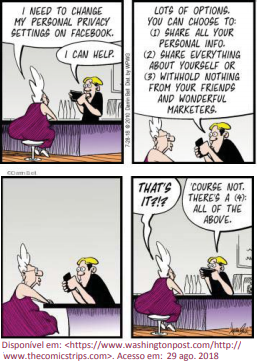
Which of the following best expresses the information discussed in the cartoon above?
06