


![[Marketing] Questao Topo - deslogado](https://storage.estuda.com.br/banners/0_6b7ebee90b03af1c560c73bb8bcce34a_banner_deslogado_70_dias.png)
Questões de Inglês
19.971 Questões
Questão 85 241525
UECE 2° Fase 1° Dia 2010Text
[1] Apart from being about murder,
suicide, torture, fear and madness, horror
stories are also concerned with ghosts,
vampires, succubi, incubi, poltergeists,
[5] demonic pacts, diabolic possession and
exorcism, witchcraft, spiritualism, voodoo,
lycanthropy and the macabre, plus such
occult or quasi occult practices as
telekinesis and hylomancy. Some horror
[10] stories are serio-comic or comic-
grotesque, but none the less alarming or
frightening for that.
From late in the 18th c. until the
present day – in short, for some two
[15] hundred years – the horror story (which is
perhaps a mode rather than an identifiable
genre) in its many and various forms has
been a diachronic feature of British and
American literature and is of considerable
[20] importance in literary history, especially in
the evolution of the short story. It is also
important because of its connections with
the Gothic novel and with a multitude of
fiction associated with tales of mystery,
[25] suspense, terror and the supernatural,
with the ghost story and the thriller and
with numerous stories in the 19th and
20th c. in which crime is a central theme.
The horror story is part of a long
[30] process by which people have tried to
come to terms with and find adequate
descriptions and symbols for deeply
rooted, primitive and powerful forces,
energies and fears which are related to
[35] death, afterlife, punishment, darkness,
evil, violence and destruction.
Writers have long been aware of the
magnetic attraction of the horrific and
have seen how to exploit or appeal to
[40] particular inclinations and appetites. It
was the poets and artists of the late
medieval period who figured out and
expressed some of the innermost fears
and some of the ultimate horrors (real and
[45] imaginary) of human consciousness. Fear
created horrors enough and the
eschatological order was never far from
people‟s minds. Poets dwelt on and
amplified the ubi sunt motif and artists
[50] depicted the spectre of death in paint,
through sculpture and by means of
woodcut. The most potent and frightening
image of all was that of hell: the abode of
eternal loss, pain and damnation. There
[55] were numerous "visions" of hell in
literature.
Gradually, imperceptibly, during the
16th c. hell was "moved‟ from its
traditional site in the center of the earth.
[60] It came to be located in the mind; it was a
part of a state of consciousness. This was
the beginning of the growth of the idea of
a subjective, inner hell, a psychological
hell; a personal and individual source of
[65] horror and terror, such as the chaos of a
disturbed and tormented mind, the
pandaemonium of psychopathic
conditions, rather than the abode of lux
atra and everlasting pain with its definite
[70] location in a measurable cosmological
system.
The horror stories of the late 16th
and early 17th c. (like the ghost stories)
are provided for us by the playwrights.
[75] The Elizabethan and Jacobean tragedians
were deeply interested in evil, crime,
murder, suicide and violence. They were
also very interested in states of extreme
suffering: pain, fear and madness. They
[80] found new modes, new metaphors and
images, for presenting the horrific and in
doing so they created simulacra of hell.
One might cite perhaps a thousand or
more instances from plays in the period c.
[85] 1580 to c. 1642 in which hell is an all-
purpose, variable and diachronic image of
horror whether as a place of punishment
or as a state of mind and spirit. Horrific
action on stage was commonplace in the
[90] tragedy and revenge tragedy of the
period. The satiety which Macbeth claimed
to have experienced when he said: “I have
supp‟d full of horrors;/ Direness, familiar
to my slaughterous thoughts, /Cannot
[95] once start me…” was representative of it.
During the 18th c. (as during the
19th ), in orthodox doctrine taught by
various „churches‟ and sects, hell remained
a place of eternal fire and punishment and
[100] the abode of the Devil. For the most part
writers of the Romantic period and
thereafter did not re-create it as a
visitable place. However, artists were
drawn to “illustrate” earlier conceptions of
[105] hell. William Blake did 102 engravings for
Dante‟s Inferno. John Martin illustrated
Paradise Lost and Gustave Doré applied
himself to Dante and Milton. The actual
hells of the 18th and 19th c. were the
[110] gaols, the madhouses, the slums and
bedlams and those lanes and alleys where
vice, squalor, depravity and unspeakable
misery created a social and moral chaos:
terrestrial counterparts to the horrors of
[115] Dante‟s Circles.
Gothic influence traveled to America
and affected writers such as Edgar Allan
Poe, whose tales are short, intense,
sensational and have the power to inspire
[120] horror and terror. He depicts extremes of
fear and insanity and, through the
operations of evil, gives us glimpses of
hell.
Poe‟s long-term influence was
[125] immeasurable (and in the case of some
writers not altogether for their good), and
one can detect it persisting through the
19th c.; in, for example the French
symbolistes (Baudelaire published
[130] translations of his tales in 1856 and
1857), in such British writers as Rossetti,
Swinburne, Dowson and R. L. Stevenson,
and in such Americans as Ambrose Bierce,
Hart Crane and H.P. Lovecraft.
[135] Towards the end of the 19th c. a
number of British and American writers
were experimenting with different modes
of horror story, and this was at a time
when there had been a steadily growing
[140] interest in the occult, in supernatural
agencies, in psychic phenomena, in
psychotherapy, in extreme psychological
states and also in spiritualism.
The enormous increase in science
[145] fiction since the 1950s has diversified
horror fiction even more than might at
first be supposed. New maps of hell have
been drawn and are being drawn; new
dimensions of the horrific exposed and
[150] explored; new simulacra and exempla
created. Fear, pain, suffering, guilt and
madness (what has already been touched
on in miscellaneous „hells‟) remain
powerful and emotive elements in horror
[155] stories. In a chaotic world, which many
see to be on a disaster course, through
the cracks, „the faults in reality‟, we and
our writers catch other vertiginous
glimpses of „chaos and old night‟,
[160] fissiparating images of death and
destruction.
From: CUDDON, J. A. The Penguin Dictionary of Literary Terms and Literary Theory. London: Penguin, 1999.
As to the French “symbolistes”, the text says that they were
Questão 84 241524
UECE 2° Fase 1° Dia 2010Text
[1] Apart from being about murder,
suicide, torture, fear and madness, horror
stories are also concerned with ghosts,
vampires, succubi, incubi, poltergeists,
[5] demonic pacts, diabolic possession and
exorcism, witchcraft, spiritualism, voodoo,
lycanthropy and the macabre, plus such
occult or quasi occult practices as
telekinesis and hylomancy. Some horror
[10] stories are serio-comic or comic-
grotesque, but none the less alarming or
frightening for that.
From late in the 18th c. until the
present day – in short, for some two
[15] hundred years – the horror story (which is
perhaps a mode rather than an identifiable
genre) in its many and various forms has
been a diachronic feature of British and
American literature and is of considerable
[20] importance in literary history, especially in
the evolution of the short story. It is also
important because of its connections with
the Gothic novel and with a multitude of
fiction associated with tales of mystery,
[25] suspense, terror and the supernatural,
with the ghost story and the thriller and
with numerous stories in the 19th and
20th c. in which crime is a central theme.
The horror story is part of a long
[30] process by which people have tried to
come to terms with and find adequate
descriptions and symbols for deeply
rooted, primitive and powerful forces,
energies and fears which are related to
[35] death, afterlife, punishment, darkness,
evil, violence and destruction.
Writers have long been aware of the
magnetic attraction of the horrific and
have seen how to exploit or appeal to
[40] particular inclinations and appetites. It
was the poets and artists of the late
medieval period who figured out and
expressed some of the innermost fears
and some of the ultimate horrors (real and
[45] imaginary) of human consciousness. Fear
created horrors enough and the
eschatological order was never far from
people‟s minds. Poets dwelt on and
amplified the ubi sunt motif and artists
[50] depicted the spectre of death in paint,
through sculpture and by means of
woodcut. The most potent and frightening
image of all was that of hell: the abode of
eternal loss, pain and damnation. There
[55] were numerous "visions" of hell in
literature.
Gradually, imperceptibly, during the
16th c. hell was "moved‟ from its
traditional site in the center of the earth.
[60] It came to be located in the mind; it was a
part of a state of consciousness. This was
the beginning of the growth of the idea of
a subjective, inner hell, a psychological
hell; a personal and individual source of
[65] horror and terror, such as the chaos of a
disturbed and tormented mind, the
pandaemonium of psychopathic
conditions, rather than the abode of lux
atra and everlasting pain with its definite
[70] location in a measurable cosmological
system.
The horror stories of the late 16th
and early 17th c. (like the ghost stories)
are provided for us by the playwrights.
[75] The Elizabethan and Jacobean tragedians
were deeply interested in evil, crime,
murder, suicide and violence. They were
also very interested in states of extreme
suffering: pain, fear and madness. They
[80] found new modes, new metaphors and
images, for presenting the horrific and in
doing so they created simulacra of hell.
One might cite perhaps a thousand or
more instances from plays in the period c.
[85] 1580 to c. 1642 in which hell is an all-
purpose, variable and diachronic image of
horror whether as a place of punishment
or as a state of mind and spirit. Horrific
action on stage was commonplace in the
[90] tragedy and revenge tragedy of the
period. The satiety which Macbeth claimed
to have experienced when he said: “I have
supp‟d full of horrors;/ Direness, familiar
to my slaughterous thoughts, /Cannot
[95] once start me…” was representative of it.
During the 18th c. (as during the
19th ), in orthodox doctrine taught by
various „churches‟ and sects, hell remained
a place of eternal fire and punishment and
[100] the abode of the Devil. For the most part
writers of the Romantic period and
thereafter did not re-create it as a
visitable place. However, artists were
drawn to “illustrate” earlier conceptions of
[105] hell. William Blake did 102 engravings for
Dante‟s Inferno. John Martin illustrated
Paradise Lost and Gustave Doré applied
himself to Dante and Milton. The actual
hells of the 18th and 19th c. were the
[110] gaols, the madhouses, the slums and
bedlams and those lanes and alleys where
vice, squalor, depravity and unspeakable
misery created a social and moral chaos:
terrestrial counterparts to the horrors of
[115] Dante‟s Circles.
Gothic influence traveled to America
and affected writers such as Edgar Allan
Poe, whose tales are short, intense,
sensational and have the power to inspire
[120] horror and terror. He depicts extremes of
fear and insanity and, through the
operations of evil, gives us glimpses of
hell.
Poe‟s long-term influence was
[125] immeasurable (and in the case of some
writers not altogether for their good), and
one can detect it persisting through the
19th c.; in, for example the French
symbolistes (Baudelaire published
[130] translations of his tales in 1856 and
1857), in such British writers as Rossetti,
Swinburne, Dowson and R. L. Stevenson,
and in such Americans as Ambrose Bierce,
Hart Crane and H.P. Lovecraft.
[135] Towards the end of the 19th c. a
number of British and American writers
were experimenting with different modes
of horror story, and this was at a time
when there had been a steadily growing
[140] interest in the occult, in supernatural
agencies, in psychic phenomena, in
psychotherapy, in extreme psychological
states and also in spiritualism.
The enormous increase in science
[145] fiction since the 1950s has diversified
horror fiction even more than might at
first be supposed. New maps of hell have
been drawn and are being drawn; new
dimensions of the horrific exposed and
[150] explored; new simulacra and exempla
created. Fear, pain, suffering, guilt and
madness (what has already been touched
on in miscellaneous „hells‟) remain
powerful and emotive elements in horror
[155] stories. In a chaotic world, which many
see to be on a disaster course, through
the cracks, „the faults in reality‟, we and
our writers catch other vertiginous
glimpses of „chaos and old night‟,
[160] fissiparating images of death and
destruction.
From: CUDDON, J. A. The Penguin Dictionary of Literary Terms and Literary Theory. London: Penguin, 1999.
Many of the innermost fears and ultimate horrors of our awareness were revealed by
Questão 56 240537
UECE 2010TEXT
[1] Humans make errors. We make errors of
fact and errors of judgment. We have blind
spots in our field of vision and gaps in our
stream of attention. Sometimes we can’t
[5] even answer the simplest questions. Where
was I last week at this time? How long have
I had this pain in my knee? How much
money do I typically spend in a day? These
weaknesses put us at a disadvantage. We
[10] make decisions with partial information. We
are forced to steer by guesswork. We go
with our gut.
That is, some of us do. Others use data.
A timer running on Robin Barooah’s
[15] computer tells him that he has been living
in the United States for 8 years, 2 months
and 10 days. At various times in his life,
Barooah — a 38-year-old self-employed
software designer from England who now
[20] lives in Oakland, Calif. — has also made
careful records of his work, his sleep and
his diet.
"People have such very poor sense of
time," Barooah says, and without good time
[25] calibration, it is much harder to see the
consequences of your actions. If you want
to replace the vagaries of intuition with
something more reliable, you first need to
gather data. Once you know the facts, you
[30] can live by them.
A fetish for numbers is the defining trait
of the modern manager. Corporate
executives facing down hostile shareholders
load their pockets full of numbers. So do
[35] politicians on the hustings, doctors
counseling patients and fans abusing their
local sports franchise on talk radio.
We tolerate the pathologies of
quantification — a dry, abstract, mechanical
[40] type of knowledge — because the results
are so powerful. Numbering things allows
tests, comparisons, experiments. Numbers
make problems less resonant emotionally
but more tractable intellectually. In science,
[45] in business and in the more reasonable
sectors of government, numbers have won
fair and square.
Almost imperceptibly, numbers are now
infiltrating the last redoubts of the
[50] personal. Sleep, exercise, sex, food, mood,
location, alertness, productivity, even
spiritual well-being are being tracked and
measured, shared and displayed. On
MedHelp, one of the largest Internet forums
[55] for health information, more than 30,000
new personal tracking projects are started
by users every month.
We use numbers when we want to tune
up a car, analyze a chemical reaction,
[60] predict the outcome of an election. We use
numbers to optimize an assembly line. Why
not use numbers on ourselves?
For many self-trackers, the goal is
unknown. Although they may take up
[65] tracking with a specific question in mind,
they continue because they believe their
numbers hold secrets that they can’t afford
to ignore, including answers to questions
they have not yet thought to ask.
[70] Until a few years ago it would have been
pointless to seek self-knowledge through
numbers.
Then four things changed. First,
electronic sensors got smaller and better.
[75] Second, people started carrying powerful
computing devices, typically disguised as
mobile phones. Third, social media made it
seem normal to share everything. And
fourth, we began to get an inkling of the
[80] rise of a global superintelligence known as
the cloud.
Millions of us track ourselves all the
time. We step on a scale and record our
weight. We balance a checkbook. We count
[85] calories. But when the familiar pen-and
paper methods of self-analysis are
enhanced by sensors that monitor our
behavior automatically, the process of self
tracking becomes both more alluring and
[90] more meaningful. Automated sensors do
more than give us facts; they also remind
us that our ordinary behavior contains
obscure quantitative signals that can be
used to inform our behavior, once we learn
[95] to read them.
At the center of this personal laboratory
is the mobile phone. During the years that
personal-data systems were making their
rapid technical progress, many people
[100] started entering small reports about their
lives into a phone. Sharing became the
term for the quick post to a social network:
a status update to Facebook, a reading list
on Goodreads, a location on Dopplr, Web
[105] tags to Delicious, songs to Last.fm, your
breakfast menu on Twitter. "People got
used to sharing," says David Lammers
Meis, who leads the design work on the
fitness-tracking products at Garmin. "The
[110] more they want to share, the more they
want to have something to share." Personal
data are ideally suited to a social life of
sharing. You might not always have
something to say, but you always have a
[115] number to report.
From: The New York Times. www.nytimes.com. April 26, 2010.
According to Barooah, if a person wants to see the results of his/her acts, he/she must
Questão 55 240523
UECE 2010TEXT
[1] Humans make errors. We make errors of
fact and errors of judgment. We have blind
spots in our field of vision and gaps in our
stream of attention. Sometimes we can’t
[5] even answer the simplest questions. Where
was I last week at this time? How long have
I had this pain in my knee? How much
money do I typically spend in a day? These
weaknesses put us at a disadvantage. We
[10] make decisions with partial information. We
are forced to steer by guesswork. We go
with our gut.
That is, some of us do. Others use data.
A timer running on Robin Barooah’s
[15] computer tells him that he has been living
in the United States for 8 years, 2 months
and 10 days. At various times in his life,
Barooah — a 38-year-old self-employed
software designer from England who now
[20] lives in Oakland, Calif. — has also made
careful records of his work, his sleep and
his diet.
"People have such very poor sense of
time," Barooah says, and without good time
[25] calibration, it is much harder to see the
consequences of your actions. If you want
to replace the vagaries of intuition with
something more reliable, you first need to
gather data. Once you know the facts, you
[30] can live by them.
A fetish for numbers is the defining trait
of the modern manager. Corporate
executives facing down hostile shareholders
load their pockets full of numbers. So do
[35] politicians on the hustings, doctors
counseling patients and fans abusing their
local sports franchise on talk radio.
We tolerate the pathologies of
quantification — a dry, abstract, mechanical
[40] type of knowledge — because the results
are so powerful. Numbering things allows
tests, comparisons, experiments. Numbers
make problems less resonant emotionally
but more tractable intellectually. In science,
[45] in business and in the more reasonable
sectors of government, numbers have won
fair and square.
Almost imperceptibly, numbers are now
infiltrating the last redoubts of the
[50] personal. Sleep, exercise, sex, food, mood,
location, alertness, productivity, even
spiritual well-being are being tracked and
measured, shared and displayed. On
MedHelp, one of the largest Internet forums
[55] for health information, more than 30,000
new personal tracking projects are started
by users every month.
We use numbers when we want to tune
up a car, analyze a chemical reaction,
[60] predict the outcome of an election. We use
numbers to optimize an assembly line. Why
not use numbers on ourselves?
For many self-trackers, the goal is
unknown. Although they may take up
[65] tracking with a specific question in mind,
they continue because they believe their
numbers hold secrets that they can’t afford
to ignore, including answers to questions
they have not yet thought to ask.
[70] Until a few years ago it would have been
pointless to seek self-knowledge through
numbers.
Then four things changed. First,
electronic sensors got smaller and better.
[75] Second, people started carrying powerful
computing devices, typically disguised as
mobile phones. Third, social media made it
seem normal to share everything. And
fourth, we began to get an inkling of the
[80] rise of a global superintelligence known as
the cloud.
Millions of us track ourselves all the
time. We step on a scale and record our
weight. We balance a checkbook. We count
[85] calories. But when the familiar pen-and
paper methods of self-analysis are
enhanced by sensors that monitor our
behavior automatically, the process of self
tracking becomes both more alluring and
[90] more meaningful. Automated sensors do
more than give us facts; they also remind
us that our ordinary behavior contains
obscure quantitative signals that can be
used to inform our behavior, once we learn
[95] to read them.
At the center of this personal laboratory
is the mobile phone. During the years that
personal-data systems were making their
rapid technical progress, many people
[100] started entering small reports about their
lives into a phone. Sharing became the
term for the quick post to a social network:
a status update to Facebook, a reading list
on Goodreads, a location on Dopplr, Web
[105] tags to Delicious, songs to Last.fm, your
breakfast menu on Twitter. "People got
used to sharing," says David Lammers
Meis, who leads the design work on the
fitness-tracking products at Garmin. "The
[110] more they want to share, the more they
want to have something to share." Personal
data are ideally suited to a social life of
sharing. You might not always have
something to say, but you always have a
[115] number to report.
From: The New York Times. www.nytimes.com. April 26, 2010.
Among the personal aspects that have been object of tracking nowadays the text mentions
Questão 20 190840
ITA 2010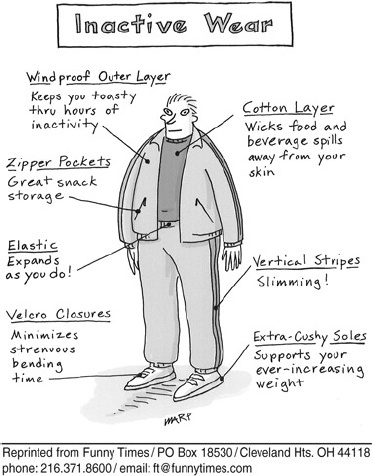
Considere as seguintes afirmações:
I. As listas verticais indicadas afinam a silhueta.
II. A figura mostra sapatos que não se desgastam com o tempo.
III. Inactive Wear é apropriada para praticantes de exercícios físicos.
Está(ão) correta(s):
Questão 16 190836
ITA 2010In August of 2000, a Japanese scientist named Toshiyuki Nakagaki announced that he had trained an amoebalike organism called slime mold to find the shortest route through a maze. Nakagaki had placed the mold in a small maze comprising four possible routes and planted pieces of food at two of the exits. Despite its being an incredibly primitive organism (a close relative of ordinary fungi) with no centralized brain whatsoever, the slime mold managed to plot the most efficient route to the food, stretching its body through the maze so that it connected directly to the two food sources. Without any apparent cognitive resources, the slime mold had “solved” the maze puzzle.
For such a simple organism, the slime mold has an impressive intellectual pedigree. Nakagaki’s announcement was only the latest in a long chain of investigations into the subtleties of slime mold behavior. For scientists trying to understand systems that use relatively simple components to build higher-level intelligence, the slime mold may someday be seen as the equivalent of the finches and tortoises that Darwin observed on the Galapagos Islands.
How did such a lowly organism come to play such an important scientific role? That story begins in the late sixties in New York City, with a scientist named Evelyn Fox Keller. A Harvard Ph.D. in physics, Keller had written her dissertation on molecular biology, and she had spent some time exploring the nascent field of “non-equilibrium thermodynamics”, which in later years would come to be associated with complexity theory. By 1968, she was working as an associate at Sloan-Kettering in Manhattan, thinking about the application of mathematics to biological problems. Mathematics had played such a tremendous role in expanding our understanding of physics, Keller thought – so perhaps it might also be useful for understanding living systems.
In the spring of 1968, Keller met a visiting scholar named Lee Segel, an applied mathematician who shared her interests. It was Segel who first introduced her to the bizarre conduct of the slime mold, and together they began a series of investigations that would help transform not just our understanding of biological development but also the disparate worlds of brain science, software design, and urban studies.
(…)
Johson, Steven. Emergence. Peguin Books Ltd. 2001, pp. 11-12.
De acordo com o texto, Evelyn Fox Keller
I. tornou-se PhD em Física pela Universidade de Harvard e foi a pioneira nos estudos sobre teoria de sistemas complexos.
II. acreditava na importância da Matemática não apenas para o estudo da Física, mas também da Biologia.
III. Influenciou as pesquisas do matemático Lee Segel, levando-o a se interessar pelo comportamento dos slime molds.
Está(ão) correta(s)
06