


![[Marketing] Questao Topo - deslogado](https://storage.estuda.com.br/banners/0_6b7ebee90b03af1c560c73bb8bcce34a_banner_deslogado_70_dias.png)
Questões de Inglês
19.971 Questões
Questão 44 49197
ESPM 2011/2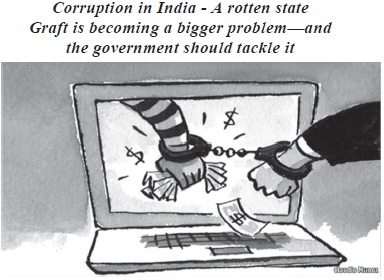
INDIANS’ anger over rising corruption has reached feverish levels. What people are calling a “season of scams” includes the alleged theft of billions by officials behind last year’s Commonwealth games in Delhi; $40 billion in revenues lost from the crooked sale of 2G telecoms licences; and over $40 billion stolen in Uttar Pradesh alone from schemes subsidising food and fuel for the poor. Foreign businessmen, who have slashed investment over the past year, rank graft as their biggest headache behind appalling infrastructure. Now India’s anti-corruption chief has been forced out over, well, corruption.
Graft is hardly new in India: the Bofors scandal brought down the government in 1989. But there seems to be more of it about than ever, if only because India is getting richer fast, and the faster the economy grows, the more chances arise for mind-boggling theft. The government says that in the next five-year plan period, which starts next year, $1 trillion will be spent on roads, railways, ports and so on, with billions more on re-equipping the armed forces and welfare. Add in an insatiable appetite for scarce land, water and minerals and a monsoon of bribes is forecast.
Some are inclined to shrug their shoulders. After all, corruption does not seem to be stopping India from growing. Yet imagine how much better the country would be doing without it. Corruption raises costs not just to Indians, but also to the foreigners whose capital India needs. Thanks in part to those scandals, India’s stockmarket was the worstperforming outside the Muslim world over the past year.
To its credit, the government has begun to take action against powerful individuals. Maharashtra state’s chief minister was forced out over a property scandal. Police have quizzed Suresh Kalmadi, the politician who ran the Commonwealth games. Most strikingly, Andimuthu Raja, the cabinet minister who oversaw the 2G telecom licences, was arrested.
(Mar 10th 2011 | www.economist.com)
In “Some are inclined to shrug their shoulders.”, the expression, underlined in the text, in the third paragraph, “to shrug their shoulders” means:
Questão 43 49196
ESPM 2011/2
INDIANS’ anger over rising corruption has reached feverish levels. What people are calling a “season of scams” includes the alleged theft of billions by officials behind last year’s Commonwealth games in Delhi; $40 billion in revenues lost from the crooked sale of 2G telecoms licences; and over $40 billion stolen in Uttar Pradesh alone from schemes subsidising food and fuel for the poor. Foreign businessmen, who have slashed investment over the past year, rank graft as their biggest headache behind appalling infrastructure. Now India’s anti-corruption chief has been forced out over, well, corruption.
Graft is hardly new in India: the Bofors scandal brought down the government in 1989. But there seems to be more of it about than ever, if only because India is getting richer fast, and the faster the economy grows, the more chances arise for mind-boggling theft. The government says that in the next five-year plan period, which starts next year, $1 trillion will be spent on roads, railways, ports and so on, with billions more on re-equipping the armed forces and welfare. Add in an insatiable appetite for scarce land, water and minerals and a monsoon of bribes is forecast.
Some are inclined to shrug their shoulders. After all, corruption does not seem to be stopping India from growing. Yet imagine how much better the country would be doing without it. Corruption raises costs not just to Indians, but also to the foreigners whose capital India needs. Thanks in part to those scandals, India’s stockmarket was the worstperforming outside the Muslim world over the past year.
To its credit, the government has begun to take action against powerful individuals. Maharashtra state’s chief minister was forced out over a property scandal. Police have quizzed Suresh Kalmadi, the politician who ran the Commonwealth games. Most strikingly, Andimuthu Raja, the cabinet minister who oversaw the 2G telecom licences, was arrested.
(Mar 10th 2011 | www.economist.com)
A synonym for “yet”, underlined in the text in the third paragraph, in “Yet imagine how much better the country would be doing without it.” would be:
Questão 42 49195
ESPM 2011/2
INDIANS’ anger over rising corruption has reached feverish levels. What people are calling a “season of scams” includes the alleged theft of billions by officials behind last year’s Commonwealth games in Delhi; $40 billion in revenues lost from the crooked sale of 2G telecoms licences; and over $40 billion stolen in Uttar Pradesh alone from schemes subsidising food and fuel for the poor. Foreign businessmen, who have slashed investment over the past year, rank graft as their biggest headache behind appalling infrastructure. Now India’s anti-corruption chief has been forced out over, well, corruption.
Graft is hardly new in India: the Bofors scandal brought down the government in 1989. But there seems to be more of it about than ever, if only because India is getting richer fast, and the faster the economy grows, the more chances arise for mind-boggling theft. The government says that in the next five-year plan period, which starts next year, $1 trillion will be spent on roads, railways, ports and so on, with billions more on re-equipping the armed forces and welfare. Add in an insatiable appetite for scarce land, water and minerals and a monsoon of bribes is forecast.
Some are inclined to shrug their shoulders. After all, corruption does not seem to be stopping India from growing. Yet imagine how much better the country would be doing without it. Corruption raises costs not just to Indians, but also to the foreigners whose capital India needs. Thanks in part to those scandals, India’s stockmarket was the worstperforming outside the Muslim world over the past year.
To its credit, the government has begun to take action against powerful individuals. Maharashtra state’s chief minister was forced out over a property scandal. Police have quizzed Suresh Kalmadi, the politician who ran the Commonwealth games. Most strikingly, Andimuthu Raja, the cabinet minister who oversaw the 2G telecom licences, was arrested.
(Mar 10th 2011 | www.economist.com)
According to the text:
Questão 60 49132
ESPM 2011/1
The e-mail she got back from Wally most likely read:
Questão 59 49131
ESPM 2011/1
You can infer from the text that the engineering department:
Questão 58 49130
ESPM 2011/1Facebook Tops 500 Million Users
By JENNA WORTHAM
Facebook, the social network created in the dormitories of Harvard six years ago, said on Wednesday that it now had 500 million members.
The company has doubled in size from a year ago, pushing international competitors aside.
“This is an important milestone for all of you who have helped spread Facebook around the world,” Mark Zuckerberg, the company’s 26-year-old chief executive, said in a company blog post.
Facebook’s dizzying rise has not been without stumbles. Most recently, the company was the focus of intense scrutiny over changes to its site that encouraged members to make more information about themselves accessible to anyone on the Internet.
A recent survey by the American Customer Satisfaction Index showed that user satisfaction with Facebook stood at 64 on a 100-point scale, which placed it in the bottom 5 percent of the companies covered in the index.
Facebook’s popularity has also spurred competition from the likes of Google, which views the billions of links and hours spent on the site each month as a threat to its business.
But if anything, the site’s steady growth in spite of its setbacks only validates the company’s approach, said Ray Valdes, an analyst at the research firm Gartner.
Facebook has been aggressive in pushing users “to the edge of their comfort zone,” Mr. Valdes said. “But Facebook has proven that it can weather those challenges and still grow.”
Mr. Valdes, who estimates that Facebook is adding 50 million new members each month, attributed the company’s rapid ascension to its continuous effort to change and improve the service.“That keeps it bubbling away,” he said.
(The New York Times, July 21, 2010)
According to the text, Facebook’s steady growth is due to:
06