


![[Marketing] Questao Topo - deslogado](https://storage.estuda.com.br/banners/0_6b7ebee90b03af1c560c73bb8bcce34a_banner_deslogado_70_dias.png)
Questões de Inglês
19.971 Questões
Questão 19 75696
FDF 2011The Environmental Permit System Explained
January 26 2009
The Brazilian environmental law framework began to take shape in the 1980s when the National Environmental Policy Law (6,938/1981) and the 1988 Constitution were promulgated, adding to the existing Water Code 1934 and the Forest Code 1965.
The 1988 Constitution, which is primarily based on European constitutions that seek more restrictive protection for the environment, was the first to refer to the fundamental right to an "ecologically balanced environment" which demands special protection. One of the mechanisms used to accomplish this protection is the permit system.
Brazilian environmental legislation provides that environmental permits are required for the construction, installation, expansion or operation of any activity that uses environmental resources or is considered to be actually or potentially polluting to the environment.
The extent of the activity's actual or potential polluting impact on the environment will determine the federal level at which it is regulated. State environmental agencies and the Federal Environmental Agency regulate most environmental permitting procedures, since municipalities can take part in the permitting process only once they have met minimum infrastructure requirements.
Therefore, an activity that affects only one municipality (e.g., a petrol station) can be licensed by the municipal environmental agency, if there is one. Otherwise, it will be licensed by the respective state environmental agency. An activity that affects more than one municipality (e.g., a small power plant) will be licensed by the state environmental agency. Finally, an activity that is of national interest (e.g., oil exploitation) will be licensed by the Federal Environmental Agency.
www.internationallawoffice.com/Newsletters/detail.aspx?g=3d7df9ac-8901-417e-94fc-c3ef4970e0f7. Adaptado.
No trecho do quarto parágrafo – since municipalities can take part in the permitting process only once they have met minimum infrastructure requirements. – a palavra once equivale, em português, a
Questão 18 75695
FDF 2011The Environmental Permit System Explained
January 26 2009
The Brazilian environmental law framework began to take shape in the 1980s when the National Environmental Policy Law (6,938/1981) and the 1988 Constitution were promulgated, adding to the existing Water Code 1934 and the Forest Code 1965.
The 1988 Constitution, which is primarily based on European constitutions that seek more restrictive protection for the environment, was the first to refer to the fundamental right to an "ecologically balanced environment" which demands special protection. One of the mechanisms used to accomplish this protection is the permit system.
Brazilian environmental legislation provides that environmental permits are required for the construction, installation, expansion or operation of any activity that uses environmental resources or is considered to be actually or potentially polluting to the environment.
The extent of the activity's actual or potential polluting impact on the environment will determine the federal level at which it is regulated. State environmental agencies and the Federal Environmental Agency regulate most environmental permitting procedures, since municipalities can take part in the permitting process only once they have met minimum infrastructure requirements.
Therefore, an activity that affects only one municipality (e.g., a petrol station) can be licensed by the municipal environmental agency, if there is one. Otherwise, it will be licensed by the respective state environmental agency. An activity that affects more than one municipality (e.g., a small power plant) will be licensed by the state environmental agency. Finally, an activity that is of national interest (e.g., oil exploitation) will be licensed by the Federal Environmental Agency.
www.internationallawoffice.com/Newsletters/detail.aspx?g=3d7df9ac-8901-417e-94fc-c3ef4970e0f7. Adaptado.
A petrol station that is located in a city where there is no environmental agency should be licensed by a
Questão 15 75692
FDF 2011The Environmental Permit System Explained
January 26 2009
The Brazilian environmental law framework began to take shape in the 1980s when the National Environmental Policy Law (6,938/1981) and the 1988 Constitution were promulgated, adding to the existing Water Code 1934 and the Forest Code 1965.
The 1988 Constitution, which is primarily based on European constitutions that seek more restrictive protection for the environment, was the first to refer to the fundamental right to an "ecologically balanced environment" which demands special protection. One of the mechanisms used to accomplish this protection is the permit system.
Brazilian environmental legislation provides that environmental permits are required for the construction, installation, expansion or operation of any activity that uses environmental resources or is considered to be actually or potentially polluting to the environment.
The extent of the activity's actual or potential polluting impact on the environment will determine the federal level at which it is regulated. State environmental agencies and the Federal Environmental Agency regulate most environmental permitting procedures, since municipalities can take part in the permitting process only once they have met minimum infrastructure requirements.
Therefore, an activity that affects only one municipality (e.g., a petrol station) can be licensed by the municipal environmental agency, if there is one. Otherwise, it will be licensed by the respective state environmental agency. An activity that affects more than one municipality (e.g., a small power plant) will be licensed by the state environmental agency. Finally, an activity that is of national interest (e.g., oil exploitation) will be licensed by the Federal Environmental Agency.
www.internationallawoffice.com/Newsletters/detail.aspx?g=3d7df9ac-8901-417e-94fc-c3ef4970e0f7. Adaptado.
The first legal code to deal with one of the environmental issues was the
Questão 20 50420
UCS Vestibular de Verão 2011DOLLHOUSE
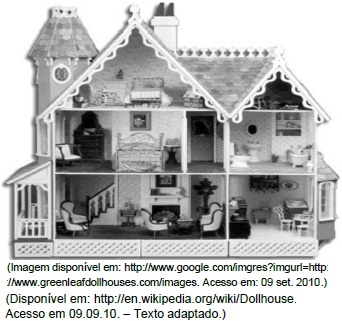
[1] A dollhouse is a toy home, made in miniature. For the last century, dollhouses have primarily been the
domain of children but their collection and crafting is also a hobby for many adults.
Today's dollhouses trace their history back about four hundred years to the baby house display cases of
Europe, which showed idealized interiors. Smaller doll houses with more realistic exteriors appeared in Europe in the
[5] 1700s. Early dollhouses were all handmade, but following the Industrial Revolution and World War II, they were
increasingly mass produced and became more standardized and affordable.
Miniature homes, furnished with domestic articles and resident inhabitants, both people and animals, have
been made for thousands of years. The earliest known examples were found in the Egyptian tombs of the Old
Kingdom, created nearly five thousand years ago. These wooden models of servants, furnishings, boats, livestock
[10] and pets placed in the Pyramids almost certainly were made for religious purposes.
The earliest known European dollhouses were the baby houses from the Sixteenth Century, which were
cabinet display cases made up of rooms. They showed idealized interiors complete with extremely detailed
furnishings and accessories. The cabinets were built with architectural details and filled with miniature household
items and were solely the playthings of adults. They were off-limits to children, not because of safety concerns for the
[15] child but for the dollhouse. Such cabinet houses were trophy collections owned by the few matrons living in the cities
of Holland, England and Germany ________ were rich enough to afford them, and, fully furnished, were worth the
price of a modest full-size house's construction.
The early European dollhouses were each unique, constructed on a custom basis by individual craftsmen.
With the advent of the Industrial Revolution, factories began producing toys, including dollhouses and miniatures
[20] suitable for furnishing them. Germany was the producer of the most prized dollhouses and their furnishings up until
World War I. Notable German miniature companies included Märklin, Rock and Garner and others. Their products
were not only avidly collected in Central Europe, but regularly exported to Britain and North America. Germany's
involvement in World War I seriously impeded both production and export. New manufacturers in other countries
arose. The TynieToy Company of Providence, in the U.S.A., made authentic replicas of American antique houses and
[25] furniture in a uniform scale beginning in about 1917. Dollhouse dolls and miniatures were also produced in Japan,
mostly by copying original German designs.
After World War II, dollhouses became mass produced in factories on a much larger scale than ever before,
even though with less detailed craftsmanship. By the 1950s, the typical dollhouse sold commercially was made of
painted sheet metal and contained plastic furniture. Such houses cost little enough so that the great majority of girls
[30] from the developed western countries that were not struggling with rebuilding after World War II could own one.
In the United States, most houses have an open back and a fancy front façade, while British houses usually
have a front part that opens to reveal the rooms.
Analise as proposições abaixo quanto à veracidade (V) ou falsidade (F), conforme o texto.
( ) A palavra unique (linha 18) pode ser adequadamente traduzida por sem igual.
( ) O pronome one (linha 30) faz remissão a maioria das meninas.
( ) A palavra fancy (linha 31) pode ser adequadamente traduzida por de bom gosto.
Assinale a alternativa que preenche corretamente os parênteses, de cima para baixo.
Questão 15 50415
UCS Vestibular de Verão 2011DOLLHOUSE
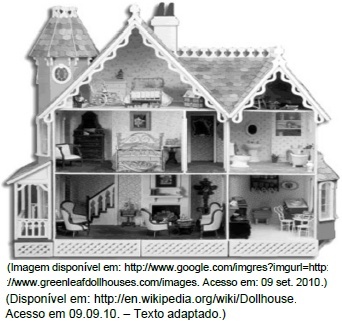
[1] A dollhouse is a toy home, made in miniature. For the last century, dollhouses have primarily been the
domain of children but their collection and crafting is also a hobby for many adults.
Today's dollhouses trace their history back about four hundred years to the baby house display cases of
Europe, which showed idealized interiors. Smaller doll houses with more realistic exteriors appeared in Europe in the
[5] 1700s. Early dollhouses were all handmade, but following the Industrial Revolution and World War II, they were
increasingly mass produced and became more standardized and affordable.
Miniature homes, furnished with domestic articles and resident inhabitants, both people and animals, have
been made for thousands of years. The earliest known examples were found in the Egyptian tombs of the Old
Kingdom, created nearly five thousand years ago. These wooden models of servants, furnishings, boats, livestock
[10] and pets placed in the Pyramids almost certainly were made for religious purposes.
The earliest known European dollhouses were the baby houses from the Sixteenth Century, which were
cabinet display cases made up of rooms. They showed idealized interiors complete with extremely detailed
furnishings and accessories. The cabinets were built with architectural details and filled with miniature household
items and were solely the playthings of adults. They were off-limits to children, not because of safety concerns for the
[15] child but for the dollhouse. Such cabinet houses were trophy collections owned by the few matrons living in the cities
of Holland, England and Germany ________ were rich enough to afford them, and, fully furnished, were worth the
price of a modest full-size house's construction.
The early European dollhouses were each unique, constructed on a custom basis by individual craftsmen.
With the advent of the Industrial Revolution, factories began producing toys, including dollhouses and miniatures
[20] suitable for furnishing them. Germany was the producer of the most prized dollhouses and their furnishings up until
World War I. Notable German miniature companies included Märklin, Rock and Garner and others. Their products
were not only avidly collected in Central Europe, but regularly exported to Britain and North America. Germany's
involvement in World War I seriously impeded both production and export. New manufacturers in other countries
arose. The TynieToy Company of Providence, in the U.S.A., made authentic replicas of American antique houses and
[25] furniture in a uniform scale beginning in about 1917. Dollhouse dolls and miniatures were also produced in Japan,
mostly by copying original German designs.
After World War II, dollhouses became mass produced in factories on a much larger scale than ever before,
even though with less detailed craftsmanship. By the 1950s, the typical dollhouse sold commercially was made of
painted sheet metal and contained plastic furniture. Such houses cost little enough so that the great majority of girls
[30] from the developed western countries that were not struggling with rebuilding after World War II could own one.
In the United States, most houses have an open back and a fancy front façade, while British houses usually
have a front part that opens to reveal the rooms.
Com base no texto, em relação às baby houses, analise a veracidade (V) ou falsidade (F) das proposições abaixo.
( ) Continham diversos aposentos e apresentavam detalhes arquitetônicos.
( ) Continham peças muito pequenas e, para a segurança das crianças, eram mantidas fora de seu alcance.
( ) Eram colecionadas por algumas senhoras ricas, que pagavam por elas um preço equivalente ao da construção de uma de suas mansões.
Assinale a alternativa que preenche corretamente os parênteses, de cima para baixo.
Questão 14 50414
UCS Vestibular de Verão 2011DOLLHOUSE
[1] A dollhouse is a toy home, made in miniature. For the last century, dollhouses have primarily been the
domain of children but their collection and crafting is also a hobby for many adults.
Today's dollhouses trace their history back about four hundred years to the baby house display cases of
Europe, which showed idealized interiors. Smaller doll houses with more realistic exteriors appeared in Europe in the
[5] 1700s. Early dollhouses were all handmade, but following the Industrial Revolution and World War II, they were
increasingly mass produced and became more standardized and affordable.
Miniature homes, furnished with domestic articles and resident inhabitants, both people and animals, have
been made for thousands of years. The earliest known examples were found in the Egyptian tombs of the Old
Kingdom, created nearly five thousand years ago. These wooden models of servants, furnishings, boats, livestock
[10] and pets placed in the Pyramids almost certainly were made for religious purposes.
The earliest known European dollhouses were the baby houses from the Sixteenth Century, which were
cabinet display cases made up of rooms. They showed idealized interiors complete with extremely detailed
furnishings and accessories. The cabinets were built with architectural details and filled with miniature household
items and were solely the playthings of adults. They were off-limits to children, not because of safety concerns for the
[15] child but for the dollhouse. Such cabinet houses were trophy collections owned by the few matrons living in the cities
of Holland, England and Germany ________ were rich enough to afford them, and, fully furnished, were worth the
price of a modest full-size house's construction.
The early European dollhouses were each unique, constructed on a custom basis by individual craftsmen.
With the advent of the Industrial Revolution, factories began producing toys, including dollhouses and miniatures
[20] suitable for furnishing them. Germany was the producer of the most prized dollhouses and their furnishings up until
World War I. Notable German miniature companies included Märklin, Rock and Garner and others. Their products
were not only avidly collected in Central Europe, but regularly exported to Britain and North America. Germany's
involvement in World War I seriously impeded both production and export. New manufacturers in other countries
arose. The TynieToy Company of Providence, in the U.S.A., made authentic replicas of American antique houses and
[25] furniture in a uniform scale beginning in about 1917. Dollhouse dolls and miniatures were also produced in Japan,
mostly by copying original German designs.
After World War II, dollhouses became mass produced in factories on a much larger scale than ever before,
even though with less detailed craftsmanship. By the 1950s, the typical dollhouse sold commercially was made of
painted sheet metal and contained plastic furniture. Such houses cost little enough so that the great majority of girls
[30] from the developed western countries that were not struggling with rebuilding after World War II could own one.
In the United States, most houses have an open back and a fancy front façade, while British houses usually
have a front part that opens to reveal the rooms.

Analise a veracidade (V) ou falsidade (F) das proposições abaixo, com base no texto.
( ) Era costume, no Antigo Egito, colocar uma casa em miniatura junto ao túmulo dos sacerdotes.
( ) Nos Estados Unidos, uma fábrica de brinquedos produzia réplicas de casas americanas antigas.
( ) Após a Segunda Guerra Mundial, as casas de bonecas passaram a ser feitas em tamanho bem maior.
Assinale a alternativa que preenche corretamente os parênteses, de cima para baixo.
06