


![[Marketing] Questao Topo - deslogado](https://storage.estuda.com.br/banners/0_6b7ebee90b03af1c560c73bb8bcce34a_banner_deslogado_70_dias.png)
Questões de Inglês
19.971 Questões
Questão 19 190224
ITA 2011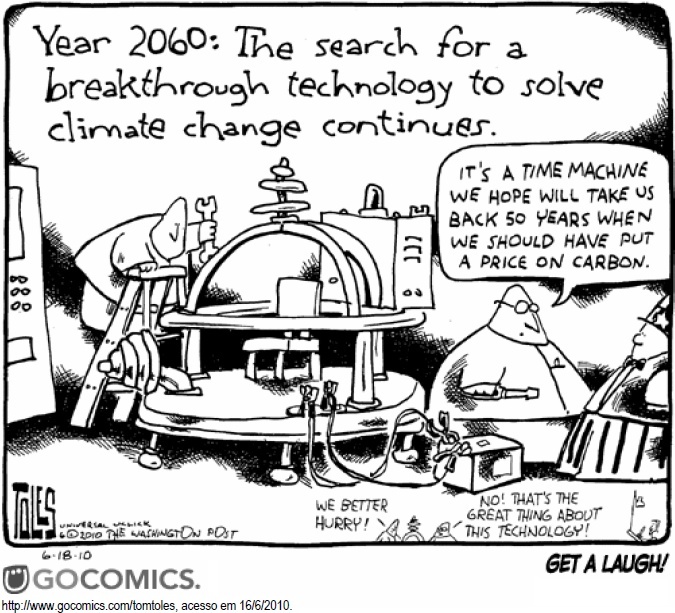
A mensagem transmitida pela charge NÃO denota
Questão 14 190218
ITA 2011New York City closed several blocks of Broadway in 2009 to create a pedestrian plaza around Times Square - a much-publicized experiment that in February became permanent policy, even though it did not improve traffic flow as much as hoped. The Big Apple has also dabbled in shorter-term but larger-scale street closures, barring cars on a stretch of streets leading from the Brooklyn Bridge to Central Park on a series of summer Saturdays in 2008 and 2009. And on June 7, New York City Mayor Michael Bloomberg announced a somewhat less sexy but nonetheless significant change in the city's infrastructure, instituting dedicated bus-only lanes on Manhattan's East Side to speed transit up and down the island.
Each of the measures instituted in the U.S.'s largest city turns over what had been primarily automotive-ruled space to pedestrians, cyclists or mass transit. In doing so the city follows a trend that has caught on in Europe and Latin America - in some cases long ago - but that has been slow to take root in the U.S. If New York and other American cities such as Portland, Ore., prove to be on the vanguard domestically, the changes there could portend a shift in the way urbanites in the U.S. use their streets in the years and decades to come.
"It clearly is a trend," says Lester Brown, president of the nonprofit Earth Policy Institute in Washington, D.C. "I think there are many cities that are ahead on this. Several years ago I was in Stockholm, and already there were many blocks where cars were banned."
Brown points to Enrique Peñalosa, who served as mayor of Bogotá, Colombia, from 1998 to 2001, as a pioneer in the kinds of changes now reaching the U.S. "He's the one who really redefined things when he took office," Brown says. The city's bus rapid transit (BRT) network, TransMilenio, is in many ways more like a subway system, with its own median-protected lanes and station platforms for loading and unloading passengers. Similar BRT systems have sprung up in places such as Mexico City and Ahmedabad, India, giving over lanes of the road exclusively to bus traffic.
"Thinking about why these kinds of reclamation make sense, I always talk about the spatial efficiency of walking, biking and buses," says Paul White, executive director of the New York City nonprofit advocacy group Transportation Alternatives. "When you think about what cities are, they are defined by their density - by definition the space between buildings is limited." The car, he adds, is the lowest density mode of transportation; that is, a person traveling by car takes up far more space than someone on a bicycle or on a bus. "In many respects cities are all the same in terms of supply and demand," White says. "There's always more demand for street use than there are streets."
Looking forward, White sees a more malleable future for the way streets are used. With retractable barriers, city planners can create socalled time-flexible streets, which might be open to vehicle traffic during part of the day and pedestrian-only at other times. "You're accommodating peak use - that could be peak deliveries in the morning and peak pedestrian use during lunchtime," he says. "That's something I think you'll see more of, and something we're pushing for."
By John Matson June 15, 2010, http://www.scientificamerican.com/article.cfm?id=car-free-streets, Acesso em 19/06/2010 (adapted)
Indique a opção CORRETA
Questão 13 190215
ITA 2011New York City closed several blocks of Broadway in 2009 to create a pedestrian plaza around Times Square - a much-publicized experiment that in February became permanent policy, even though it did not improve traffic flow as much as hoped. The Big Apple has also dabbled in shorter-term but larger-scale street closures, barring cars on a stretch of streets leading from the Brooklyn Bridge to Central Park on a series of summer Saturdays in 2008 and 2009. And on June 7, New York City Mayor Michael Bloomberg announced a somewhat less sexy but nonetheless significant change in the city's infrastructure, instituting dedicated bus-only lanes on Manhattan's East Side to speed transit up and down the island.
Each of the measures instituted in the U.S.'s largest city turns over what had been primarily automotive-ruled space to pedestrians, cyclists or mass transit. In doing so the city follows a trend that has caught on in Europe and Latin America - in some cases long ago - but that has been slow to take root in the U.S. If New York and other American cities such as Portland, Ore., prove to be on the vanguard domestically, the changes there could portend a shift in the way urbanites in the U.S. use their streets in the years and decades to come.
"It clearly is a trend," says Lester Brown, president of the nonprofit Earth Policy Institute in Washington, D.C. "I think there are many cities that are ahead on this. Several years ago I was in Stockholm, and already there were many blocks where cars were banned."
Brown points to Enrique Peñalosa, who served as mayor of Bogotá, Colombia, from 1998 to 2001, as a pioneer in the kinds of changes now reaching the U.S. "He's the one who really redefined things when he took office," Brown says. The city's bus rapid transit (BRT) network, TransMilenio, is in many ways more like a subway system, with its own median-protected lanes and station platforms for loading and unloading passengers. Similar BRT systems have sprung up in places such as Mexico City and Ahmedabad, India, giving over lanes of the road exclusively to bus traffic.
"Thinking about why these kinds of reclamation make sense, I always talk about the spatial efficiency of walking, biking and buses," says Paul White, executive director of the New York City nonprofit advocacy group Transportation Alternatives. "When you think about what cities are, they are defined by their density - by definition the space between buildings is limited." The car, he adds, is the lowest density mode of transportation; that is, a person traveling by car takes up far more space than someone on a bicycle or on a bus. "In many respects cities are all the same in terms of supply and demand," White says. "There's always more demand for street use than there are streets."
Looking forward, White sees a more malleable future for the way streets are used. With retractable barriers, city planners can create socalled time-flexible streets, which might be open to vehicle traffic during part of the day and pedestrian-only at other times. "You're accommodating peak use - that could be peak deliveries in the morning and peak pedestrian use during lunchtime," he says. "That's something I think you'll see more of, and something we're pushing for."
By John Matson June 15, 2010, http://www.scientificamerican.com/article.cfm?id=car-free-streets, Acesso em 19/06/2010 (adapted)
Marque o título que melhor contempla o tema do texto.
Questão 9 190210
ITA 2011Our Imaginary, Hotter Selves
Avatars might serve therapeutic purposes, helping those with social phobia become more confident.
by Sharon Begley
[1] Anyone who has ever had a bad hair day, when looking like a latter-day Medusa makes you feel cranky and antisocial and
plodding, can sympathize with the Oakland Raiders - and not because the players get helmet hair. The Raiders alternated between
mostly black and mostly white uniforms, depending on whether they were playing at home or away. Knowing that appearance
affects people's mood and outlook, psychologists wondered whether uniform color influenced the Raiders' aggressiveness. Using
[5] data from the 1970s and 1980s, they found that the team racked up way more penalty yards - a measure of aggression - when they
wore black than when they wore white, for infractions both minor (encroachment) and major (roughing the kicker). The pattern held
even when the scientists took into account different conditions and styles of play at home and away. But while the 1988 finding has
become a classic in psychology, the explanation remains controversial. Do referees, because of black's cultural baggage, see
black-clad players as meaner and badder than those in, say, baby blue? Or does wearing black make players see themselves as
[10] tougher and meaner - and therefore cause them to play that way?
Jeremy Bailenson and Nick Yee of Stanford University had this and other classic studies in mind when they started wondering
about the effect of being able to alter one's appearance. They weren't going to study wardrobe choices, however. Their quarry is
avatars, digital representations of players in such games as Second Life. "Your physical appearance changes how people treat
you," says Bailenson. "But independent of that, when you perceive yourself in a certain way, you act differently." He and Yee call it
[15] "the Proteus effect," after the shape-changing Greek god. The effect of appearance on behavior, they find, carries over from the
virtual world to the real one, with intriguing consequences. (…)
http://www.newsweek.com. Acesso em 5/6/2010.
Assinale a opção CORRETA.
Questão 8 190208
ITA 2011Our Imaginary, Hotter Selves
Avatars might serve therapeutic purposes, helping those with social phobia become more confident.
by Sharon Begley
[1] Anyone who has ever had a bad hair day, when looking like a latter-day Medusa makes you feel cranky and antisocial and
plodding, can sympathize with the Oakland Raiders - and not because the players get helmet hair. The Raiders alternated between
mostly black and mostly white uniforms, depending on whether they were playing at home or away. Knowing that appearance
affects people's mood and outlook, psychologists wondered whether uniform color influenced the Raiders' aggressiveness. Using
[5] data from the 1970s and 1980s, they found that the team racked up way more penalty yards - a measure of aggression - when they
wore black than when they wore white, for infractions both minor (encroachment) and major (roughing the kicker). The pattern held
even when the scientists took into account different conditions and styles of play at home and away. But while the 1988 finding has
become a classic in psychology, the explanation remains controversial. Do referees, because of black's cultural baggage, see
black-clad players as meaner and badder than those in, say, baby blue? Or does wearing black make players see themselves as
[10] tougher and meaner - and therefore cause them to play that way?
Jeremy Bailenson and Nick Yee of Stanford University had this and other classic studies in mind when they started wondering
about the effect of being able to alter one's appearance. They weren't going to study wardrobe choices, however. Their quarry is
avatars, digital representations of players in such games as Second Life. "Your physical appearance changes how people treat
you," says Bailenson. "But independent of that, when you perceive yourself in a certain way, you act differently." He and Yee call it
[15] "the Proteus effect," after the shape-changing Greek god. The effect of appearance on behavior, they find, carries over from the
virtual world to the real one, with intriguing consequences. (…)
http://www.newsweek.com. Acesso em 5/6/2010.
De acordo com o título e o subtítulo do texto, avatares
Questão 7 190207
ITA 2011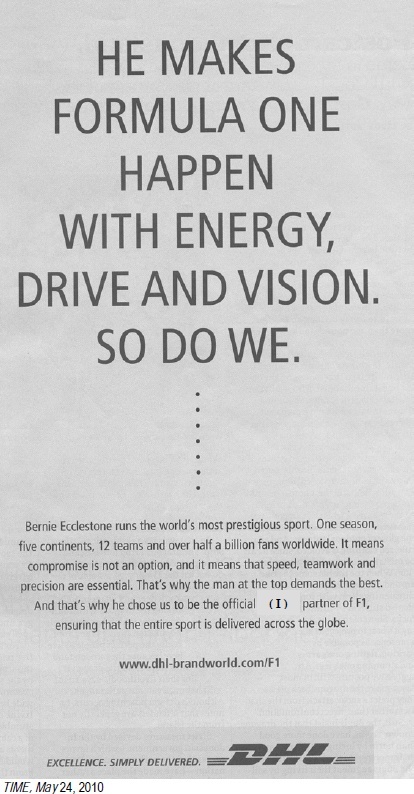
O texto informa que Bernie Ecclestone
06