


![[Marketing] Questao Topo - deslogado](https://storage.estuda.com.br/banners/0_6b7ebee90b03af1c560c73bb8bcce34a_banner_deslogado_70_dias.png)
Questões de Inglês
19.971 Questões
Questão 48 603326
UCPEL Verão 2011Leia o texto e responda a pergunta.
[1] TURNING THOUGHTS INTO WORDS
[2] A new approach allows more information to be extracted from the brain.
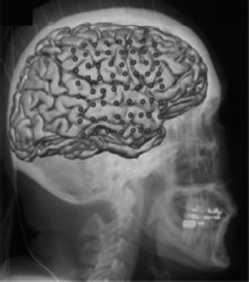
[3] Brain-computer interfaces could someday provide a lifeline to “locked-in”
[4] patients, who are unable to talk or move but are aware and awake. Many
[5] of these patients can communicate by blinking their eyes, but turning blinks
[6] into words is time-consuming and exhausting. Scientists in Utah have now
[7] demonstrated a way to determine which of 10 distinct words a person is
[8] thinking by recording the electrical activity from the surface of the brain.
[9] The new technique involves training algorithms to recognize specific brain
[10] signals picked up by an array of nonpenetrating electrodes placed over the
[11] language centers of the brain, says Spencer Kellis, one of the bioengineers
[12] who carried out the work at the University of Utah, in Salt Lake City. The
[13] approach used is known as electrocorticography (ECoG). The group was
[14] able to identify the words “yes,” “no,” “hot, “cold,” “thirsty,” “hungry,”
[15] “hello,” “goodbye,” “more,” and “less” with an accuracy of 48 percent.
[16] “The accuracy definitely needs to be improved,” says Kellis. “But we have
[17] shown the information is there.”
[18] Individual words have been decoded from brain signals in the past using
[19] functional magnetic resonance imaging (fMRI), says Eric Leuthardt, director of the Center for Innovation in Neuroscience
[20] and Technology at Washington University School of Medicine in St. Louis, Missouri. This is the first time that the feat
[21] has been performed using ECoG, a far more practical and portable approach than fMRI, he says.
[22] Working with colleagues Bradley Greger and Paul House, Kellis placed 16 electrodes on the surface of the brain of a
[23] patient being treated for epilepsy. The electrodes recorded signals from the facial motor cortex—an area of the brain
[24] that controls face muscles during speech—and over the Wernicke’s area, part of the cerebral cortex that is linked with
[25] language. To train the algorithm, signals were analyzed as the patient was asked to repeatedly utter the 10 words.
[26] It’s possible to use less invasive techniques, such as electroencephalography (EEG), which places electrodes _____
[27] the scalp, to enable brain-to-computer communications. Adrian Owen, a senior scientist in the Cognition and Brain
[28] Sciences Unit at the University of Cambridge, UK, has shown that EEG signals can be used to allow people in a
[29] persistent vegetative state to communicate “yes” and “no.”
[30] But with EEG, many of the signals are filtered out by the skull, says Leuthardt. “What’s really nice about ECoG is its
[31] potential to give us a lot more information,” he says.
[32] Decoding 10 words is “very cool,” says Owen, but the accuracy will need to improve dramatically, given the patients
[33] the technology is aimed at. “I don’t think even 60 percent or 70 percent accuracy is going to work for patients who
[34] cannot communicate in any other way and where there is no other margin for verification,” he says.
[35] Ultimately, the hope is that ECoG will enable much more sophisticated communication. Last year Leuthardt showed
[36] that ECoG could be used to decode vowel and consonant sounds—an approach that might eventually be used to
[37] reconstruct a much larger number of complete words.
[38] By Duncan Graham-Rowe / Massachusetts, Technology Review, MIT, 09/23/2010
[39] Adapted from http://www.technologyreview.com/communications/26332/?p1=Headlines&a=f#afteradbody
Em relação às afirmações abaixo, é correto afirmar que
I. Já é possível identificar palavras nas quais uma pessoa está pensando através da decodificação da atividade elétrica no interior do cérebro.
II. O grupo de pesquisa conseguiu identificar palavras como “sim”, “não”, “quente”, “frio”, “com sede”, “com fome”, “olá”, “adeus”, “mais” e “menos” com mais de 48% de acerto.
III. A nova técnica desenvolvida pelos cientistas envolve o treinamento de algoritmos para reconhecer sinais cerebrais captados por eletrodos internos colocados nos centros de linguagem do cérebro.
IV. Os cientistas estão completamente satisfeitos com a precisão dos resultados da nova técnica.
Questão 47 603319
UCPEL Verão 2011Leia o texto e responda a pergunta.
[1] TURNING THOUGHTS INTO WORDS
[2] A new approach allows more information to be extracted from the brain.
[3] Brain-computer interfaces could someday provide a lifeline to “locked-in”
[4] patients, who are unable to talk or move but are aware and awake. Many
[5] of these patients can communicate by blinking their eyes, but turning blinks
[6] into words is time-consuming and exhausting. Scientists in Utah have now
[7] demonstrated a way to determine which of 10 distinct words a person is
[8] thinking by recording the electrical activity from the surface of the brain.
[9] The new technique involves training algorithms to recognize specific brain
[10] signals picked up by an array of nonpenetrating electrodes placed over the
[11] language centers of the brain, says Spencer Kellis, one of the bioengineers
[12] who carried out the work at the University of Utah, in Salt Lake City. The
[13] approach used is known as electrocorticography (ECoG). The group was
[14] able to identify the words “yes,” “no,” “hot, “cold,” “thirsty,” “hungry,”
[15] “hello,” “goodbye,” “more,” and “less” with an accuracy of 48 percent.
[16] “The accuracy definitely needs to be improved,” says Kellis. “But we have
[17] shown the information is there.”
[18] Individual words have been decoded from brain signals in the past using
[19] functional magnetic resonance imaging (fMRI), says Eric Leuthardt, director of the Center for Innovation in Neuroscience
[20] and Technology at Washington University School of Medicine in St. Louis, Missouri. This is the first time that the feat
[21] has been performed using ECoG, a far more practical and portable approach than fMRI, he says.
[22] Working with colleagues Bradley Greger and Paul House, Kellis placed 16 electrodes on the surface of the brain of a
[23] patient being treated for epilepsy. The electrodes recorded signals from the facial motor cortex—an area of the brain
[24] that controls face muscles during speech—and over the Wernicke’s area, part of the cerebral cortex that is linked with
[25] language. To train the algorithm, signals were analyzed as the patient was asked to repeatedly utter the 10 words.
[26] It’s possible to use less invasive techniques, such as electroencephalography (EEG), which places electrodes _____
[27] the scalp, to enable brain-to-computer communications. Adrian Owen, a senior scientist in the Cognition and Brain
[28] Sciences Unit at the University of Cambridge, UK, has shown that EEG signals can be used to allow people in a
[29] persistent vegetative state to communicate “yes” and “no.”
[30] But with EEG, many of the signals are filtered out by the skull, says Leuthardt. “What’s really nice about ECoG is its
[31] potential to give us a lot more information,” he says.
[32] Decoding 10 words is “very cool,” says Owen, but the accuracy will need to improve dramatically, given the patients
[33] the technology is aimed at. “I don’t think even 60 percent or 70 percent accuracy is going to work for patients who
[34] cannot communicate in any other way and where there is no other margin for verification,” he says.
[35] Ultimately, the hope is that ECoG will enable much more sophisticated communication. Last year Leuthardt showed
[36] that ECoG could be used to decode vowel and consonant sounds—an approach that might eventually be used to
[37] reconstruct a much larger number of complete words.
[38] By Duncan Graham-Rowe / Massachusetts, Technology Review, MIT, 09/23/2010
[39] Adapted from http://www.technologyreview.com/communications/26332/?p1=Headlines&a=f#afteradbody
Na linha 3, usa-se a expressão “locked-in” para definir pessoas. Nesse contexto, a expressão significa
Questão 48 603067
UCPEL Fevereiro 2011Leia o texto e responda a pergunta.
[1] ACID RAIN

[2] Acid rain is a form of precipitation containing a heavy
[3] concentration of sulfuric and nitric acids. When fossil
[4] fuels such as coal, gasoline, and fuel oils are burned,
[5] they emit oxides of sulfur, carbon, and nitrogen into the
[6] air. These oxides combine with moisture in the air to
[7] form sulfuric acid, carbonic acid, and nitric acid. The
[8] term acid rain is also applied to other forms of
[9] precipitation - snow, hail, sleet, and fog - that are
[10] similarly acidic. Such precipitation has become an
[11] increasingly serious environmental problem in many
[12] areas of North America, Europe, and Asia. Although
[13] this form of pollution is most severe in and around large
[14] urban and industrial areas, substantial amounts of acid
[15] precipitation may be transported great distances.
[16] The process that results in the formation of acid rain
[17] generally begins with emissions into the atmosphere of sulfur dioxide and nitrogen oxide. These gases are released by
[18] automobiles, certain industrial operations, and electric power plants that burn fossil fuels such as coal and oil. The
[19] gases combine with water vapour in clouds to form sulfuric and nitric acids. When precipitation falls from the clouds,
[20] it is highly acidic, having a pH value of about 5.6 or lower.
[21] Precipitation and fog of high acidity contaminate lakes and streams; they are particularly harmful to fish and other
[22] aquatic life in regions with thin soil and granitic rock, which provide little buffering to acidic inputs. It also has been
[23] discovered that aluminum is leached from the soil in regions subjected to such acid precipitation, and that dissolved
[24] aluminum seems to be extremely toxic to aquatic organisms. All forms of acid precipitation have been found to
[25] damage various kinds of vegetation, including agricultural crops and trees, chiefly by inhibiting nitrogen fixation and
[26] leaching nutrients from foliage. ________, these pollutants can corrode the external surfaces of buildings and other
[27] man-made structures; marble structures and statues are especially vulnerable to their damaging effects.
[28] The problem of acid rain has been mainly dealt with in two ways. Adherents to the “cost-sharing” principle believe acid
[29] rain is a regional problem that should be dealt with collectively by all countries affected by the problem. Supporters of
[30] the “polluter pays” approach highlight the actions and responsibility of the polluter, which they believe should pay for
[31] the damages caused by its habits and institutions.
[32] From the Encyclopædia Britannica
[33] http://www.britannica.com/EBchecked/topic/3761/acid-rain
Leia as afirmações a seguir e as analise como VERDADEIRAS (V) ou FALSAS (F).
( ) A chuva ácida contém alta concentração de ácido sulfúrico e ácido nítrico.
( ) A chuva, que é uma precipitação atmosférica, possui pH básico.
( ) As precipitações ácidas contaminam lagos e rios.
( ) A chuva ácida somente ocorre em áreas urbanas e industriais.
( ) Os gases produtores de chuva ácida são emitidos principalmente por automóveis e indústrias.
A sequência correta para as afirmações anteriores é
Questão 47 603060
UCPEL Fevereiro 2011Leia o texto e responda a pergunta.
[1] ACID RAIN
[2] Acid rain is a form of precipitation containing a heavy
[3] concentration of sulfuric and nitric acids. When fossil
[4] fuels such as coal, gasoline, and fuel oils are burned,
[5] they emit oxides of sulfur, carbon, and nitrogen into the
[6] air. These oxides combine with moisture in the air to
[7] form sulfuric acid, carbonic acid, and nitric acid. The
[8] term acid rain is also applied to other forms of
[9] precipitation - snow, hail, sleet, and fog - that are
[10] similarly acidic. Such precipitation has become an
[11] increasingly serious environmental problem in many
[12] areas of North America, Europe, and Asia. Although
[13] this form of pollution is most severe in and around large
[14] urban and industrial areas, substantial amounts of acid
[15] precipitation may be transported great distances.
[16] The process that results in the formation of acid rain
[17] generally begins with emissions into the atmosphere of sulfur dioxide and nitrogen oxide. These gases are released by
[18] automobiles, certain industrial operations, and electric power plants that burn fossil fuels such as coal and oil. The
[19] gases combine with water vapour in clouds to form sulfuric and nitric acids. When precipitation falls from the clouds,
[20] it is highly acidic, having a pH value of about 5.6 or lower.
[21] Precipitation and fog of high acidity contaminate lakes and streams; they are particularly harmful to fish and other
[22] aquatic life in regions with thin soil and granitic rock, which provide little buffering to acidic inputs. It also has been
[23] discovered that aluminum is leached from the soil in regions subjected to such acid precipitation, and that dissolved
[24] aluminum seems to be extremely toxic to aquatic organisms. All forms of acid precipitation have been found to
[25] damage various kinds of vegetation, including agricultural crops and trees, chiefly by inhibiting nitrogen fixation and
[26] leaching nutrients from foliage. ________, these pollutants can corrode the external surfaces of buildings and other
[27] man-made structures; marble structures and statues are especially vulnerable to their damaging effects.
[28] The problem of acid rain has been mainly dealt with in two ways. Adherents to the “cost-sharing” principle believe acid
[29] rain is a regional problem that should be dealt with collectively by all countries affected by the problem. Supporters of
[30] the “polluter pays” approach highlight the actions and responsibility of the polluter, which they believe should pay for
[31] the damages caused by its habits and institutions.
[32] From the Encyclopædia Britannica
[33] http://www.britannica.com/EBchecked/topic/3761/acid-rain
O termo chuva ácida também é utilizado para outras formas de precipitação atmosférica igualmente ácidas. A forma NÃO CITADA no texto é
Questão 48 450028
UCPEL Inverno 2011[1] “BING” GETS FRIENDLIER WITH “FACEBOOK”

[2] New features will push the Microsoft search engine ahead of Google in the race to make search more social.
[3] Starting tomorrow, recommendations from your Facebook
[4] friends will become a regular part of Web search results, at
[5] least if you use Microsoft’s Bing search engine. A slew of new
[6] Bing features will use Facebook data to make its results more
[7] personalized, and to create opportunities to discuss what you
[8] are searching for with friends.
[9] “All the stuff we’ve deployed previously for Web search doesn’t
[10] acknowledge the human, social side of our users,” says Stefan
[11] Weitz, director of Bing search. “We were looking at it like
[12] engineers, and built a purely logic-based experience,” Weitz
[13] says. Web search should support people’s instincts to consult
[14] and discuss things with other people. A survey of Bing users found that 90 percent would talk with a friend before they
[15] acted on any information they found when searching online for product information, he says.
[16] The new features will push Bing ahead of Google in the race to make search more social. Last month, Google launched
[17] +1, its own close analogue of the Like button, with the intention of using it to shape search results. However, +1 is off to
[18] a slow start, because it is not hitched to a large social network, giving users little motivation to use it.
[19] Bing’s new features primarily use data that comes from the clicks on Facebook’s Like buttons. These buttons appear on
[20] sites across the Web. The Like button started as a low-cost way to communicate recommendations with friends online,
[21] but in recent years, it’s been adapted by Facebook to drive the ambitious “open graph” project, whose goal is to
[22] intertwine Facebook’s network of connections with the Web.
[23] Bing has been using data on the likes of users’ friends in its results since October, adding a box featuring relevant links
[24] liked by Facebook friends to some search results. Now these likes will have a much more visible effect on search results.
[25] The profile pictures of friends will appear next to search results that they have liked. Those likes will also be used to
[26] promote pages that otherwise may not have appeared on the first page of results.
[27] Other new features are intended to make search into a communication tool that can connect you with existing Facebook
[28] contacts or new ones. Searching for people – even those you are not linked with directly – may now return a short bio taken
[29] from Facebook profiles. This could include information like the person’s location, school, and employer.
[30] When a user searches for a city, Bing will highlight friends that Facebook says are located nearby. This presumably
[31] would allow you to connect with people who might have recommendations about places to stay or visit, or friends you
[32] might want to inform about your visit.
[33] Bing’s product search engine will also include new Facebook features. It will be possible to post a short list of possible
[34] purchases to your Facebook wall, to encourage friends to help you choose. “This turns search into a conversation, and
[35] makes it a less passive experience,” says Weitz.
[36] Bing’s new features can only access information if your Facebook privacy settings will allow it. Research on neurobiology
[37] and social psychology helped guide Bing’s new direction, says Weitz, who claims the approach will help make decision
[38] making easier. Traditional Web search triggers an unhelpful phenomenon known as “decision quicksand,” says Weitz.
[39] The term describes how people come to think of decisions as more important _________ they really are because of the
[40] complexity of weighing all the evidence. “When you use traditional Web search, your brain thinks everything is really
[41] important because there are half a million results you are told are relevant and have to deal with,” says Weitz. “What
[42] we’re doing now is using social signals to simplify that so your brain isn’t tricked.”
By Tom Simonite / Massachusetts, Technology Review, MIT, 16/05/2011
Adapted from http://www.technologyreview.com/web/37585/?mod=chfeatured
Em relação às afirmações abaixo, é correto afirmar o seguinte:
I. A ferramenta de busca do Bing considerará as recomendações feitas por seus amigos no Facebook.
II. Uma pesquisa com usuários do Bing revelou que 90% deles já se comunicam com seus amigos por telefone antes de tomar decisões sobre qualquer informação que encontrem sobre produtos online.
III. As novas funcionalidades farão com que o Bing ultrapasse a liderança do Google na corrida para tornar as buscas mais sociáveis.
IV. O botão “+1” do Google é análogo ao botão “Like” (Gostei) do Facebook.
Questão 40 411438
URCA 2° Dia 2011/2Remarks by the President Barack Obama on Osama Bin Laden (Part II)
(…)
Then, last August, after years of painstaking work by our intelligence community, I was briefed on a possible lead to bin Laden. It was far from certain, and it took many months to run this thread to ground. And finally, last week, I determined that we had enough intelligence to take action, and authorized an operation to get Osama bin Laden and bring him to justice.
Today, at my direction, the United States launched a targeted operation against that compound in Abbottabad, Pakistan. A small team of Americans carried out the operation with extraordinary courage and capability. No Americans were harmed. They took care to avoid civilian casualties. After a firefight, they killed Osama bin Laden and took custody of his body.
For over two decades, bin Laden has been al Qaeda’s leader and symbol, and has continued to plot attacks against our country and our friends and allies. The death of bin Laden marks the most significant achievement to date in our nation’s effort to defeat al Qaeda.
Yet his death does not mark the end of our effort. There’s no doubt that al Qaeda will continue to pursue attacks against us. We must and we will remain vigilant at home and abroad.
As we do, we must also reaffirm that the United States is not and never will be at war with Islam. I’ve made clear, just as President Bush did shortly after 9/11, that our war is not against Islam. Bin Laden was not a Muslim leader; he was a mass murderer of Muslims. Indeed, al Qaeda has slaughtered scores of Muslims in many countries, including our own. So his demise should be welcomed by all who believe in peace and human dignity.
(…)
Extracted from: http://www.whitehouse.gov/blog/2011/05/02/osama binladendead
Painstaking means:
06