


![[Marketing] Questao Topo - deslogado](https://storage.estuda.com.br/banners/0_6b7ebee90b03af1c560c73bb8bcce34a_banner_deslogado_70_dias.png)
Questões de Inglês
19.971 Questões
Questão 85 44113
UFG 2012/1Potatoes Can Reduce Blood Pressure
Just a couple of servings of potato a day can reduce blood pressure in obese or overweight people with high blood pressure, calling into question the lowly spud's current reputation as a fattening, unhealthy food, according to new research presented at a conference in Denver, Colorado, USA, on Wednesday.
“The potato, more than perhaps any other vegetable, has an undeserved, bad reputation that has led many healthconscious people to ban them from their diet, “said Dr Joe Vinson, a professor in the Department of Chemistry at the University of Scranton in Pennsylvania, who led the research that was presented at the 242nd National Meeting & Exposition of the American Chemical Society (ACS)
But before you go out and order French fries, the preferred way of eating this most consumed of all vegetables in the US, consider this: the research was done with purple potatoes cooked in the microwave oven, with no oil or fat whatsoever.
Disponível em: <http://www.medicalnewstoday.com/articles/233690.php>. Acesso em: 1º set. 2011.
The main aim of the report is to
Questão 83 44111
UFG 2012/1Slavoj Žižek: the world’s hippest philosopher
Slavoj Žižek has got an opinion on every subject from decaffeinated coffee to sex, from seagulls and swearing to the end of the world. He talks to Helen Brown.
Žižek dismisses those who dub him “The Elvis of Philosophy” with a brisk: “To the gulag! All of them!”. “It is too traumatic for me to see myself. Whenever I see such a thing, my reaction is to ask: 'Would a woman allow me to take her daughter to the cinema?’ My God! Of course not! I don’t want to deal with myself. I don’t want to exist. I just want to think.”
But whether he wanted to or not, Slavoj Žižek came into independent existence in March 1949, in the then-Yugoslav republic of Slovenia. His father was an economist and civil servant and his mother was an accountant.
“My life is straightforward,” he says. “Nothing happened. At 15, I wanted to be a movie director. But I saw some really good European films and I accepted that I couldn’t do that. Then, at 17, I decided to become a philosopher.”
BROWN, Helen. Slavoj Zizek: the world’s hippest philosopher.Disponível em:<http://www.telegraph.co.uk/culture/books/authorinterviews/7871302/Sl avoj-Zizek-the-worlds-hippest-philosopher.html>. Acesso em: 12 set. 2011. [Excerpt]. [Adapted].
Glossary:
hippest: mais famoso
gullag: agência do governo da União Soviética responsável pelos principais instrumentos de repressão política.
Which sentence concerns Žižek?
Questão 17 42717
UERJ 2012/2What’s in a name? The trouble with lingo
Remember the campaign in New York for garbage collectors to be called sanitation engineers?
Near the top of the strike’s agenda was the matter of getting the respect due to the people doing
such essential work. Unfortunately, the new euphemistic title clarified nothing about the work
and by now is either simply not heard for what it means, or is used in moments of gentle disdain.
[5] A clearer term may have both generated the respect desired and withstood the test of time.
Clarity and sincerity matter. Terms which mislead, confuse or cause offence can become
a distraction from the real content of public debate. In the search for consensus, since public
understanding is harder to change than terminology, changing the terminology might be a better
place to start. No additional prejudice or emotion should be brought to a debate by the terminology
[10] used in it. Here are two examples.
Genetic Engineering and Genetic Modification
Despite the insistence of biotech scientists that genes of completely different species are no
longer being mixed, the message isn’t being heard. They insist that they are now involved only
in developments which simply hasten the natural processes of selective and cross breeding or
[15] cross pollination. As farmers and horticulturists have been doing exactly this, unquestioned, for
years, they cannot understand public resistance.
The problem may well be the terminology. In this context, the words “scientific” or “genetic” have
been irreparably sullied. If “genetic engineering” has, in the public’s view, become synonymous
with the indiscriminate mixing of genes, and if the softer label “genetically modified” hasn’t been
[20] able to shake off a perception of sinister overtones, these terms might as well be dropped − or
left attached only to experiments in Dr. Frankenstein’s laboratory.
Ideally, a new agricultural term would leave out the word “genetic” altogether: it seems to
frighten the public. Assuming it described science’s benign genetic activities accurately, the term
“productivity breeding” is not a trivial call for a euphemism; besides, it would probably encounter
[25] less public opposition.
So, let’s have new terms for selective cross breeding by scientists who simply speed up the same
process that is carried out in nature.
Clean coal*
If this new term was intended to be clear, it hasn’t worked.
[30] In “Politics and the English Language” (1946), George Orwell wrote that because so much political
speech involves defending the indefensible, it has to consist largely of euphemism. He insisted
that, in politics, these euphemisms are “swindles” and “perversions” left deliberately vague in
order to mislead. Deliberate or not, “clean coal” is one of these. Aside from being a contradiction
in terms, the name is misleading, creating the impression of the existence of a new type of coal. In
[35] fact, it is ordinary coal which has been treated to “eliminate” most of its destructive by-products,
which are then buried. The whole process produces emissions. This, though, isn’t clear when it
is simply labelled “clean coal”. The term just doesn’t seem sincere. It’s a red rag to any green.
It’s not asking too much to expect the term describing these procedures to be more accurate. A
clearer term would be less provocative.
[40] So, what’s in a name? A lot. There’s the possibility of confusion, prejudice, perversions and
swindles. For the sake of fair debate, let’s mean what we say and say what we mean.
SEEARGH MACAULAY www.londongrip.com
The logical relationship between clauses establishes different notions.
An example which expresses the notion of concession is indicated in:
Questão 3 14040709
UEG Conhecimentos Gerais 2011/2Analise os textos. A questão se refere à eles.
TEXTO
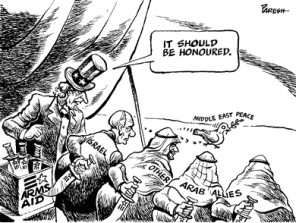
Disponível em: http://www.blackcommentator.com/241/241_images/241_cartoon_us_arms_aid_middle_east_small_over.gif. Acesso em: 7 fev. 2011.
TEXTO
US Arms Sales to Middle East Send Signal to Iran
By Gidon Belmaker
Dating back to the Cold War, American military aid to its Middle Eastern allies(1) has been one of the key factors affecting the power balance in the conflict-filled area.
The U.S. foreign aid policy in the Middle East “evolved over the years from a focus on preventing Soviet influence from gaining a foothold(2) in the region, and from maintaining a neutral stance(3) in the Arab-Israeli conflict, to strengthening Israel’s military and economy, and using foreign aid as an incentive to foster(4) peace agreements between countries in the region,” according to a congressional research service paper on aid to the Middle East. The United States is committed to keeping Israel's strategic advantage over its neighbors.
American aid in the Middle East is distributed to a wide variety of countries, some of which are in conflict with one another. The Saudi ruling(5) family is known for its extreme religious views and was accused in the past of supporting the Palestinian terrorist group Hamas.
Disponível em: http://www.theepochtimes.com/n2/content/view/45545/. Acesso em: 7 fev. 2011. (Adaptado).
Glossary
(1) Allies: countries that have agreed to help and support another country, especially in case of a war.
(2) Foothold: a strong position from which somebody can make progress and achieve success.
(3) Stance: position.
(4) Foster: to encourage something to develop.
(5) Ruling: having control over a particular group or country.
OXFORD ADVANCED LEARNER’S DICTIONARY. 6. ed. Oxford University Press, 2000.
Analisando a relação entre os textos, infere-se que eles
Questão 2 14040706
UEG Conhecimentos Gerais 2011/2TEXTO
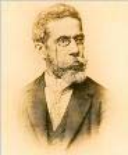
Disponível em:http://www.encyclopedia.com/RankImages.aspx?topicid=104931.Acesso em: 7 fev. 2011.
The Posthumous Memoirs of Bras Cubas
Where most novels are concerned with plot and characters, this one is all about structure. The narrative is a chronicle, of sorts, and through its realism and satire, it's impossible not to think that Machado de Assis is poking fun at(1) the very form he is seeking to embrace. There are many themes at the crux(2) of this work, not least of which is time, and how it relates to the deterioration of people, places, customs, and things. We are instructed to understand that even that which brings us joy is only temporary.
The narrator describes Virgilia as "the great sin of his youth." It was when she came into his life, he says, that his delirium began. Although Machado de Assis lived in a time when Romanticism in literature was the style du jour, the naturalistic, even sardonic(3) brush with which he paints his characters and scenes is refreshing for its very distinctiveness. Unlike Eça de Queiroz, whom he has been compared to on more than one occasion, Machado tends to parody the melodramatic genre, making light of romance, and treating love scenes with as much sincerity as if they were part of a theatrical skit.
The key to why this book works so well is that it's a parody of everything it represents. In spite of all the subtexts and literary allusions, it's worth reading strictly for its satire, as well as for its exceptional prose. It isn't difficult to see why this is considered to be a landmark novel in the history of Brazilian literature. Never has Machado more deftly(4) conveyed his realization of the vanity of all existence than he does in The Posthumous Memoirs of Bras Cubas.
Disponível em: http://www.worldliteratureforum.com/forum/showthread.php/10589-Machado-de-Assis-The-Posthumous-Memoirs-Of-Bras-Cubas.Acesso em: 7 fev. 2011. (Adaptado).
Glossary:
(1) Poke fun at: to say unkind things about somebody/something in order to make other people laugh at them.
(2) Crux: the most important or difficult part of a problem or an issue.
(3) Sardonic: showing that you think that you are better than other people and do not take them seriously.
(4) Deftly: skillfully.
OXFORD ADVANCED LEARNER’S DICTIONARY. 6. ed. Oxford University Press, 2000.
Sobre a obra Memórias póstumas de Brás Cubas, o texto afirma que se trata de
Questão 1 14040698
UEG Conhecimentos Gerais 2011/2TEXTO
Disponível em:http://www.encyclopedia.com/RankImages.aspx?topicid=104931.Acesso em: 7 fev. 2011.
The Posthumous Memoirs of Bras Cubas
Where most novels are concerned with plot and characters, this one is all about structure. The narrative is a chronicle, of sorts, and through its realism and satire, it's impossible not to think that Machado de Assis is poking fun at(1) the very form he is seeking to embrace. There are many themes at the crux(2) of this work, not least of which is time, and how it relates to the deterioration of people, places, customs, and things. We are instructed to understand that even that which brings us joy is only temporary.
The narrator describes Virgilia as "the great sin of his youth." It was when she came into his life, he says, that his delirium began. Although Machado de Assis lived in a time when Romanticism in literature was the style du jour, the naturalistic, even sardonic(3) brush with which he paints his characters and scenes is refreshing for its very distinctiveness. Unlike Eça de Queiroz, whom he has been compared to on more than one occasion, Machado tends to parody the melodramatic genre, making light of romance, and treating love scenes with as much sincerity as if they were part of a theatrical skit.
The key to why this book works so well is that it's a parody of everything it represents. In spite of all the subtexts and literary allusions, it's worth reading strictly for its satire, as well as for its exceptional prose. It isn't difficult to see why this is considered to be a landmark novel in the history of Brazilian literature. Never has Machado more deftly(4) conveyed his realization of the vanity of all existence than he does in The Posthumous Memoirs of Bras Cubas.
Disponível em: http://www.worldliteratureforum.com/forum/showthread.php/10589-Machado-de-Assis-The-Posthumous-Memoirs-Of-Bras-Cubas.Acesso em: 7 fev. 2011. (Adaptado).
Glossary:
(1) Poke fun at: to say unkind things about somebody/something in order to make other people laugh at them.
(2) Crux: the most important or difficult part of a problem or an issue.
(3) Sardonic: showing that you think that you are better than other people and do not take them seriously.
(4) Deftly: skillfully.
OXFORD ADVANCED LEARNER’S DICTIONARY. 6. ed. Oxford University Press, 2000.
According to the text, Machado de Assis
06