


![[Marketing] Questao Topo - deslogado](https://storage.estuda.com.br/banners/0_6b7ebee90b03af1c560c73bb8bcce34a_banner_deslogado_70_dias.png)
Questões de Inglês
19.971 Questões
Questão 41 49376
ESPM 2012/2Rolling back the nanny state Live free and pay more tax
The need for revenue has encouraged cash-strapped state and local governments to scrap restrictions on alcohol sales, gambling and even fireworks
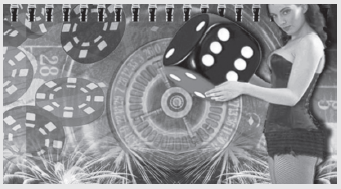
LAST week the state of Washington began auctioning the licences to 167 of the liquor stores it runs. By June 1st Washington will be out of the liquor business altogether, freeing private businesses to sell spirits in the state for the first time since Prohibition. Last year, despite dire warnings about corporate profiteers, drunk drivers and surging policing costs, voters in the state approved the privatisation in a referendum by 59% to 41%.
Something similar happened in Georgia on March 6th, when voters lifted the ban on sales of alcohol on Sundays in 24 of the 27 cities and counties that had put the issue on the ballot, alongside the state’s presidential primary. Since Georgia first allowed local governments to hold referendums on Sunday sales last year, voters have approved the practice in 129 out of 154 instances, often by huge margins. Last year in Texas, attempts to turn “dry” localities “wet” succeeded on 57 out of 64 occasions. In West Virginia meanwhile, the state legislature has just passed a bill allowing liquor stores to hold tasting sessions. It is the ninth state to approve such a measure since 2009. “The world is getting wetter,” exults Frank Coleman of the Distilled Spirits Council of the United States (DISCUS), an industry group.
It is not just drinkers who are benefiting from a loosening of puritanical regulations around America. Massachusetts last year became the 24th state to allow casinos in some form. Ohio did the same in 2009, and Maryland did in 2008. Maine, not to be outdone, has just issued its first casino licence, and also lifted a ban on fireworks at the beginning of the year. Rhode Island legalised fireworks in 2010, and will hold a referendum in November about expanding gambling.
This trend is not, sadly, the result of a sudden renunciation of paternalism by state governments. Rather, it stems from the states’ dire fiscal straits in the aftermath of the recession. “States are looking for a source of revenue beyond [directly] taxing their residents,” says Holly Wetzel of the American Gaming Association, which represents gambling interests. Mandy Rafool of the National Conference of State Legislatures puts it more bluntly: “States have been so desperate over the last few years that they’re looking at everything.”
Mar 17th 2012 | www.economist.com
The underlined words ‘the practice’ in ‘Since Georgia first allowed local governments to hold referendums on Sunday sales last year, voters have approved the practice in 129 out of 154 instances, often by huge margins.’, refer to:
Questão 50 49302
ESPM 2012/1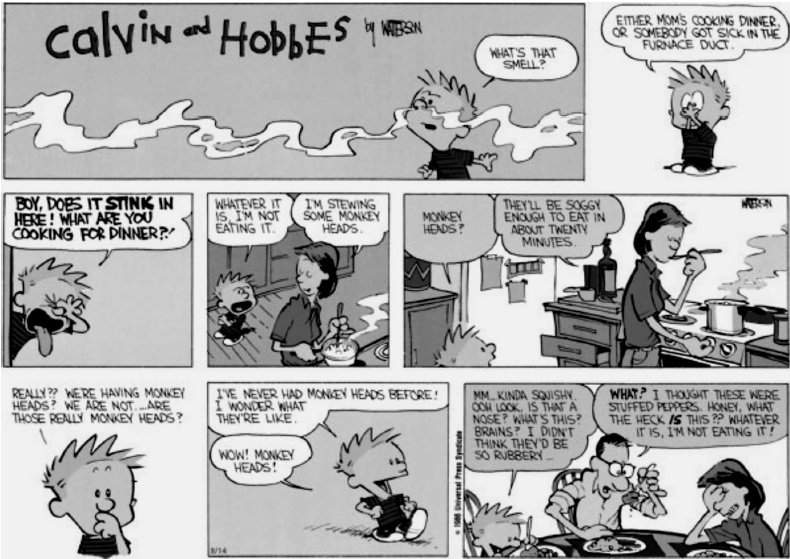
According to the comic strip:
Questão 49 49301
ESPM 2012/1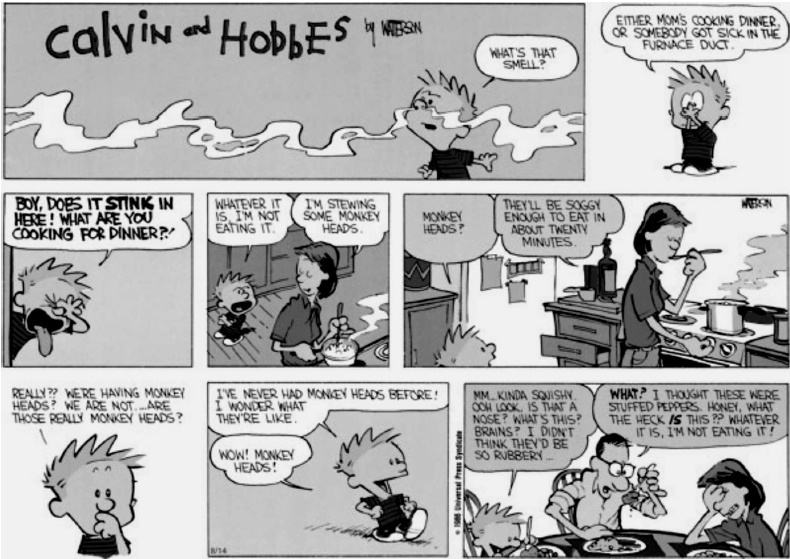
In the second strip, the sentence “Either mom’s cooking dinner, or someone got sick in the furnace duct”, either...or... expresses the idea of:
Questão 47 49299
ESPM 2012/1New riot-control technology
The sound and the fury
Quelling unrest is a lucrative trade
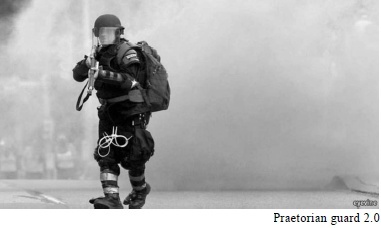
MOBS are bad for businesses—unless you are selling riot-control gear, that is. Even before this week’s riots in Britain governments were bracing themselves against protests stoked by the economic downturn. Firms such as Israel’s Hagor Industries are doing a roaring trade in antiriot shields, batons and helmets. David Frenkel, the firm’s production manager, says demand is growing from police and military services in Europe, South America and Africa, bolstered by “war, unrest and natural disasters”.
Ochlocracy—mob rule—was a term coined in ancient times, when grain prices or a celebrity murder could spark a riot. The Roman emperors’ Praetorian Guard used cavalry and swords against stone-throwers. Their latter-day counterparts (human and equine) are better protected, with goggles, shields and other kit made of lightweight, flameresistant, unshatterable and stab-proof materials.
They also have more ways of disrupting the rioters. Police in India spray unruly crowds with coloured water: stained and sodden agitators are easier to identify. America’s forces have developed (but not used) a “heat ray” designed to clear crowds by painfully zapping the skin. The unfamiliar tones of classical music can disperse loiterers, while big sound-blasters, known as “long-range acoustic devices” (LRADS), have been deployed against protesters in some American states. At a cost of up to $30,000 they can emit sound at 150-plus decibels (like a roaring jet engine at close range). Israel has a fancier version known as the “Scream” that affects the inner ear and induces nausea. When ochlophonics fail, authorities there have been known to douse Palestinian protesters with “skunk bombs” of smelly liquid.
Eyes are as vulnerable as ears and noses. A firm called Intelligent Optical Systems, based in California, is developing, with government backing, a strobe torch that makes targets dizzy and disoriented (at least within a range of 15 metres). Laser Energetics, in New Jersey, sells “Dazer Lasers” that emit a green beam capable of dazzling people up to 2.4 km away.
(Aug 13th 2011 | www.economist.com)
According to the text:
Questão 46 49298
ESPM 2012/1New riot-control technology
The sound and the fury
Quelling unrest is a lucrative trade
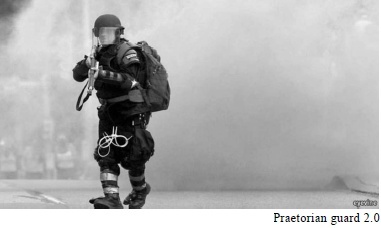
MOBS are bad for businesses—unless you are selling riot-control gear, that is. Even before this week’s riots in Britain governments were bracing themselves against protests stoked by the economic downturn. Firms such as Israel’s Hagor Industries are doing a roaring trade in antiriot shields, batons and helmets. David Frenkel, the firm’s production manager, says demand is growing from police and military services in Europe, South America and Africa, bolstered by “war, unrest and natural disasters”.
Ochlocracy—mob rule—was a term coined in ancient times, when grain prices or a celebrity murder could spark a riot. The Roman emperors’ Praetorian Guard used cavalry and swords against stone-throwers. Their latter-day counterparts (human and equine) are better protected, with goggles, shields and other kit made of lightweight, flameresistant, unshatterable and stab-proof materials.
They also have more ways of disrupting the rioters. Police in India spray unruly crowds with coloured water: stained and sodden agitators are easier to identify. America’s forces have developed (but not used) a “heat ray” designed to clear crowds by painfully zapping the skin. The unfamiliar tones of classical music can disperse loiterers, while big sound-blasters, known as “long-range acoustic devices” (LRADS), have been deployed against protesters in some American states. At a cost of up to $30,000 they can emit sound at 150-plus decibels (like a roaring jet engine at close range). Israel has a fancier version known as the “Scream” that affects the inner ear and induces nausea. When ochlophonics fail, authorities there have been known to douse Palestinian protesters with “skunk bombs” of smelly liquid.
Eyes are as vulnerable as ears and noses. A firm called Intelligent Optical Systems, based in California, is developing, with government backing, a strobe torch that makes targets dizzy and disoriented (at least within a range of 15 metres). Laser Energetics, in New Jersey, sells “Dazer Lasers” that emit a green beam capable of dazzling people up to 2.4 km away.
(Aug 13th 2011 | www.economist.com)
Another way of saying: “MOBS are bad for businesses— unless you are selling riot-control gear” would be:
Questão 45 49297
ESPM 2012/1New riot-control technology
The sound and the fury
Quelling unrest is a lucrative trade
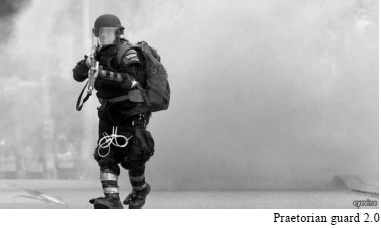
MOBS are bad for businesses—unless you are selling riot-control gear, that is. Even before this week’s riots in Britain governments were bracing themselves against protests stoked by the economic downturn. Firms such as Israel’s Hagor Industries are doing a roaring trade in antiriot shields, batons and helmets. David Frenkel, the firm’s production manager, says demand is growing from police and military services in Europe, South America and Africa, bolstered by “war, unrest and natural disasters”.
Ochlocracy—mob rule—was a term coined in ancient times, when grain prices or a celebrity murder could spark a riot. The Roman emperors’ Praetorian Guard used cavalry and swords against stone-throwers. Their latter-day counterparts (human and equine) are better protected, with goggles, shields and other kit made of lightweight, flameresistant, unshatterable and stab-proof materials.
They also have more ways of disrupting the rioters. Police in India spray unruly crowds with coloured water: stained and sodden agitators are easier to identify. America’s forces have developed (but not used) a “heat ray” designed to clear crowds by painfully zapping the skin. The unfamiliar tones of classical music can disperse loiterers, while big sound-blasters, known as “long-range acoustic devices” (LRADS), have been deployed against protesters in some American states. At a cost of up to $30,000 they can emit sound at 150-plus decibels (like a roaring jet engine at close range). Israel has a fancier version known as the “Scream” that affects the inner ear and induces nausea. When ochlophonics fail, authorities there have been known to douse Palestinian protesters with “skunk bombs” of smelly liquid.
Eyes are as vulnerable as ears and noses. A firm called Intelligent Optical Systems, based in California, is developing, with government backing, a strobe torch that makes targets dizzy and disoriented (at least within a range of 15 metres). Laser Energetics, in New Jersey, sells “Dazer Lasers” that emit a green beam capable of dazzling people up to 2.4 km away.
(Aug 13th 2011 | www.economist.com)
According to the main idea expressed by the text, it is correct to state that:
06