


![[Marketing] Questao Topo - deslogado](https://storage.estuda.com.br/banners/0_6b7ebee90b03af1c560c73bb8bcce34a_banner_deslogado_70_dias.png)
Questões de Inglês
19.971 Questões
Questão 21 89592
UEFS Caderno 1 2012/2TEXTO:
Thickening glaciers
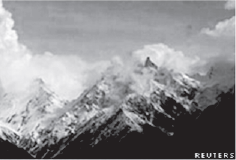
A team of scientists has shown that the glaciers in
one of Asia’s major mountain ranges are defying the
general tendency towards shrinkage, and have in fact
expanded slightly over the last few years. The range in
5 question is the Karakoram, which straddles Pakistan,
India and China on the north-western end of the
Himalayas.
Glacial decline and the gradual loss of polar ice
caps has been a worrying trend over recent decades,
10 but scientists have been aware of an apparently curious
anomaly with the Karakoram, which contains some of
the world’s biggest mountains including the second
highest, K2. It has about 20,000 square kilometers of
glaciers, accounting for three percent of the total area of
15 ice outside the Antarctic and Greenland ice sheets.
Now a team of French scientists has carried out a
detailed survey over a large area of the range using
sophisticated remote-sensing measurements. Writing in
the scientific journal, Nature, they say they found that in
20 the first years of this century the Karakoram’s glaciers
had actually expanded by a small amount, while in the
neighboring Himalayas they’d been shrinking.
It’s unclear why this is happening, but it seems that by
a quirk in the weather pattern that’s not fully understood,
25 less heat is being delivered to the Karakoram and the
mountains are receiving heavier falls of snow.
Thickening glaciers. Disponível em: . Acesso em: 21 jul. 2012.
According to the team of scientists mentioned in the text, Karakoram’s glaciers
Questão 57 86805
UNIFOR 1ª Fase 2012/1Interprete o quadrinho e escolha a opção correta.
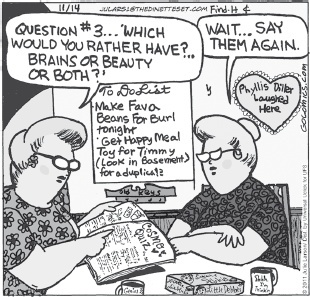
No diálogo acima a pergunta “Which would you rather have…?” significa:
Questão 59 86741
UNIFOR Medicina 2012/1Leia a tira abaixo.
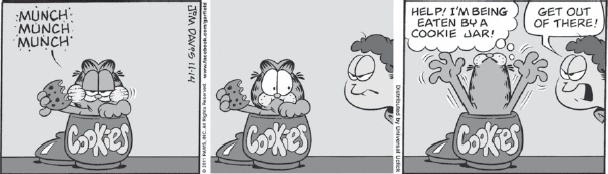
Analise as seguintes afirmações.
I - The cat has been eating the cookies.
II - The cat was caught eating his pal’s cookies.
III - The cat was eating the cookies when he was caught by his pal.
IV - The cat had been eating the cookies when his pal caught him.
V - Garfield asked for help because he was being eaten by the cookie jar.
Marque a opção correta:
Questão 57 86739
UNIFOR Medicina 2012/1Leia o texto sobre Madre Teresa de Calcutá, decida se as sentenças são verdadeiras (V) ou falsas (F) e marque a opção correta.
MOTHER TERESA
(1910-1997) Mother Teresa was born in 1910 in Skopje, Albania. Her real name was Agnes Gonxha Bojaxhiu. She was from a devout Catholic family who helped poor people in their neighborhood. She studied languages and read books about missionaries. When Mother Teresa was 12, she decided to give her life to service for God. When she was 18, she went to Ireland to become a Catholic sister. A year later, she went to India. She chose the name Teresa from Saint Teresa of Lisieux, the patron saint of foreign missionaries. First, she was a principal at a Roman Catholic high school in Calcutta, India. But she saw many sick and dying poor people in the streets of India. Mother Teresa was very concerned, so in 1948, she began working with poor people. She brought the medicine, clothes and food. She taught the children to read and write. In 1950, Mother Teresa and her sister started the Missionaries of Charity, a group of women who work with the poor and dying. They made many sacrifices to help the poor. In 1952, Mother Teresa opened the Pure Heart Home for poor dying people in Calcutta. Eventually, Mother Teresa and her Missionaries of Charity worked all over the world to help poor people. She opened homes and schools for them. Mother Teresa received the Nobel Peace Prize in 1979. Mother Teresa: In My Own Words, a collection of her ideas and thoughts was published in 1996. She died in 1997.
1. Madre Teresa morreu aos 87 anos. ( )
2. Madre Teresa ingressou na vida religiosa em 1922. ( )
3. A Ordem Missionárias da Caridade foi fundada em 1952. ( )
4. Trabalhou como diretora de uma escola em Calcutá. ( )
5. Tornou-se uma freira Católica na Irlanda em 1928. ( )
6. Ela foi para a Índia em 1927. ( )
Questão 55 86737
UNIFOR Medicina 2012/1Leia o texto abaixo e marque a alternativa com as opções que o completam corretamente.
Mrs Ramone admitted/was admitted1 to hospital for an operation. She didn’t give/wasn’t given2 food for eight hours. She brought/was brought3 to theatre at sixteen hundred hours.
She was prepared/ prepared4 for theatre. The nurse was shaved/shaved5 the area which was going to cut/be cut6, and Mrs Ramone put on/was put on7 a theatre gown. Her dentures removed/were removed8, and her wedding ring taped to her wrist.
Questão 59 86655
UNIFOR 1ª Fase 2012/2
[1] Since the fall of 2009, the European Union has been struggling with a slow-moving but
unshakable crisis over the enormous debts faced by its weakest economies, such as
Greece and Portugal, or those most battered by the global recession, like Ireland.
A series of negotiations, bailouts and austerity packages have failed to stop the slide of
[5] investor confidence or to restore the growth needed to give struggling countries a way out
of1 their debt traps. By August 2011 European leaders found themselves scrambling once
again to intervene in the markets, this time to protect Italy and Spain, two countries seen
as too big to bail out2.
The crisis has produced the deepest tensions within the union in memory, as Germany in
[10] particular has resisted aid to countries it sees as profligate, and has raised questions about
whether the euro can survive as a multinational currency, since countries like Greece have
been unable to boost their exports by devaluing their own currency.
A reluctant, indirect intervention by the European Central Bank in late 2011 led the crisis
fever to cool considerably, as it lent vast sums to banks on easy terms to head off3 a
[15] liquidity crunch. But crisis has given way to a grinding reality for Europe of economic
stagnation and even a second recession for countries including Spain, Italy, Belgium, the
Czech Republic and the Netherlands as well as Greece. Nearby, Britain also fell into4 a
double dip recession after two years of Conservative-led austerity.
In April 2012 there was a growing sense of resistance to the German prescription of budget
[20] cuts as the prescription for all. From trading floors to polling stations to the streets of cities
across Europe, the message appeared increasingly to be that countries cannot cut their
way to5 fiscal health, but need growth, too.
In May, voters in France and Greece punished politicians associated with austerity; France
ousted conservative President Nicolas Sarkozy in favor of Francois Hollande, a socialist
[25] and Greek voters cut the share of votes for its two traditionally dominant parties in half,
while far right and far left parties gained.
[1] Since the fall of 2009, the European Union has been struggling with a slow-moving but
unshakable crisis over the enormous debts faced by its weakest economies, such as
Greece and Portugal, or those most battered by the global recession, like Ireland.
A series of negotiations, bailouts and austerity packages have failed to stop the slide of
[5] investor confidence or to restore the growth needed to give struggling countries a way out
of1 their debt traps. By August 2011 European leaders found themselves scrambling once
again to intervene in the markets, this time to protect Italy and Spain, two countries seen
as too big to bail out2.
The crisis has produced the deepest tensions within the union in memory, as Germany in
[10] particular has resisted aid to countries it sees as profligate, and has raised questions about
whether the euro can survive as a multinational currency, since countries like Greece have
been unable to boost their exports by devaluing their own currency.
A reluctant, indirect intervention by the European Central Bank in late 2011 led the crisis
fever to cool considerably, as it lent vast sums to banks on easy terms to head off3 a
[15] liquidity crunch. But crisis has given way to a grinding reality for Europe of economic
stagnation and even a second recession for countries including Spain, Italy, Belgium, the
Czech Republic and the Netherlands as well as Greece. Nearby, Britain also fell into4 a
double dip recession after two years of Conservative-led austerity.
In April 2012 there was a growing sense of resistance to the German prescription of budget
[20] cuts as the prescription for all. From trading floors to polling stations to the streets of cities
across Europe, the message appeared increasingly to be that countries cannot cut their
way to5 fiscal health, but need growth, too.
In May, voters in France and Greece punished politicians associated with austerity; France
ousted conservative President Nicolas Sarkozy in favor of Francois Hollande, a socialist
[25] and Greek voters cut the share of votes for its two traditionally dominant parties in half,
while far right and far left parties gained.
Marque a opção que melhor resuma a ideia central do texto:
06