


![[Marketing] Questao Topo - deslogado](https://storage.estuda.com.br/banners/0_6b7ebee90b03af1c560c73bb8bcce34a_banner_deslogado_70_dias.png)
Questões de Inglês
19.971 Questões
Questão 32 89603
UEFS Caderno 1 2012/2TEXTO:
New glowing mushrooms found in Brazil
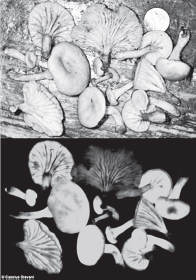
Like a black light poster come to life, a group of
bioluminescent fungi collected from Ribeira Valley Tourist
State Park near São Paulo, Brazil, emanates a soft green
glow when the lights go out. The mushrooms are part of
5 the genus Mycena, a group that includes about 500
species worldwide. Of these only 33 are known to be
bioluminescent — capable of producing light through a
chemical reaction.
Since 2002, Cassius Stevani, professor of Chemistry
10 at the University of São Paulo, Dennis Desjardin,
professor of mycology at San Francisco State University
in California, and Marina Capelari of Brazil’s Institute of
Botany have discovered 10 more bioluminescent fungi
species — four of which are new to science — in Brazil’s
15 tropical forests. The work, Stevani says, has increased
the number of glowers known since the 1970s by 30
percent.
In addition to mushrooms, a variety of marine
animals, select species of bacteria, insects, and annelids
20 (earthworms) are known to be bioluminescent.
Bioluminescence creates “cold” light — emissions with
low thermal radiation. An enzyme called luciferase
triggers a pigment called luciferin to oxidize, and the
reaction emits light. But why the fungi evolved to glow
25 this way remains a mystery, Stevani says. To get the
green glow of the new specimens of bioluminescent
mushrooms, Dr Desjardin and Dr Stevani had to go out
on new moon nights and stumble around in the forest,
running into trees, while keeping an eye out for poisonous
30 snakes and prowling jaguars.
Besides helping researchers decipher how and why
mushrooms glow, Stevani is studying the bioluminescent
fungi’s ability to signal the presence of toxins in the soil.
In the lab, his team has developed a procedure that
35 shows that fungi emit less light when exposed to several
metals and organic pollutants. “In a near future we can
use it to evaluate the toxicity of environmental samples
of soil and sediments,” Stevani said in an email to
National Geographic News. The researcher also says
40 that the fungi could serve as a tool for bioremediation
(cleanup using living organisms) of contaminated soil.
New glowing mushrooms found in Brazil. Disponível em: . Acesso em:
Fill in the parentheses with T (True) or F (False).
About the new fungi discovered in Brazil, it’s true to say:
( ) They only glow when there is no light.
( ) They produce a strong dark green glow.
( ) All of them were unknown to scientists.
( ) Their discovery has made the numbers of glowers go up by thirty percent.
According to the text, the correct sequence, from top to bottom, is
Questão 31 89602
UEFS Caderno 1 2012/2TEXTO:
We always think “It will never happen to me,” but
disasters can strike, at any time, anywhere — from hotel
fires to train crashes to terrorist attacks. How would you
cope if the unthinkable happened?
5 According to experts, people caught up in disasters
tend to fall into three categories. About 10% to 15%
remain calm and act quickly and efficiently. Another 15%
completely panic, crying and screaming and obstructing
the evacuation. But the vast majority (70%) of people do
10 very little. They are “stunned and confused,” says
psychologist John Leach.
Why is this? Research suggests that under great
stress, our minds take much longer to process
information. So, in a crisis, many people “freeze” just at
15 the moment when they need to act quickly. It also seems
that personality is not a good guide to how people might
react — a normally decisive person may not act quickly
enough in a crisis and vice versa. “Most people go their
entire lives without a disaster,” says Michael Lindell, a
20 professor at Texas A&M University. “So when something
bad happens, they are so shocked they just think, ‘This
can’t possibly be happening to me,’ instead of taking
action.”
OXENDEN, C et Latham-Koenig, C American English File 4B, p. 52 Oxford University Press.
The only word or expression which is not suitably defined is
Questão 29 89600
UEFS Caderno 1 2012/2TEXTO:
We always think “It will never happen to me,” but
disasters can strike, at any time, anywhere — from hotel
fires to train crashes to terrorist attacks. How would you
cope if the unthinkable happened?
5 According to experts, people caught up in disasters
tend to fall into three categories. About 10% to 15%
remain calm and act quickly and efficiently. Another 15%
completely panic, crying and screaming and obstructing
the evacuation. But the vast majority (70%) of people do
10 very little. They are “stunned and confused,” says
psychologist John Leach.
Why is this? Research suggests that under great
stress, our minds take much longer to process
information. So, in a crisis, many people “freeze” just at
15 the moment when they need to act quickly. It also seems
that personality is not a good guide to how people might
react — a normally decisive person may not act quickly
enough in a crisis and vice versa. “Most people go their
entire lives without a disaster,” says Michael Lindell, a
20 professor at Texas A&M University. “So when something
bad happens, they are so shocked they just think, ‘This
can’t possibly be happening to me,’ instead of taking
action.”
OXENDEN, C et Latham-Koenig, C American English File 4B, p. 52 Oxford University Press.
According to Michael Lindell,
Questão 26 89597
UEFS Caderno 1 2012/2TEXTO:
Thickening glaciers
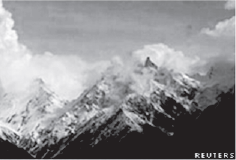
A team of scientists has shown that the glaciers in
one of Asia’s major mountain ranges are defying the
general tendency towards shrinkage, and have in fact
expanded slightly over the last few years. The range in
5 question is the Karakoram, which straddles Pakistan,
India and China on the north-western end of the
Himalayas.
Glacial decline and the gradual loss of polar ice
caps has been a worrying trend over recent decades,
10 but scientists have been aware of an apparently curious
anomaly with the Karakoram, which contains some of
the world’s biggest mountains including the second
highest, K2. It has about 20,000 square kilometers of
glaciers, accounting for three percent of the total area of
15 ice outside the Antarctic and Greenland ice sheets.
Now a team of French scientists has carried out a
detailed survey over a large area of the range using
sophisticated remote-sensing measurements. Writing in
the scientific journal, Nature, they say they found that in
20 the first years of this century the Karakoram’s glaciers
had actually expanded by a small amount, while in the
neighboring Himalayas they’d been shrinking.
It’s unclear why this is happening, but it seems that by
a quirk in the weather pattern that’s not fully understood,
25 less heat is being delivered to the Karakoram and the
mountains are receiving heavier falls of snow.
Thickening glaciers. Disponível em: . Acesso em: 21 jul. 2012.
Considering language use in the text, it’s correct to say
Questão 23 89594
UEFS Caderno 1 2012/2TEXTO:
Thickening glaciers
A team of scientists has shown that the glaciers in
one of Asia’s major mountain ranges are defying the
general tendency towards shrinkage, and have in fact
expanded slightly over the last few years. The range in
5 question is the Karakoram, which straddles Pakistan,
India and China on the north-western end of the
Himalayas.
Glacial decline and the gradual loss of polar ice
caps has been a worrying trend over recent decades,
10 but scientists have been aware of an apparently curious
anomaly with the Karakoram, which contains some of
the world’s biggest mountains including the second
highest, K2. It has about 20,000 square kilometers of
glaciers, accounting for three percent of the total area of
15 ice outside the Antarctic and Greenland ice sheets.
Now a team of French scientists has carried out a
detailed survey over a large area of the range using
sophisticated remote-sensing measurements. Writing in
the scientific journal, Nature, they say they found that in
20 the first years of this century the Karakoram’s glaciers
had actually expanded by a small amount, while in the
neighboring Himalayas they’d been shrinking.
It’s unclear why this is happening, but it seems that by
a quirk in the weather pattern that’s not fully understood,
25 less heat is being delivered to the Karakoram and the
mountains are receiving heavier falls of snow.
Thickening glaciers. Disponível em: . Acesso em: 21 jul. 2012.
The phenomenon with the Karakoram
Questão 22 89593
UEFS Caderno 1 2012/2TEXTO:
Thickening glaciers
A team of scientists has shown that the glaciers in
one of Asia’s major mountain ranges are defying the
general tendency towards shrinkage, and have in fact
expanded slightly over the last few years. The range in
5 question is the Karakoram, which straddles Pakistan,
India and China on the north-western end of the
Himalayas.
Glacial decline and the gradual loss of polar ice
caps has been a worrying trend over recent decades,
10 but scientists have been aware of an apparently curious
anomaly with the Karakoram, which contains some of
the world’s biggest mountains including the second
highest, K2. It has about 20,000 square kilometers of
glaciers, accounting for three percent of the total area of
15 ice outside the Antarctic and Greenland ice sheets.
Now a team of French scientists has carried out a
detailed survey over a large area of the range using
sophisticated remote-sensing measurements. Writing in
the scientific journal, Nature, they say they found that in
20 the first years of this century the Karakoram’s glaciers
had actually expanded by a small amount, while in the
neighboring Himalayas they’d been shrinking.
It’s unclear why this is happening, but it seems that by
a quirk in the weather pattern that’s not fully understood,
25 less heat is being delivered to the Karakoram and the
mountains are receiving heavier falls of snow.
Thickening glaciers. Disponível em: . Acesso em: 21 jul. 2012.
Fill in the parentheses with T (True) or F (False). The text says:
( ) Lately, the slow melting of ice rivers and polar ice caps has been a general pattern.
( ) The Karakoram range is on the border between Pakistan, India and China.
( ) The Karakoram has around two thousand square kilometers of glaciers.
( ) The Karakoram’s glaciers have showed this tendency towards expansion since the beginning of the twentieth century.
According to the text, the correct sequence, from top to bottom, is
06