


![[Marketing] Questao Topo - deslogado](https://storage.estuda.com.br/banners/0_6b7ebee90b03af1c560c73bb8bcce34a_banner_deslogado_70_dias.png)
Questões de Inglês
19.971 Questões
Questão 29 89838
UEFS Caderno 1 2012/1TEXTO:
Brazil’s time bomb
President Dilma Rousseff is raising eyebrows with
her plans for Brazil. She is winning agreement even from
the political opposition for an agenda that includes
eradicating absolute poverty, trimming the national
5 budget, and safeguarding freedom of the press. But she
is also shocking everyone with what she plans to ignore:
the social-security time bomb.
Brazil’s social-welfare system is an unrivaled mess.
Though Brazil has one of the world’s youngest
10 populations, it shells out the same share of its GDP (11
percent) as the grayest nations of Europe. Worse, it’s
aging faster than the rich countries ever did — twice as
fast as Europe in the last century. And the problem is
getting worse: federal, state, and local governments write
15 checks to private-sector pensioners worth more than 7
percent of GDP, up from 2.5 percent 30 years ago. With
the economy surging again, even the ballooning
social-security debt seems almost manageable. But to
unleash its full potential, Brazil has little choice but to
20 disarm the pension bomb. While Rousseff says she’s
got no such appetite, she well knows that the average
retirement age in Brazil is a tender 53 … and that France
was in flames because Parliament voted to raise the
retirement age from 60 to 62.
MARGOLIS, Mac. Brazil’s time bomb. Newsweek, Nov 29, 2010, p. 8. GDP: Gross Domestic Product
Fill in the parentheses with T (True) or F (False).
About President Dilma Rousseff, it’s stated in the text that she
( ) is doing exactly what people expected.
( ) has faced strong opposition from politicians.
( ) is reducing the amount of money the government has to spend.
( ) is all against total freedom of the press.
According to the text, the correct sequence, from top to bottom, is:
Questão 25 89834
UEFS Caderno 1 2012/1TEXTO:
Steve Jobs — early life and education

Steven Paul “Steve” Jobs was
an American businessman and
visionary widely recognized (along
with his Apple business partner
5 Steve Wozniak) as a charismatic
pioneer of the personal computer
revolution. He was co-founder,
chairman, and chief executive officer
of Apple Inc.
10 Steve Jobs was born in San
Francisco in 1955, and adopted
at birth by Paul Reinhold Jobs
(1922–1993) and Clara Jobs (1924–1986). When asked
about his “adoptive parents,” Jobs replied emphatically
15 that Paul and Clara Jobs “were my parents 1,000%.”
Asked in a 1995 interview what he wanted to pass on to
his children, Jobs replied, “Just to try to be as good a
father to them as my father was to me. I think about that
every day of my life.”
20 Jobs told an interviewer, “I was very lucky. My father,
Paul, was a pretty remarkable man, a genius with his
hands.” When his son was five or six, Paul Jobs
sectioned a piece of his workbench and gave it to Jobs,
25 saying ‘Steve, this is your workbench now.’ And he gave
me some of his smaller tools and showed me how to
use a hammer and saw and how to build things. It really
was very good for me. He spent a lot of time with me...
teaching me how to build things, how to take things apart,
30 put things back together.” Jobs also noted that while his
father “did not have a deep understanding of electronics
[...] he’d encountered electronics a lot in automobiles
and other things he would fix. He showed me the
rudiments of electronics and I got very interested in that.”
35 Jobs went to elementary school and high school in
Cupertino, California. He attended after-school lectures
at the Hewlett-Packard Company in Palo Alto, California,
and was later hired there, working with Steve Wozniak
as a summer employee. Following high school graduation
40 in 1972, Jobs enrolled at Reed College in Portland,
Oregon. Although he dropped out after only one
semester, he continued auditing classes at Reed, while
sleeping on the floor in friends’ rooms, returning Coke
bottles for food money, and getting weekly free meals at
45 the local Hare Krishna temple. Jobs later said, “If I had
never dropped in on that single calligraphy course in
college, the Mac would have never had multiple typefaces
or proportionally spaced fonts.”
STEVE Jobs — early life and education. Disponível em: . Acesso em: 8 dez. 2011.
Fill in the parentheses with T (True) or F (False).
The 4th paragraph has answers to the following questions about Steve Jobs:
( ) When did he finish high school?
( ) Where did he use to stay while he was in Oregon?
( ) How long did he attend college in Oregon?
( ) What did he do after college graduation?
According to the text, the correct sequence, from top to bottom, is:
Questão 24 89833
UEFS Caderno 1 2012/1TEXTO:
Steve Jobs — early life and education
Steven Paul “Steve” Jobs was
an American businessman and
visionary widely recognized (along
with his Apple business partner
5 Steve Wozniak) as a charismatic
pioneer of the personal computer
revolution. He was co-founder,
chairman, and chief executive officer
of Apple Inc.
10 Steve Jobs was born in San
Francisco in 1955, and adopted
at birth by Paul Reinhold Jobs
(1922–1993) and Clara Jobs (1924–1986). When asked
about his “adoptive parents,” Jobs replied emphatically
15 that Paul and Clara Jobs “were my parents 1,000%.”
Asked in a 1995 interview what he wanted to pass on to
his children, Jobs replied, “Just to try to be as good a
father to them as my father was to me. I think about that
every day of my life.”
20 Jobs told an interviewer, “I was very lucky. My father,
Paul, was a pretty remarkable man, a genius with his
hands.” When his son was five or six, Paul Jobs
sectioned a piece of his workbench and gave it to Jobs,
25 saying ‘Steve, this is your workbench now.’ And he gave
me some of his smaller tools and showed me how to
use a hammer and saw and how to build things. It really
was very good for me. He spent a lot of time with me...
teaching me how to build things, how to take things apart,
30 put things back together.” Jobs also noted that while his
father “did not have a deep understanding of electronics
[...] he’d encountered electronics a lot in automobiles
and other things he would fix. He showed me the
rudiments of electronics and I got very interested in that.”
35 Jobs went to elementary school and high school in
Cupertino, California. He attended after-school lectures
at the Hewlett-Packard Company in Palo Alto, California,
and was later hired there, working with Steve Wozniak
as a summer employee. Following high school graduation
40 in 1972, Jobs enrolled at Reed College in Portland,
Oregon. Although he dropped out after only one
semester, he continued auditing classes at Reed, while
sleeping on the floor in friends’ rooms, returning Coke
bottles for food money, and getting weekly free meals at
45 the local Hare Krishna temple. Jobs later said, “If I had
never dropped in on that single calligraphy course in
college, the Mac would have never had multiple typefaces
or proportionally spaced fonts.”
STEVE Jobs — early life and education. Disponível em: . Acesso em: 8 dez. 2011.
Steve Jobs found electronics___ ___he was introduced to it.
According to the text, the words that complete the two blanks correctly are, respectively,
Questão 39 89610
UEFS Caderno 1 2012/2TEXTO:
New glowing mushrooms found in Brazil
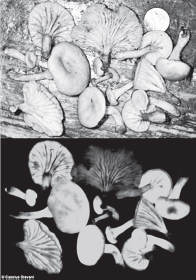
Like a black light poster come to life, a group of
bioluminescent fungi collected from Ribeira Valley Tourist
State Park near São Paulo, Brazil, emanates a soft green
glow when the lights go out. The mushrooms are part of
5 the genus Mycena, a group that includes about 500
species worldwide. Of these only 33 are known to be
bioluminescent — capable of producing light through a
chemical reaction.
Since 2002, Cassius Stevani, professor of Chemistry
10 at the University of São Paulo, Dennis Desjardin,
professor of mycology at San Francisco State University
in California, and Marina Capelari of Brazil’s Institute of
Botany have discovered 10 more bioluminescent fungi
species — four of which are new to science — in Brazil’s
15 tropical forests. The work, Stevani says, has increased
the number of glowers known since the 1970s by 30
percent.
In addition to mushrooms, a variety of marine
animals, select species of bacteria, insects, and annelids
20 (earthworms) are known to be bioluminescent.
Bioluminescence creates “cold” light — emissions with
low thermal radiation. An enzyme called luciferase
triggers a pigment called luciferin to oxidize, and the
reaction emits light. But why the fungi evolved to glow
25 this way remains a mystery, Stevani says. To get the
green glow of the new specimens of bioluminescent
mushrooms, Dr Desjardin and Dr Stevani had to go out
on new moon nights and stumble around in the forest,
running into trees, while keeping an eye out for poisonous
30 snakes and prowling jaguars.
Besides helping researchers decipher how and why
mushrooms glow, Stevani is studying the bioluminescent
fungi’s ability to signal the presence of toxins in the soil.
In the lab, his team has developed a procedure that
35 shows that fungi emit less light when exposed to several
metals and organic pollutants. “In a near future we can
use it to evaluate the toxicity of environmental samples
of soil and sediments,” Stevani said in an email to
National Geographic News. The researcher also says
40 that the fungi could serve as a tool for bioremediation
(cleanup using living organisms) of contaminated soil.
New glowing mushrooms found in Brazil. Disponível em: . Acesso em:
The only singular word is in alternative
Questão 36 89607
UEFS Caderno 1 2012/2TEXTO:
New glowing mushrooms found in Brazil
Like a black light poster come to life, a group of
bioluminescent fungi collected from Ribeira Valley Tourist
State Park near São Paulo, Brazil, emanates a soft green
glow when the lights go out. The mushrooms are part of
5 the genus Mycena, a group that includes about 500
species worldwide. Of these only 33 are known to be
bioluminescent — capable of producing light through a
chemical reaction.
Since 2002, Cassius Stevani, professor of Chemistry
10 at the University of São Paulo, Dennis Desjardin,
professor of mycology at San Francisco State University
in California, and Marina Capelari of Brazil’s Institute of
Botany have discovered 10 more bioluminescent fungi
species — four of which are new to science — in Brazil’s
15 tropical forests. The work, Stevani says, has increased
the number of glowers known since the 1970s by 30
percent.
In addition to mushrooms, a variety of marine
animals, select species of bacteria, insects, and annelids
20 (earthworms) are known to be bioluminescent.
Bioluminescence creates “cold” light — emissions with
low thermal radiation. An enzyme called luciferase
triggers a pigment called luciferin to oxidize, and the
reaction emits light. But why the fungi evolved to glow
25 this way remains a mystery, Stevani says. To get the
green glow of the new specimens of bioluminescent
mushrooms, Dr Desjardin and Dr Stevani had to go out
on new moon nights and stumble around in the forest,
running into trees, while keeping an eye out for poisonous
30 snakes and prowling jaguars.
Besides helping researchers decipher how and why
mushrooms glow, Stevani is studying the bioluminescent
fungi’s ability to signal the presence of toxins in the soil.
In the lab, his team has developed a procedure that
35 shows that fungi emit less light when exposed to several
metals and organic pollutants. “In a near future we can
use it to evaluate the toxicity of environmental samples
of soil and sediments,” Stevani said in an email to
National Geographic News. The researcher also says
40 that the fungi could serve as a tool for bioremediation
(cleanup using living organisms) of contaminated soil.
New glowing mushrooms found in Brazil. Disponível em: . Acesso em:
______ mushrooms______ a variety of marine animals, select species of bacteria, insects, and annelids are known to be bioluminescent.
According to paragraph 3, the only alternative that does not suitably complete the two blanks is
Questão 35 89606
UEFS Caderno 1 2012/2TEXTO:
New glowing mushrooms found in Brazil
Like a black light poster come to life, a group of
bioluminescent fungi collected from Ribeira Valley Tourist
State Park near São Paulo, Brazil, emanates a soft green
glow when the lights go out. The mushrooms are part of
5 the genus Mycena, a group that includes about 500
species worldwide. Of these only 33 are known to be
bioluminescent — capable of producing light through a
chemical reaction.
Since 2002, Cassius Stevani, professor of Chemistry
10 at the University of São Paulo, Dennis Desjardin,
professor of mycology at San Francisco State University
in California, and Marina Capelari of Brazil’s Institute of
Botany have discovered 10 more bioluminescent fungi
species — four of which are new to science — in Brazil’s
15 tropical forests. The work, Stevani says, has increased
the number of glowers known since the 1970s by 30
percent.
In addition to mushrooms, a variety of marine
animals, select species of bacteria, insects, and annelids
20 (earthworms) are known to be bioluminescent.
Bioluminescence creates “cold” light — emissions with
low thermal radiation. An enzyme called luciferase
triggers a pigment called luciferin to oxidize, and the
reaction emits light. But why the fungi evolved to glow
25 this way remains a mystery, Stevani says. To get the
green glow of the new specimens of bioluminescent
mushrooms, Dr Desjardin and Dr Stevani had to go out
on new moon nights and stumble around in the forest,
running into trees, while keeping an eye out for poisonous
30 snakes and prowling jaguars.
Besides helping researchers decipher how and why
mushrooms glow, Stevani is studying the bioluminescent
fungi’s ability to signal the presence of toxins in the soil.
In the lab, his team has developed a procedure that
35 shows that fungi emit less light when exposed to several
metals and organic pollutants. “In a near future we can
use it to evaluate the toxicity of environmental samples
of soil and sediments,” Stevani said in an email to
National Geographic News. The researcher also says
40 that the fungi could serve as a tool for bioremediation
(cleanup using living organisms) of contaminated soil.
New glowing mushrooms found in Brazil. Disponível em: . Acesso em:
“the fungi could serve as a tool for bioremediation [...] of contaminated soil.” (l. 40-41)
This fragment of the text refers to the use of
06