


![[Marketing] Questao Topo - deslogado](https://storage.estuda.com.br/banners/0_6b7ebee90b03af1c560c73bb8bcce34a_banner_deslogado_70_dias.png)
Questões de Inglês
19.971 Questões
Questão 13 152962
IFPE Superior 2012Working Students
In places like Canada, the USA, Spain, England and many other countries in Europe it is very common to see teenagers working during their free time. They work in restaurants or shops; they work as baby sitters or dog walkers. There are many part time jobs for students. Many students work part time during the year and full time during their summer vacation.
Things are different in Brazil. Teens usually work only if their families need money. There are not many part time jobs for students. Working students usually work during the day and go to school in the evening. A few students who do not need the money work part time as volunteers in social projects, but they are not many.
Is that just a cultural difference or is it some kind of prejudice?
(Amos, Prescher e Pasqualin.Challenge. – Richmond Publishing p. 57)
It can be deduced from the text that:
Questão 11 152960
IFPE Superior 2012Working Students
In places like Canada, the USA, Spain, England and many other countries in Europe it is very common to see teenagers working during their free time. They work in restaurants or shops; they work as baby sitters or dog walkers. There are many part time jobs for students. Many students work part time during the year and full time during their summer vacation.
Things are different in Brazil. Teens usually work only if their families need money. There are not many part time jobs for students. Working students usually work during the day and go to school in the evening. A few students who do not need the money work part time as volunteers in social projects, but they are not many.
Is that just a cultural difference or is it some kind of prejudice?
(Amos, Prescher e Pasqualin.Challenge. – Richmond Publishing p. 57)
According to the text, Brazilian students:
Questão 53 129866
UFPA 2012Leia o texto abaixo para responder à questão.
NASA Discovers New 'Tatooine' Planet With Two Suns
By Chloe Albanesius
September 16, 2011 12:55pm EST
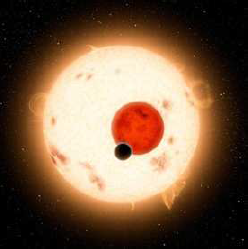
First we get the Back to the Future sneakers and now Tatooine? It's a big week for sci-fi movie buffs, as NASA on Thursday revealed that its Kepler mission had uncovered evidence of a circumbinary planet, or a planet that orbits two stars.
As Star Wars fans will know, and as PCMag analyst Tony Hoffman pointed out this week, the discovery is reminiscent of Tatooine, the planet on which Luke Skywalker grew up, which circled a double star, or two suns that appeared close together in the sky.
But before you pack up your things in hopes of living the life of a Jedi, NASA said the planet it has discovered is cold, gaseous, and not thought to contain life. It's about the size of Saturn and scientists think it's made up of half rock and half gas. Of the two stars, meanwhile, one is 69 percent the mass of our sun while the other is 20 percent.
But discovery of this system, dubbed Kepler-16, is significant because we've never before had actual proof of circumbinary planets.
"This discovery confirms a new class of planetary systems that could harbor life," Kepler principal investigator William Borucki said in a statement. "Given that most stars in our galaxy are part of a binary system, this means the opportunities for life are much broader than if planets form only around single stars. This milestone discovery confirms a theory that scientists have had for decades but could not prove until now."
The planet, known as Kepler-16b, orbits around both stars every 229 days, similar to Venus' 225 day orbit. But NASA said it exists beyond a zone where liquid water could exist on the surface, because the stars are cooler than our sun.
The research team was led by Laurance Doyle of the SETI Institute, (which was featured in the movie Contact and recently revived its alien research thanks to donations). The SETI team used data from the Kepler space telescope, which measures dips in brightness for more than 15,000 stars in the hopes of finding transiting planets.
"When the smaller star partially blocks the larger star, a primary eclipse occurs, and a secondary eclipse occurs when the smaller star is occulted, or completely blocked, by the larger star," NASA said. "Astronomers further observed that the brightness of the system dipped even when the stars were not eclipsing one another, hinting at a third body."
John Knoll, the visual effects supervisor for Industrial Light and Magic (ILM), the company founded by George Lucas that produced the special effects for the Star Wars movies, was in attendance at Thursday's announcement. "Working in film, we often are tasked with creating something never before seen. However, more often than not, scientific discoveries prove to be more spectacular than anything we dare imagine," he said in a statement. "There is no doubt these discoveries influence and inspire storytellers. Their very existence serves as cause to dream bigger and open our minds to new possibilities beyond what we think we 'know.'"
http://www.pcmag.com/article2/0,2817,2393115,00.asp
O pesquisador William Borucki afirma que a possibilidade de haver formas de vida é maior em planetas
Questão 52 129865
UFPA 2012Leia o texto abaixo para responder à questão.
NASA Discovers New 'Tatooine' Planet With Two Suns
By Chloe Albanesius
September 16, 2011 12:55pm EST
First we get the Back to the Future sneakers and now Tatooine? It's a big week for sci-fi movie buffs, as NASA on Thursday revealed that its Kepler mission had uncovered evidence of a circumbinary planet, or a planet that orbits two stars.
As Star Wars fans will know, and as PCMag analyst Tony Hoffman pointed out this week, the discovery is reminiscent of Tatooine, the planet on which Luke Skywalker grew up, which circled a double star, or two suns that appeared close together in the sky.
But before you pack up your things in hopes of living the life of a Jedi, NASA said the planet it has discovered is cold, gaseous, and not thought to contain life. It's about the size of Saturn and scientists think it's made up of half rock and half gas. Of the two stars, meanwhile, one is 69 percent the mass of our sun while the other is 20 percent.
But discovery of this system, dubbed Kepler-16, is significant because we've never before had actual proof of circumbinary planets.
"This discovery confirms a new class of planetary systems that could harbor life," Kepler principal investigator William Borucki said in a statement. "Given that most stars in our galaxy are part of a binary system, this means the opportunities for life are much broader than if planets form only around single stars. This milestone discovery confirms a theory that scientists have had for decades but could not prove until now."
The planet, known as Kepler-16b, orbits around both stars every 229 days, similar to Venus' 225 day orbit. But NASA said it exists beyond a zone where liquid water could exist on the surface, because the stars are cooler than our sun.
The research team was led by Laurance Doyle of the SETI Institute, (which was featured in the movie Contact and recently revived its alien research thanks to donations). The SETI team used data from the Kepler space telescope, which measures dips in brightness for more than 15,000 stars in the hopes of finding transiting planets.
"When the smaller star partially blocks the larger star, a primary eclipse occurs, and a secondary eclipse occurs when the smaller star is occulted, or completely blocked, by the larger star," NASA said. "Astronomers further observed that the brightness of the system dipped even when the stars were not eclipsing one another, hinting at a third body."
John Knoll, the visual effects supervisor for Industrial Light and Magic (ILM), the company founded by George Lucas that produced the special effects for the Star Wars movies, was in attendance at Thursday's announcement. "Working in film, we often are tasked with creating something never before seen. However, more often than not, scientific discoveries prove to be more spectacular than anything we dare imagine," he said in a statement. "There is no doubt these discoveries influence and inspire storytellers. Their very existence serves as cause to dream bigger and open our minds to new possibilities beyond what we think we 'know.'"
http://www.pcmag.com/article2/0,2817,2393115,00.asp
De acordo com a NASA, o planeta descoberto
Questão 24 124823
UPF Inverno 2012Summer Reading Challenge - Volunteers Wanted!
13/04/2012
Northamptonshire Libraries
(England) are looking for a team
of volunteers aged between 14
and 17 to act as reading buddies
to younger children taking part in
the Summer Reading Challenge
this summer. We have a network
of 36 libraries across the county
so there is a good chance there is one close to you.
All our libraries offer the summer reading challenge
starting on Saturday 14th July and running throughout the
summer holidays.
What is involved?
The theme this year is \\'Story Lab\\'. The idea of the
challenge is to read for fun, and get rewards (collector
cards, stickers, medal and certificate) for taking part.
The reading buddies will be on hand to join children to the
challenge, talk to them about what they have read, help
them choose other books to read, assist with activities or
just to help them enjoy the experience of visiting the
library.
a. Volunteers will be offered training and will be
asked to commit to 10-15 hours (or more)
volunteer activity over the summer holiday in their
local library.
b. Training will be offered in late June/early July at
several locations around the county.
c. Volunteers will receive a certificate to show they
have taken part.
Apply now
· Apply online to volunteer
The closing date for applications to be entered online is
Monday 18th June.
© 2012 Northamptonshire County Council
Adapted from
http://www.northamptonshire.gov.uk/en/news/cn/pages/ countynews.aspx
The best definition for ‘volunteer’ in the sentence ‘Apply online to volunteer’ (line 32) is
Questão 20 124812
UPF Inverno 2012‘Titanic 3D’: An unnecessary enhancement
To contemplate "Titanic 3D" - James Cameron\\\'s 1997
action-adventure-historical-romance about the 1912
sinking of the eponymous ship - is to engage in a double
dose of wistfulness. Cameron’s movie takes filmgoers back
not only to an era that seemed to disappear along with the
1,500 people who perished in the disaster, but to a more
recent time, when an un-superstar named Leonardo
DiCaprio and an unknown named Kate Winslet were barely
in their 20s, as ripe and tender as a baby’s sit-down.
With Cameron having converted "Titanic" to 3-D in
celebration of the film\\\'s 15th anniversary, watching the new
version also points up just how unnecessary such
technological gimmicks are when you have a perfectly
good original in the first place. The added visual depth
neither enhances nor detracts from the charm of revisiting
the film\\\'s young actors in the beginning of their fame.
Cameron pays tribute to a Victorian civilization and
culture that went down with the ship, his film pays tribute to
an era when a hugely expensive movie could be made with
no-name stars, just as it announces a coming age when
stars would barely be needed if a director could
manipulate the right computer effects.
Adapted from
http://www.todayszaman.com/newsDetail_getNewsById.action? newsId=276511
Consider the questions below:
I. Who are the main actors of Titanic?
II. How much did Cameron spend with the conversion of the film?
III. When did Cameron produce the first version of Titanic?
IV. What kind of film is Titanic?
The question/questions which can’t be answered by the content of the text are, only:
06