


![[Marketing] Questao Topo - deslogado](https://storage.estuda.com.br/banners/0_6b7ebee90b03af1c560c73bb8bcce34a_banner_deslogado_70_dias.png)
Questões de Inglês
19.971 Questões
Questão 11 189315
ITA 2012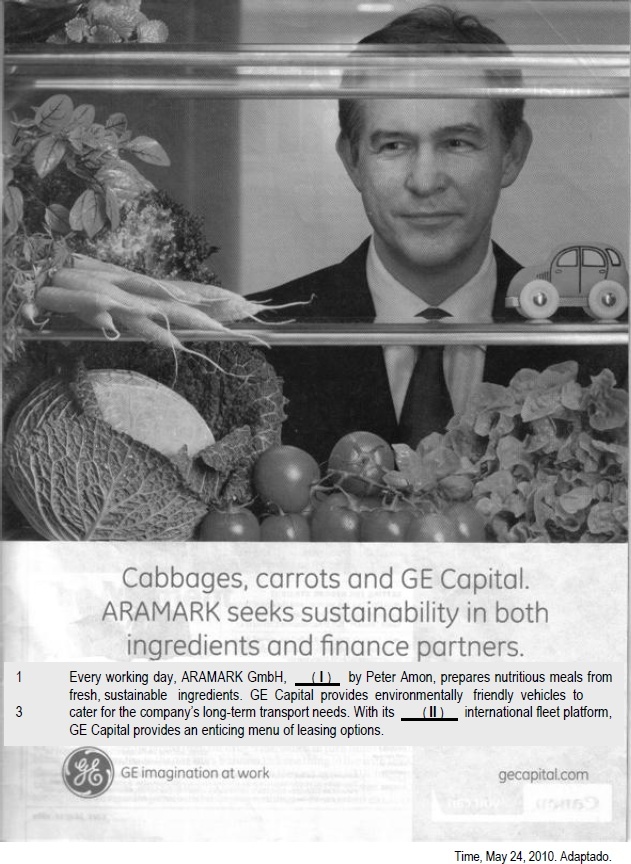
A opção que traduz the company’s long-term transport needs (linha 3) é
Questão 10 189313
ITA 2012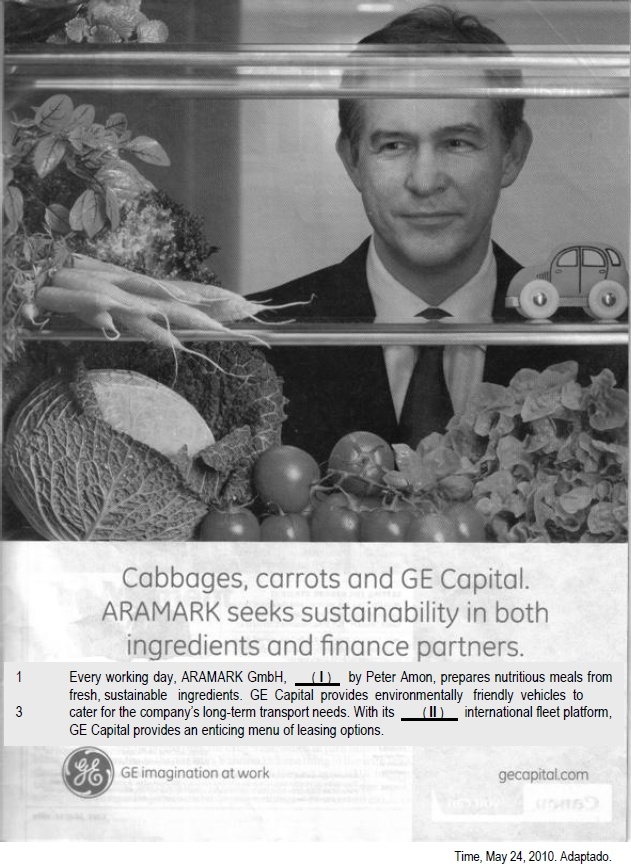
Assinale a opção que indica a relação das palavras cabbage e carrots com o restante do anúncio.
Questão 9 189310
ITA 2012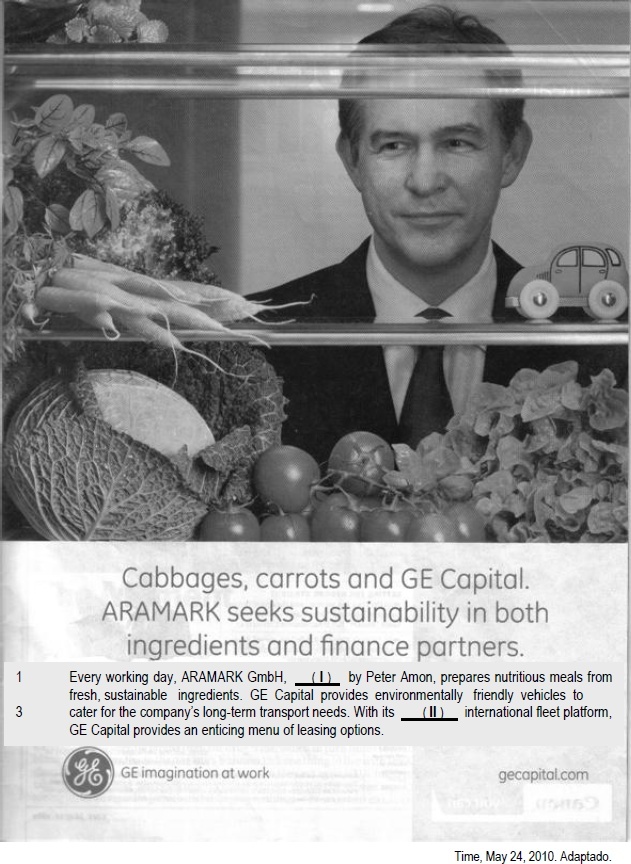
As lacunas I e II devem ser preenchidas, respectivamente, por
Questão 7 189305
ITA 2012Thursday, Feb. 10, 2011
2045: The Year Man Becomes Immortal
By Lev Grossman
[1] (…), Kurzweil believes that we’re approaching a moment when computers will become intelligent, and not just intelligent but more
intelligent than humans. When that happens, humanity – our bodies, our minds, our civilization – will be completely and irreversibly
transformed. He believes that this moment is not only inevitable but imminent. According to his calculations, the end of human
civilization as we know it is about 35 years away.
[5] Computers are getting faster. Everybody knows that. Also, computers are getting faster faster – that is, the rate at which they’re
getting faster is increasing.
True? True.
So if computers are getting so much faster, so incredibly fast, there might conceivably come a moment when they are capable of
something comparable to human intelligence. Artificial intelligence. All that horsepower could be put in the service of emulating
[10] whatever it is our brains are doing when they create consciousness – not just doing arithmetic very quickly or composing piano music
but also driving cars, writing books, making ethical decisions, appreciating fancy paintings, making witty observations at cocktail
parties.
If you can swallow that idea, and Kurzweil and a lot of other very smart people can, then all bets are off. From that point on, there’s no
reason to think computers would stop getting more powerful. They would keep on developing until they were far more intelligent than
[15] we are. Their rate of development would also continue to increase, because they would take over their own development from their
slower-thinking human creators. Imagine a computer scientist that was itself a super-intelligent computer. It would work incredibility
quickly. It could draw on huge amounts of data effortlessly. It wouldn’t even take breaks to play Farmville.
(…)
http://www.time.com/printout/0,8816,2048138,00.html. Acesso em 07/04/2011. Adaptado.
From that point on (linha 13), refere-se a
Questão 5 189297
ITA 2012THE WORLDS OF INFINITIES
To see the world in a grain of sand, And a heaven in a wildflower; Hold infinity in the palm of you hand, And eternity in an hour. – William Blake
[1] Infinity has stimulated imaginations for thousands of years. It is an idea drawn upon by theologians, poets, artists, philosophers,
writers, scientists, mathematicians – an idea that has perplexed and intrigued – an idea that remains illusive. Infinity has taken on
different identities in different fields of thought. In early times, the idea of infinity was, rightly or wrongly, linked to large numbers.
People of antiquity experienced a feeling of the infinite by gazing at stars and planets or at grains of sand on a beach. Ancient
[5] philosophers and mathematicians such as Zeno, Anaxagoras, Democritus, Aristotle, Archimedes pondered, posed and argued the
ideas that infinity presented.
Aristotle proposed the ideas of potential and actual infinities. He argued that only potential infinity existed.
In The Sand Reckoner Archimedes dispelled the idea that the number of grains of sand on a beach are infinite by actually determining
a method for calculating the number on all the beaches of the earth.
[10] Infinity has been the culprit in many paradoxes. Zeno’s paradoxes of Achilles and the tortoise and the Dichotomy have perplexed
readers for centuries. Galileo’s paradoxes dealing with segments, points, and infinite sets should also be noted.
The list of mathematicians with their discoveries and uses or misuses of infinity extends through the centuries. (…).
Texto adaptado de PAPPAS, T. ―The Magic of Mathematics: Discovering the Spell of Mathematics‖, 1994.
Sobre as inúmeras ideias e paradoxos relativos ao infinito, o texto informa que
Questão 4 189295
ITA 2012THE WORLDS OF INFINITIES
To see the world in a grain of sand, And a heaven in a wildflower; Hold infinity in the palm of you hand, And eternity in an hour. – William Blake
[1] Infinity has stimulated imaginations for thousands of years. It is an idea drawn upon by theologians, poets, artists, philosophers,
writers, scientists, mathematicians – an idea that has perplexed and intrigued – an idea that remains illusive. Infinity has taken on
different identities in different fields of thought. In early times, the idea of infinity was, rightly or wrongly, linked to large numbers.
People of antiquity experienced a feeling of the infinite by gazing at stars and planets or at grains of sand on a beach. Ancient
[5] philosophers and mathematicians such as Zeno, Anaxagoras, Democritus, Aristotle, Archimedes pondered, posed and argued the
ideas that infinity presented.
Aristotle proposed the ideas of potential and actual infinities. He argued that only potential infinity existed.
In The Sand Reckoner Archimedes dispelled the idea that the number of grains of sand on a beach are infinite by actually determining
a method for calculating the number on all the beaches of the earth.
[10] Infinity has been the culprit in many paradoxes. Zeno’s paradoxes of Achilles and the tortoise and the Dichotomy have perplexed
readers for centuries. Galileo’s paradoxes dealing with segments, points, and infinite sets should also be noted.
The list of mathematicians with their discoveries and uses or misuses of infinity extends through the centuries. (…).
Texto adaptado de PAPPAS, T. ―The Magic of Mathematics: Discovering the Spell of Mathematics‖, 1994.
Segundo o texto, a ideia de infinito
06