


![[Marketing] Questao Topo - deslogado](https://storage.estuda.com.br/banners/0_6b7ebee90b03af1c560c73bb8bcce34a_banner_deslogado_70_dias.png)
Questões de Inglês
19.971 Questões
Questão 47 272608
CESUPA 2012Nancy by Guy Gilchrist and Brad Gilchrist
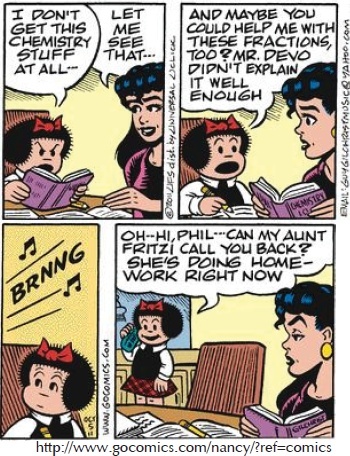
Choose the correct alternative to the next questions according to the comic strip:
47) In “I don’t get this chemistry stuff at all” Nancy means that ____.
Questão 32 238375
UESB Caderno 1 2012TEXTO:
Higher Learning
For more than two decades, as the cost of college has climbed at twice the rate of inflation, critics have argued that
bloated bureaucracies, overpaid faculty, and unnecessary amenities are inflating tuition. Yet in a new book — Why Does
College Cost So Much? — economists Robert Archibald and David Feldman argue that college isn’t actually overpriced.
The reason: although the total cost of attending an in-state, four-year public university has nearly doubled
[5] to $16,140 since 2000, the benefits that come with it have increased considerably, too. Indeed, over the same period of
time, the difference in wages between those who attend college and those who don’t has climbed by 20 percent.
Yet in the aftermath of the recession, a more important question is who’s losing out in the process? Even though aid
packages have risen by more than 50 percent since 2000, one recent study found that college enrollment could fall by 3.6
percent due to the housing crisis, which has made it harder for families to finance their children’s education.
[10] “The prices are rising precisely at the time when minorities and lower-income families are having the most trouble
meeting costs,” says Rucker Johnson, a professor of public policy at the University of California, Berkeley. In other words,
college may still be a good deal, but its price is rising at a time when fewer people can afford it.
By Joel Schectman. Higher Learning. Newsweek, December 6, 2010, p. 12.
The economists R. Archibald and D. Feldman argue that college isn’t actually overpriced because
Questão 30 238372
UESB Caderno 1 2012TEXTO:
The future of the book
The transformation of the book industry has reached
a tipping point. Electronic books now outsell paperbacks
on Amazon, the retailer recently announced. And
Borders, the second-largest bookstore chain in the
[5] United States, is reportedly considering a bankruptcy
filing. With books evolving at extremely rapid speed, we
polled some literary brains on the future of reading:
JUDITH REGAN, book editor :
I think books will be more affordable. Books are
[10] pretty expensive. Publishers are so silly because
they focus on “We’re not going to be selling so many
hard-cover books at $26.” Yeah, but you’re going to sell
infinitely more electronically, so what are you complaining
about? I view it as a greater opportunity.
[15] DAVE EGGERS, author and founder of the publishing
house McSweeney’s:
I don’t own an e-reader, and I’ve never read a page
on an e-reader. I do everything I can to avoid more screen
time.
[20] I don’t think e-books have topped 10 % of the market.
My guess is that it will be about 15 to 20 % of the market,
because e-readers are expensive, and they’ll continue
to be expensive.
Not to diminish the value of a paperback, when it
[25] comes to somebody investing in a hardcover, it’s
something you want to keep. You have to give readers a
choice, between a richer experience with paper books
and a more sterile experience through an electronic
reader. We just try to make every aspect of the physical
[30] book as good as it can possibly be, because that’s our
greatest hedge against the dominance of e-books.
JAMES H. BILLINGTON, librarian of Congress:
The new immigrants don’t shoot the old inhabitants
when they come in. One technology tends to supplement
[35] rather than supplant. How you read is not as important
as: will you read? And will you read something that’s a
book — the sustained train of thought of one person
speaking to another? Search techniques are embedded
in e-books that invite people to get slightly involved rather
[40] than follow a full train of thought. This is part of a general
cultural problem.
JOYCE CAROL OATES, author:
My husband, Charlie, is a neuroscientist, and of
course he immediately ordered both the Kindle and iPad.
[45] When we travel, we read books and The New York Times
on the iPad. I’d much rather have a book.
SETOODEH, Ramin .The future of the book. Newsweek, New York, Feb 14, 2011, p.10. Adaptado.
The conjunction in bold can be suitably replaced by the one in brackets, on the right, in alternative
Questão 26 238364
UESB Caderno 1 2012TEXTO:
The future of the book
The transformation of the book industry has reached
a tipping point. Electronic books now outsell paperbacks
on Amazon, the retailer recently announced. And
Borders, the second-largest bookstore chain in the
[5] United States, is reportedly considering a bankruptcy
filing. With books evolving at extremely rapid speed, we
polled some literary brains on the future of reading:
JUDITH REGAN, book editor :
I think books will be more affordable. Books are
[10] pretty expensive. Publishers are so silly because
they focus on “We’re not going to be selling so many
hard-cover books at $26.” Yeah, but you’re going to sell
infinitely more electronically, so what are you complaining
about? I view it as a greater opportunity.
[15] DAVE EGGERS, author and founder of the publishing
house McSweeney’s:
I don’t own an e-reader, and I’ve never read a page
on an e-reader. I do everything I can to avoid more screen
time.
[20] I don’t think e-books have topped 10 % of the market.
My guess is that it will be about 15 to 20 % of the market,
because e-readers are expensive, and they’ll continue
to be expensive.
Not to diminish the value of a paperback, when it
[25] comes to somebody investing in a hardcover, it’s
something you want to keep. You have to give readers a
choice, between a richer experience with paper books
and a more sterile experience through an electronic
reader. We just try to make every aspect of the physical
[30] book as good as it can possibly be, because that’s our
greatest hedge against the dominance of e-books.
JAMES H. BILLINGTON, librarian of Congress:
The new immigrants don’t shoot the old inhabitants
when they come in. One technology tends to supplement
[35] rather than supplant. How you read is not as important
as: will you read? And will you read something that’s a
book — the sustained train of thought of one person
speaking to another? Search techniques are embedded
in e-books that invite people to get slightly involved rather
[40] than follow a full train of thought. This is part of a general
cultural problem.
JOYCE CAROL OATES, author:
My husband, Charlie, is a neuroscientist, and of
course he immediately ordered both the Kindle and iPad.
[45] When we travel, we read books and The New York Times
on the iPad. I’d much rather have a book.
SETOODEH, Ramin .The future of the book. Newsweek, New York, Feb 14, 2011, p.10. Adaptado.
About Joyce and her husband, the only question to which there’s no answer in the text (l. 42-46) is
Questão 25 238363
UESB Caderno 1 2012TEXTO:
The future of the book
The transformation of the book industry has reached
a tipping point. Electronic books now outsell paperbacks
on Amazon, the retailer recently announced. And
Borders, the second-largest bookstore chain in the
[5] United States, is reportedly considering a bankruptcy
filing. With books evolving at extremely rapid speed, we
polled some literary brains on the future of reading:
JUDITH REGAN, book editor :
I think books will be more affordable. Books are
[10] pretty expensive. Publishers are so silly because
they focus on “We’re not going to be selling so many
hard-cover books at $26.” Yeah, but you’re going to sell
infinitely more electronically, so what are you complaining
about? I view it as a greater opportunity.
[15] DAVE EGGERS, author and founder of the publishing
house McSweeney’s:
I don’t own an e-reader, and I’ve never read a page
on an e-reader. I do everything I can to avoid more screen
time.
[20] I don’t think e-books have topped 10 % of the market.
My guess is that it will be about 15 to 20 % of the market,
because e-readers are expensive, and they’ll continue
to be expensive.
Not to diminish the value of a paperback, when it
[25] comes to somebody investing in a hardcover, it’s
something you want to keep. You have to give readers a
choice, between a richer experience with paper books
and a more sterile experience through an electronic
reader. We just try to make every aspect of the physical
[30] book as good as it can possibly be, because that’s our
greatest hedge against the dominance of e-books.
JAMES H. BILLINGTON, librarian of Congress:
The new immigrants don’t shoot the old inhabitants
when they come in. One technology tends to supplement
[35] rather than supplant. How you read is not as important
as: will you read? And will you read something that’s a
book — the sustained train of thought of one person
speaking to another? Search techniques are embedded
in e-books that invite people to get slightly involved rather
[40] than follow a full train of thought. This is part of a general
cultural problem.
JOYCE CAROL OATES, author:
My husband, Charlie, is a neuroscientist, and of
course he immediately ordered both the Kindle and iPad.
[45] When we travel, we read books and The New York Times
on the iPad. I’d much rather have a book.
SETOODEH, Ramin .The future of the book. Newsweek, New York, Feb 14, 2011, p.10. Adaptado.
It’s possible to infer from what Dave Eggers says that he
Questão 99 234331
UECE 2° Fase 1° Dia 2012/2If the scientists had not carried out the research, the discoveries ________________.
06