


![[Marketing] Questao Topo - deslogado](https://storage.estuda.com.br/banners/0_6b7ebee90b03af1c560c73bb8bcce34a_banner_deslogado_70_dias.png)
Questões de Inglês
19.971 Questões
Questão 59 11916317
UEPA 2ª Etapa 2012Leia o texto abaixo para responder à questão.
Dear Readers,
Were you bullied at school today?
Did you see someone else being
bullied? According to a 2005 study
by researchers at the University of
California at Los Angeles, nearly
one half of middle-school students
reported being bullied at least
once during five school days. Even
more kids had seen others being
bullied. Bullying is harmful not
only to the kids that are bullied,
but to every kid in school. Hitting,
teasing, name-calling and other
forms of bullying create an
atmosphere of fear and dread.
Every kid wonders, Will I be
bullied next?
At TIME For Kids, we want every
kid to feel comfortable, safe and
confident at school, so everyone
can focus on learning and
growing. That’s why we are so
proud that the Department
of Health and Human Services has
sponsored this supplement “Stop
Bullying Now!” This is the first of
three issues you will receive this
year presenting bullying scenarios
and showing you ways to cope
with them. Share this comic book,
and the two that follow, with your
family and friends.
Bullying behavior has probably
been around for as long as human
beings have walked the earth. We
hope to give kids the tools they
need to react appropriately to
bullying situations. Bullying should
not be rewarded or tolerated.
Sincerely yours,
Martha Pickerill
Managing Editor, TIME For Kids
(Fonte: adaptado de http://www.edpubs.gov/document/ ed005149p.pdf?ck=308; acesso em 06.09.2011)
Estudos realizados em 2005, na Universidade da Califórnia, revelam que:
I. Metade dos alunos americanos já presenciou cenas de bullying.
II. Bullying é prejudicial a todos os alunos da escola.
III. Caçoar e bater são algumas das formas de bullying utilizadas.
IV. Medo e terror são gerados em consequência desse tipo de violência.
V. Los Angeles é a cidade americana que registra mais casos de bullying.
De acordo com as afirmativas acima, a alternativa correta é:
Questão 58 11916284
UEPA 2ª Etapa 2012Leia o texto abaixo para responder à questão.
Dear Readers,
Were you bullied at school today?
Did you see someone else being
bullied? According to a 2005 study
by researchers at the University of
California at Los Angeles, nearly
one half of middle-school students
reported being bullied at least
once during five school days. Even
more kids had seen others being
bullied. Bullying is harmful not
only to the kids that are bullied,
but to every kid in school. Hitting,
teasing, name-calling and other
forms of bullying create an
atmosphere of fear and dread.
Every kid wonders, Will I be
bullied next?
At TIME For Kids, we want every
kid to feel comfortable, safe and
confident at school, so everyone
can focus on learning and
growing. That’s why we are so
proud that the Department
of Health and Human Services has
sponsored this supplement “Stop
Bullying Now!” This is the first of
three issues you will receive this
year presenting bullying scenarios
and showing you ways to cope
with them. Share this comic book,
and the two that follow, with your
family and friends.
Bullying behavior has probably
been around for as long as human
beings have walked the earth. We
hope to give kids the tools they
need to react appropriately to
bullying situations. Bullying should
not be rewarded or tolerated.
Sincerely yours,
Martha Pickerill
Managing Editor, TIME For Kids
(Fonte: adaptado de http://www.edpubs.gov/document/ ed005149p.pdf?ck=308; acesso em 06.09.2011)
De acordo com Martha Pickerill, o tema em questão pode ser encontrado:
Questão 65 11748393
APMBB 2012Leia o texto para responder à questão.
2010 census shows Brazil’s inequalities remain
November 17, 2011
By Joe Leahy in São Paulo
Brazil has a long way to go to become a more egalitarian society in spite of significant advances over the past decade, when millions of poor joined the ranks of the middle classes, the country’s 2010 census shows.
Among the most glaring inequalities, the figures found that 25 per cent of the population still lived on an average monthly income per capita of up to R$188 ($106) and half the population on up to R$375. This was compared to the minimum wage in 2010 of R$510. “The results of Census 2010 show that income inequality is still very strong in Brazil, despite the declining trend observed in recent years,” the government data bureau, the Brazilian Institute of Geography and Statistics – known as the IBGE – said.
Once notorious for its rich/poor divide, Brazil has made great strides over the past decade. The rise of a new middle class, which is attracting a flurry of international investment as multinationals from car companies to snackfood producers compete to grab a share of the market, was made possible by increases in the minimum wage, improved welfare benefits and stable economic management.
In particular, successive governments were able to put an end to runaway inflation, which eroded the value of the wages and savings of lower income earners while benefiting those rich enough to buy property or save in dollars.
According to a study by the Getúlio Vargas Foundation, an academic institution, an estimated 33m people have risen to the ranks of the so-called “new middle classes” or above since 2003. Today, 105.5m Brazilians out of a total population of 190m are members of this group, earning between R$1,200 and R$5,174 per household.
But the census indicates tens of millions of people have yet to catch up or have been left behind completely. Discrepancies between races are among the greatest. The average monthly income of whites was R$1,538 and Asians R$1,574, nearly double that of blacks and those of mixed race with R$834 and R$845 respectively, and more than twice as much as indigenous people with R$735.
Whites were also living longer while blacks and those of mixed race accounted for a higher proportion of people below 40 years. “Whites have a higher proportion of elderly people – over 65 years and especially over 80 years of age – which is probably linked to differences in living conditions and access to healthcare, and unequal distribution of income,” the IBGE said.
The same pattern was represented in levels of illiteracy. Although the national rate of illiteracy among the population aged 15 years or older had fallen from 13.63 per cent in 2000 to 9.6 per cent in 2010, it was still as high as 28 per cent in some medium-sized municipalities in the poorer north-east. Illiteracy among blacks was at 14.4 per cent and among those of mixed race 13 per cent in 2010, nearly triple that of whites at 5.9 per cent.
(www.ft.com/intl/cms/s/0/71352352-112c-11e1-ad22- 00144feabdc0.html#axzz1wrL3w1LE)
A palavra glaring no trecho do segundo parágrafo – Among the most glaring inequalities... – equivale, em português, a
Questão 3 9637121
UEG 2012/1Leia o texto abaixo.
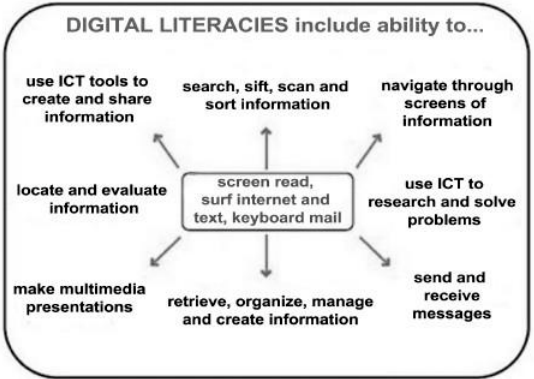
Disponivel em: http4/1 bp.blogspot.com/_duOx79TOByOTKHSJewoPsI/AAAAAAAAhS/sUCACMIp91 Y,'s400/EsquemaUNESCo.bmp. Acesso em: 19 ago. 2011.
Conforme o conteúdo do texto, letramento digital pressupõe a habilidade de
Questão 2 9637118
UEG 2012/1Leia o texto que segue. A questão referem-se a ele.
DIGITAL LITERACY
The concept of digital literacy, as the term is now generally used, was introduced by Paul Gilster, in his 1997 book of the same name. The term itself had been used during the previous decade, though with a more restricted meaning – the ability to deal with hypertextual information. Gilster's idea was much broader, and did not involve the enumeration of lists of particular skills, competences or attitudes defining what it is to be digitally literate. Rather, he explained the concept quite generally, as an ability to understand and to use information from a variety of digital sources, and regarded it simply as literacy in the digital age. It is therefore the current form of the traditional idea of literacy per se; the ability to read, write and otherwise deal with information using the technologies and formats of the time. In an 'information society' and a 'knowledge economy', it is plainly an essential life skill. This generic expression of the idea, although it has irritated some commentators, is one of the strengths of Gilster‟s concept, allowing it to be applied without concern for the sometimes restrictive „competence lists‟ which have afflicted some other descriptions of the literacies of information.
Disponível em: http://www.scitopics.com/Digital_Literacy.html. Acesso em: 19 ago. 2011. (Adaptado).
Considerando-se os aspectos estruturais do texto,
Questão 82 8016730
FMJ 2012Leia o texto e responda à questão.
Life on a Desert Island
Most of us have formed an unrealistic picture of life on a desert island. We sometimes imagine a desert island to be a sort of paradise where the sun always shines. Life there is simple and good. Ripe fruit falls from the trees and you never have to work. There is also the other side of the picture: Life in a desert island is wretched – you either starve to death or live like Robinson Crusoe waiting for a boat which never comes. Perhaps there is an element of truth in both these pictures, but few of us have had the opportunity to find out.
Two men who recently spentfive days on a coral island wished they stayed there longer. They were taking a badly damaged boat from the Virgin Islands to Miami to have it repaired. During the journey, their boat began to sink. They quickly loaded a small rubber dinghy with food, matches, and cans of beer and rowed for a few miles across the Caribbean until they arrived at a tiny coral island. There were hardly any trees on the island and there was no water, but this didn’t prove to a problem since the men collected rain-water in their rubber dinghy.As they had brought a spear gun with them, they had plenty to eat. They caught lobster and fish every day, and, as one of them put it, “ate like kings!” When a passing tanker rescued them five days later, both men were genuinely sorry that they had to leave.
( L. G. Alexander, Developing Skills, Longman. Adaptado)
A ideia implícita na frase do primeiro parágrafo – Perhaps there is an element of truth in both these pictures – é semelhante à expressa no seguinte provérbio:
06