


![[Marketing] Questao Topo - deslogado](https://storage.estuda.com.br/banners/0_6b7ebee90b03af1c560c73bb8bcce34a_banner_deslogado_70_dias.png)
Questões de Inglês
19.971 Questões
Questão 18 45690
Mackenzie 2013/1STOP ANTICIPATING TIREDNESS
Recently, I was on a flight from San Francisco to Chicago when I overheard one of the silliest conversations imaginable. It demonstrates a critical yet common mistake that many people seem to make on an ongoing basis. The conversation, ____( I )____, centered around how tired each of these two people were going to be – tomorrow and all week!
It was as if each person was trying to convince the other, and perhaps themselves, how many hours and how hard they were working, how few hours of sleep they were going to get, and, most of all, how tired they were going to be. I wasn’t quite sure if they were bragging or complaining, but one thing was certain, they were appearing more and more tired the longer the conversation continued.
They each said things like, “Boy, am I going to be tired tomorrow,” “I don’t know how I’m going to make it through the rest of the week,” and “I’m only going to get three hours of sleep tonight.” They told stories of late nights, lack of sleep, uncomfortable hotel beds, and early morning meetings. They anticipated feeling exhausted, and I’m sure they were going to be correct in their assumption. Their voices were heavy, as if the lack of sleep they were going to get was already affecting them. I actually felt myself getting tired just listening to part of the conversation!
The problem with anticipating tiredness in this way, or in any way, is thatit clearly reinforces tiredness. It rivets your attention to the number of hours you are sleeping and how tired you are going to be. Then, when you wake up, you’re likely to do it again by reminding yourself how few hours it has been since your head hit the pillow. Who knows what really happens, but seems it to me that anticipating tiredness must send a message to your brain reminding you to feel and act tired because that is the way you have programmed yourself to respond.
Don’t sweat the small stuff
By Richard Carlson
The text states that
Questão 16 45688
Mackenzie 2013/1STOP ANTICIPATING TIREDNESS
Recently, I was on a flight from San Francisco to Chicago when I overheard one of the silliest conversations imaginable. It demonstrates a critical yet common mistake that many people seem to make on an ongoing basis. The conversation, ____( I )____, centered around how tired each of these two people were going to be – tomorrow and all week!
It was as if each person was trying to convince the other, and perhaps themselves, how many hours and how hard they were working, how few hours of sleep they were going to get, and, most of all, how tired they were going to be. I wasn’t quite sure if they were bragging or complaining, but one thing was certain, they were appearing more and more tired the longer the conversation continued.
They each said things like, “Boy, am I going to be tired tomorrow,” “I don’t know how I’m going to make it through the rest of the week,” and “I’m only going to get three hours of sleep tonight.” They told stories of late nights, lack of sleep, uncomfortable hotel beds, and early morning meetings. They anticipated feeling exhausted, and I’m sure they were going to be correct in their assumption. Their voices were heavy, as if the lack of sleep they were going to get was already affecting them. I actually felt myself getting tired just listening to part of the conversation!
The problem with anticipating tiredness in this way, or in any way, is thatit clearly reinforces tiredness. It rivets your attention to the number of hours you are sleeping and how tired you are going to be. Then, when you wake up, you’re likely to do it again by reminding yourself how few hours it has been since your head hit the pillow. Who knows what really happens, but seems it to me that anticipating tiredness must send a message to your brain reminding you to feel and act tired because that is the way you have programmed yourself to respond.
Don’t sweat the small stuff
By Richard Carlson
The sentence that properly fills in blank I in the text is
Questão 13 45685
Mackenzie 2013/1Could This Be The End Of Cancer?
It’s a disease that kills millions a year and a slew of hoped-for miracle treatments have gone nowhere. Now scientists say vaccines could hold the key—not just to a cure but to wiping out cancer forever.
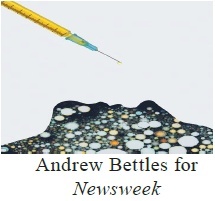
_________________( I )_______________. In 2005, more than a year after three doctors dismissed a lump under her arm as a harmless cyst, she was diagnosed with stage IV (metastatic) breast cancer, which takes the lives of at least 80 percent of patients within five years; it killed Elizabeth Edwards in 2010. Half of those diagnosed with breast cancer that has spread—in Baker, it had reached her spine—die within 39 months. But the 53-year-old jewelry designer in Scottsdale, Ariz., wasn’t ready to die. “I’ve been a competitive athlete and a body builder, I take care of myself and eat right,” she says. “I was going to fight this.”
Baker began searching for a clinical trial, and through the International Cancer Advocacy Network (ICAN) found an intriguing possibility: a cancer vaccine. In May 2006, she traveled to the University of Washington. The vaccine was injected into her upper arm; she got five more shots over the next five months. Today, with scans detecting no cancer anywhere, Baker seems to have beaten some extremely stiff odds.
Short of a sci-fi nano-camera to capture what was going on at the cellular level, it’s impossible to know exactly what the vaccine did. But based on studies of lab animals and cells in petri dishes, scientists have a pretty good idea. The vaccine contained fragments of a molecule called her2/neu, which, perched on the surface of tumor cells, fuels the growth and proliferation of some breast cancers. Baker’s immune system treated the flood of injected her2/neu like an invading army and mounted a counterattack. Cells called CD4, acting like biological Paul Reveres, sounded the alarm, rousing white blood cells called T cells. The body’s Minutemen, they invaded Baker’s tumor, summoning reinforcements called cytotoxic (“killer”) T cells, which destroyed the tumor cells in Baker’s breast as well as her spine. Enough of the other 21 women who received the experimental vaccine against metastatic breast cancer are doing so well that its inventor, immunologist Mary (“Nora”) Disis of UW, dares to envision a future in which vaccines “control or even eliminate cancer.”
By Sharon Begley
Which question below CANNOT be answered with information from the text?
Questão 12 45684
Mackenzie 2013/1Could This Be The End Of Cancer?
It’s a disease that kills millions a year and a slew of hoped-for miracle treatments have gone nowhere. Now scientists say vaccines could hold the key—not just to a cure but to wiping out cancer forever.
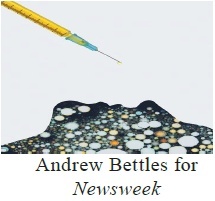
_________________( I )_______________. In 2005, more than a year after three doctors dismissed a lump under her arm as a harmless cyst, she was diagnosed with stage IV (metastatic) breast cancer, which takes the lives of at least 80 percent of patients within five years; it killed Elizabeth Edwards in 2010. Half of those diagnosed with breast cancer that has spread—in Baker, it had reached her spine—die within 39 months. But the 53-year-old jewelry designer in Scottsdale, Ariz., wasn’t ready to die. “I’ve been a competitive athlete and a body builder, I take care of myself and eat right,” she says. “I was going to fight this.”
Baker began searching for a clinical trial, and through the International Cancer Advocacy Network (ICAN) found an intriguing possibility: a cancer vaccine. In May 2006, she traveled to the University of Washington. The vaccine was injected into her upper arm; she got five more shots over the next five months. Today, with scans detecting no cancer anywhere, Baker seems to have beaten some extremely stiff odds.
Short of a sci-fi nano-camera to capture what was going on at the cellular level, it’s impossible to know exactly what the vaccine did. But based on studies of lab animals and cells in petri dishes, scientists have a pretty good idea. The vaccine contained fragments of a molecule called her2/neu, which, perched on the surface of tumor cells, fuels the growth and proliferation of some breast cancers. Baker’s immune system treated the flood of injected her2/neu like an invading army and mounted a counterattack. Cells called CD4, acting like biological Paul Reveres, sounded the alarm, rousing white blood cells called T cells. The body’s Minutemen, they invaded Baker’s tumor, summoning reinforcements called cytotoxic (“killer”) T cells, which destroyed the tumor cells in Baker’s breast as well as her spine. Enough of the other 21 women who received the experimental vaccine against metastatic breast cancer are doing so well that its inventor, immunologist Mary (“Nora”) Disis of UW, dares to envision a future in which vaccines “control or even eliminate cancer.”
By Sharon Begley
The sentence that properly fills in blank I in the text is
Questão 39 45250
UNIFESP 2013Work after eight months of pregnancy is as harmful as smoking, study finds
Conal Urquhart and agencies
July 28, 2012
Working after eight months of pregnancy is as harmful for babies as smoking, according to a new study. Women who worked after they were eight months pregnant had babies on average around 230g lighter than those who stopped work between six and eight months.
The University of Essex research – which drew on data from three major studies, two in the UK and one in the US – found the effect of continuing to work during the late stages of pregnancy was equal to that of smoking while pregnant. Babies whose mothers worked or smoked throughout pregnancy grew more slowly in the womb.
Past research has shown babies with low birth weights are at higher risk of poor health and slow development, and may suffer from a variety of problems later in life. Stopping work early in pregnancy was particularly beneficial for women with lower levels of education, the study found – suggesting that the effect of working during pregnancy was possibly more marked for those doing physically demanding work. The birth weight of babies born to mothers under the age of 24 was not affected by them continuing to work, but in older mothers the effect was more significant.
The researchers identified 1,339 children whose mothers were part of the British Household Panel Survey, which was conducted between 1991 and 2005, and for whom data was available. A further sample of 17,483 women who gave birth in 2000 or 2001 and who took part in the Millennium Cohort Study was also examined and showed similar results, along with 12,166 from the National Survey of Family Growth, relating to births in the US between the early 1970s and 1995.
One of the authors of the study, Prof. Marco Francesconi, said the government should consider incentives 42 employers to offer more flexible maternity leave to women who might need a break before, 43 after, their babies were born. He said: “We know low birth weight is a predictor of many things that happen later, including lower chances of completing school successfully, lower wages and higher mortality. We need to think seriously about parental leave, because – as this study suggests – the possible benefits of taking leave flexibly before the birth 44 quite high.”
The study also suggests British women may be working for 45 now during pregnancy. While 16% of mothers questioned by the British Household Panel Study, which went as far back as 1991, worked up to one month before the birth, the figure was 30% in the Millennium Cohort Study, whose subjects were born in 2000 and 2001.
(www.guardian.co.uk)
O estudo mencionado no texto indica que
Questão 35 45246
UNIFESP 2013Life of a Nantucket Surgeon
By Tara Parker-Pope July 27, 2012
In her new book, “Island Practice”, the New York Times reporter Pam Belluck tells the story of Dr. Timothy Lepore, a quirky 67-year-old physician who for the past 30 years has been the only surgeon working on the island of Nantucket. But Dr. Lepore is no ordinary surgeon. Life on an island, even one that has become a summer playground to the rich and famous, requires a certain amount of resourcefulness and flexibility. Over the years Dr. Lepore has taken it upon himself to deliver whatever type of medical care his island inhabitants need, often challenging conventional notions of medicine and redefining what it means to be a healer. While his surgical skills have been used for minor repairs and lifesaving procedures, he often works as a general practitioner, treating everyday ailments. Distraught island residents also call on him for counseling and comfort, and he even steps into the role of veterinarian when needed. I recently spoke with Ms. Belluck about the time she spent with Dr. Lepore. Here’s part of our conversation.
• I think of Nantucket as a posh summer tourist destination. Were you surprised to find such a quirky character there?
I thought of it as this rich summer haven, but there is this whole year-round population that is really interesting and diverse and has to scrabble for a living. Even the hardship was surprising. You think any place is accessible, but there are a lot of times where you cannot get on or off the island, and you can’t get what you need. Even though they have fast ferries and airplanes now, you’re still at the mercy of the elements, and that creates a lot of drama.
• What kinds of challenges has Dr. Lepore faced?
Part of it is the fact that as the only surgeon, you kind of need to do everything, and you may not know how to do something. There was a guy who came home and had forgotten to pick up potatoes, and his wife stabbed him in the heart. It’s the kind of stab wound that only 10 percent of patients make it to the hospital alive, and 1 percent will survive. Dr. Lepore had never seen anything like this before, but there was no time to get the guy off the island. So he had to reach in and get the heart started. There wasn’t the right equipment to sew him up, and they had only six units of blood, which is not that much. But he’s an encyclopedia of arcane facts, and he remembered that in the 1800s they used black silk thread for this kind of injury. They found some black silk thread, and he managed to close this guy’s heart and get it beating again. The guy survived and became a marathon runner. There is a field hospital-type feeling to it. You’re not under fire, but there is making do with what you have and flying by the seat of your pants. Often the weather is bad, and he has never done it before, but he just has to do it.
• Does he make a good living? Does he take insurance?
He takes insurance, but he also takes people who can’t pay at all. He will even allow people to pay him in kind. One of the undercurrents of the book is that his hospital on Nantucket is now run by Partners Health Care, the big health care corporation that runs Massachusetts General and Brigham and Women’s Hospital. They have instituted some new systems, but he flouts many of them. He says, “Nobody is going to manage my time. Nobody is going to tell me what to do.” They can’t really complain because they need him.
(www.nytimes.com. Adaptado.)
No trecho da resposta à primeira pergunta – Even though they have fast ferries and airplanes now –, é possível substituir corretamente Even though, sem alterar o sentido da frase, por:
06