


![[Marketing] Questao Topo - deslogado](https://storage.estuda.com.br/banners/0_6b7ebee90b03af1c560c73bb8bcce34a_banner_deslogado_70_dias.png)
Questões de Inglês
19.971 Questões
Questão 46 95750
UFTM 2013/1Brazil despite its economic success remains one of the inequality champions
August 22nd, 2012
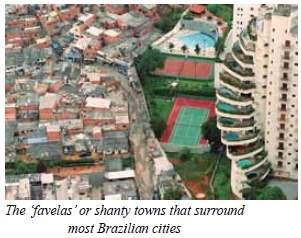
Brazil might be the leading economy in Latin America and has had a significant performance in reducing poverty in recent years, but it still remains among the countries with the highest inequality in the region together with Guatemala, Honduras and Colombia, points out the UN-Habitat report. In all four countries based on 2009 data, the Gini income per capita distribution index stood at 0.56, to which must be added Dominican Republic and Bolivia, two inequality champions with high concentration of wealth. This compares with the US and Portugal Gini indicator of 0.38, two countries that offer no relief since Portugal, for example, has the highest inequality index of the European Union.
Nevertheless, Brazil advanced compared to 1990 when it had the highest degree of inequality and stood well ahead from the rest of the continent. But the region continues to have the highest inequality rate in spite of advances in helping income distribution. Among some of the causes for distribution improvement are productivity, upward trend of salaries and workers categories, strong economy and implementation of income transfer programs in several countries, particularly in the two leading economies, Brazil and Mexico. In the case of Brazil, the country’s economy now figures sixth at global level.
Former president Lula da Silva and one of the most popular leaders in history of that country based his success precisely on the Bolsa Família Plan, which distributed a monthly basic food basket to millions, helping anywhere from 14 to 22 million climb out of poverty, plus ensuring his Workers Party an encouraging future.The Gini coefficient or index measures the inequality among values of a frequency distribution (for instance, levels of income). A Gini coefficient of zero expresses perfect equality where all values are the same (for instance, where everyone has an exactly equal income). A Gini coefficient of one (100 on the percentile scale) expresses maximal inequality among values (for instance, where only one person has all the income).
(http://en.mercopress.com. Adaptado.)
In terms of income inequality, Brazil
Questão 14 94545
Mackenzie 2013/2Django Unchained review:
A truly wild Western with a killer line-up
Review of Oscar-nominated film by Sunday Mirror film critic Mark Adam.
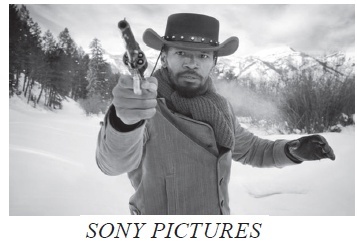
THE STARS
Jamie Foxx, Christoph Waltz, Leonardo DiCaprio, Samuel L Jackson, Walton Goggins, Kerry Washington.
THE STORY
Two years before the start of the Civil War, the unlikely partnership of German bounty hunter Dr King Schultz (Waltz) and Django (Foxx) – the slave he recently freed – set about making money tracking and killing outlaws.
But Django also has plans to rescue his wife Broomhilda (Washington) from charismatic but cruel Mississippi plantation owner Calvin Candie (DiCaprio).
THE VERDICTWhen Quentin Tarantino decides to make a Western, you know it’s going to be epic, violent, funny, exciting and challenging. And this wonderfully irreverent and distinctively bloody take on the wild Wild West hits the spot, brimming with delightfully oddball characters and racy style.
This is obviously not your run-of-the-mill cowboy tale. Instead, Tarantino flies close to controversy by setting his story against the violent and brutal backdrop of the slave trade.
As usual his casting is spot on. Waltz (who won an Oscar for his evil Nazi role in Tarantino’s last film Inglourious Basterds) is smooth perfection as a German dentist/bounty hunter and is wonderfully complemented by Jamie Foxx’s steely-eyed former slave.
The early bonding scenes of them tracking redneck villains (Django relishes the fact he can make money killing “white folk”) are amusingly and snappily shot.
Initially, Tarantino pokes fun at the rampant and casual racism of the period – hilariously so in a scene involving a Ku Klux Klan mob complaining about eye holes in their hoods??– but things turn nastier when Schultz and Django attempt to rescue Broomhilda.
Leonardo DiCaprio has a fine old time as the brutal Candie and absolutely oozes slippery cruelty. But he manages to be out-acted by Tarantino regular Samuel L Jackson, playing an elderly slave and close confidant of Candie who is as menacing and controlling as his supposed master.
According to the movie review,
Questão 41 93726
PUC-SP Inverno 2013
Brazil buys 34 German tanks in security drive
ahead of World
Cup, Olympics,
and Pope
Francis visit
By Jeevan Vasagar, Berlin
3:08PM BST 12 Apr 2013 in
http://www.telegraph.co.uk/news/wor
ldnews/southamerica/brazil/9990242
/Brazil-buys-34-German-tanks-insecurity-
drive-ahead-of-World-Cup-
Olympics-and-Pope-Francisvisit.
html
[1] Brazil is buying 34 German anti-aircraft tanks as it beefs up security ahead of hosting the World Cup, the 2016 Olympic Games, and a papal visit.
[2] The first consignment of Flakpanzer Gepard tanks is due to arrive in the South American country by June. The armour, which has been phased out by the German military in favour of missile systems, is equipped with two 35mm guns.
[3] Brazil is strengthening internal security and counter-terrorism measures ahead of the World Cup next year and the Olympic Games in 2016.
[4] Ahead of the sporting events, Pope Francis, the first Latin American head of th Catholic church, is due to visit Rio de Janeiro in July. He will say mass at Copacabana beach, pray at the Christ the Redeemer statue, and attend a Catholic youth festival.
[5] The Brazilian army officer in command of anti-aircraft artillery, General Marcio Heise, told the G1 news service that the first eight Gepards would arrive in June. They will be deployed in the Brazilian capital, Brasilia, where the Confederations Cup - a prelude to the World Cup - kicks off on June 15, and in Rio de Janeiro, where the tournament ends on June 30, and also for the papal visit.
[6] Brazil has spent little on defence in recent decades but is now seeking to modernize its armed forces. The country's defence ministry recently announced that it was purchasing surface-to-air missile and artillery batteries from Russia. Brazil is also building five submarines in partnership with France, and plans to replaces its ageing air force.
[7] The country's air force is thought to be the largest in Latin America, and its tasks include surveillance of the Amazon rainforest, to curb drug trafficking and illegal logging.
[8] Germany is one of the world's five biggest exporters of arms. Its exports make up 7 percent of the global total, according to the Stockholm International Peace Research Institute.
Após a leitura do texto, na íntegra, infere-se que, em termos de defesa, o Brasil
Questão 45 93663
PUC-SP Verão 2013Jorge Amado: Brazil celebrates its master story-teller
10 August 2012
By Julia Dias Carneiro, BBC Brasil

As Brazil celebrates the centenary of his birth, Jorge Amado is remembered as one of the country's most important and best-loved writers, famous not only at home but also internationally. His vivid portrayal of his fellow countrymen and women struck a chord, and he created characters that captured the popular imagination. Amado was born in the north-eastern state of Bahia, where culture, music and religion were deeply influenced by the arrival of African slaves. His books stress Brazil's African heritage and the mixing of races that define the country' population, as positive values.
Amado wrote his first novel in 1931 and by the end of the decade his stories were being published in France. Amado's foreign success was partly boosted by his politics. He was a militant communist, which helped his work reach the Soviet Union and other countries behind the Iron Curtain. However, his politics also led him into exile in 1947. He was elected to Congress but with the Cold War, the Brazilian Communist Party was banned – and his mandate revoked. Hespent five years in Paris and Czechoslovakia with his wife, Zelia Gattai, travelling extensively and mixing in circles that included Pablo Picasso, Jean-Paul Sartre and Simone de Beauvoir.
Amado's earlier books portray social injustice and are heavily influenced by his political views. He wrote the first Brazilian book with a black main character in the 1930s. Other unlikely heroes for the time followed, from a prostitute to a black caretaker who contests a white professor's racist theories in university. "He brought the ordinary man from the street to the centre of the book. He establishes him as the hero of his stories, so winning over many ordinary workers as readers." says Eduardo de Assis Duarte, author of Jorge Amado: Romance in Times of Utopia. In the 1950s, after the world became aware of the crimes of Soviet leader Joseph Stalin, he abandoned communism and began a new phase in writing, with more humour and less ideology.
www.bbc.co.uk/news. Adaptado e editado.
No trecho do terceiro parágrafo – "He brought the ordinary man from the street to the centre of the book. He establishes him as the hero of his stories, so winning over many ordinary workers as readers." – a palavra him se refere a
Questão 41 93659
PUC-SP Verão 2013Jorge Amado: Brazil celebrates its master story-teller
10 August 2012
By Julia Dias Carneiro, BBC Brasil
As Brazil celebrates the centenary of his birth, Jorge Amado is remembered as one of the country's most important and best-loved writers, famous not only at home but also internationally. His vivid portrayal of his fellow countrymen and women struck a chord, and he created characters that captured the popular imagination. Amado was born in the north-eastern state of Bahia, where culture, music and religion were deeply influenced by the arrival of African slaves. His books stress Brazil's African heritage and the mixing of races that define the country' population, as positive values.
Amado wrote his first novel in 1931 and by the end of the decade his stories were being published in France. Amado's foreign success was partly boosted by his politics. He was a militant communist, which helped his work reach the Soviet Union and other countries behind the Iron Curtain. However, his politics also led him into exile in 1947. He was elected to Congress but with the Cold War, the Brazilian Communist Party was banned – and his mandate revoked. Hespent five years in Paris and Czechoslovakia with his wife, Zelia Gattai, travelling extensively and mixing in circles that included Pablo Picasso, Jean-Paul Sartre and Simone de Beauvoir.
Amado's earlier books portray social injustice and are heavily influenced by his political views. He wrote the first Brazilian book with a black main character in the 1930s. Other unlikely heroes for the time followed, from a prostitute to a black caretaker who contests a white professor's racist theories in university. "He brought the ordinary man from the street to the centre of the book. He establishes him as the hero of his stories, so winning over many ordinary workers as readers." says Eduardo de Assis Duarte, author of Jorge Amado: Romance in Times of Utopia. In the 1950s, after the world became aware of the crimes of Soviet leader Joseph Stalin, he abandoned communism and began a new phase in writing, with more humour and less ideology.
www.bbc.co.uk/news. Adaptado e editado.
Os temas da obra de Jorge Amado
Questão 20 92420
PUC- RJ 2013/1Are You A Digital Native or A Digital Immigrant?
[1] We all know that we are living in an increasingly
technologically driven world. Living here in the heart
of Silicon Valley I certainly feel it every day. In fact, I
don’t think I know a single couple in my neighborhood,
[5] other than my wife and I, who don’t work in the
technology field in some capacity. Our local companies
are Facebook, Apple, Google, Yahoo, and so many
venture capital firms that I can’t keep them straight.
But you don’t have to live in Silicon Valley to feel
[10] that the world is getting more and more technology
centered, focused, and driven. We can debate the
pros and cons of this reality but we can’t deny that
the world has changed very quickly in head spinning
ways. Two recent comments led me to finally enter
[15] the 21st century by getting a smart phone this week,
kicking and screaming.
First, I mentioned to one of my undergraduate
classes at Santa Clara University that I didn’t have
a smart phone, but rather I had a dumb phone. My
[20] phone can make and receive phone calls and that’s
about it. No email, internet, and so forth. So one of my
students looked at me in an odd and curious way, like
she was talking to someone from another planet, and
stated in a matter of fact manner, “Professor Plante,
[25] even 2nd graders have smart phones.” Ouch!
Second, I was talking with a producer at the
PBS NewsHour who wanted me to do a live interview
within a few hours of his call regarding some late
breaking news about clergy sexual abuse, which is
[30] my specialty. I was out of the office and driving my
car when he called and in a matter of fact manner
he said that he wanted to send me some important
information to my smart phone to best prepare me for
the upcoming interview. When I told him that I couldn’t
[35] receive anything since I had a dumb phone and not a
smart phone, there was a long silence. He then said
he’d have to just read it to me over the phone as a
Plan B. He wasn’t happy ... neither was I.
In case you haven’t noticed, the 21st century is
[40] really upon us and to live in it one really does need
to be connected in my view. Although I often consider
myself a 19th or 20th century guy trapped in the 21st
century we really do need to adapt. For most of us
we are just living in a new world that really demands
[45] comfort with and access to technology.
This notion of digital native vs. digital immigrant
makes a great deal of sense to me. Young people
in our society are digital natives. They seem to be
very comfortable with everything from iPhones to TV
[50] remotes. Digital immigrants, like me, just never feel
that comfortable with these technologies. Sure we
may learn to adapt by using email, mobile phones,
smart ones or dumb ones, Facebook, and so forth but
it just doesn’t and perhaps will never be very natural
[55] for us. It is like learning a second language ... you can
communicate but with some struggle.
This has perhaps always been true. I remember
when I was in graduate school in the 1980s trying to
convince my grandparents that buying a telephone
[60] answering machine as well as a clothes dryer would
be a good idea. They looked at me like I was talking
in another language or that I was from another planet.
Perhaps we have a critical period in our lives for
technology just like we do for language. When we are
[65] young we soak up language so quickly but find it so
much harder to learn a new language when we are
older. The same seems to be true for technology.
So, this week I bought my first smart phone and
am just learning to use it. When questions arise, I turn
[70] to my very patient teenage son for answers. And when
he’s not around, I just look to the youngest person
around for help.
So, what about you? Are you a digital native or
a digital immigrant and how does it impact your life?
Adapted from “Digital Native vs Digital Immigrant? Which are you?” Published on July 24, 2012 by Thomas G. Plante, Ph.D., ABPP in Do the Right Thing http://www.psychologytoday.com/blog/do-the-right-thing/201207/ digital-native-vs-digital-immigrant-which-are-you retrieved on July 28, 2012
Mark the INCORRECT option concerning the statements
06