


![[Marketing] Questao Topo - deslogado](https://storage.estuda.com.br/banners/0_6b7ebee90b03af1c560c73bb8bcce34a_banner_deslogado_70_dias.png)
Questões de Inglês
19.971 Questões
Questão 13 11304889
IFSudesteMinas 2019/1TEXT
Has a hashtag changed your life?
Has your life been changed by a hashtag or a social media movement?
Among the pictures of cats and avocadoes on toast, there are some important conversations
happening about health, politics, family, society and much more.
Have you had your outlook altered by a social media interaction? Have you been inspired to
make a change after a hashtag went viral? Have you become part of a social media community?
Hashtags as diverse as #MeToo, #BlackLivesMatters and #IceBucketChallenge have been huge
topics online, but how have you been affected by a social media trend?
If you have a story about how social media or a specific hashtag has changed your life, use the
form below to get in touch.
You can also contact us in the following ways:
• Email: haveyoursay@bbc.co.uk
• Tweet: @BBC_HaveYourSay
• WhatsApp: +44 7555 173285
• Please read our terms & conditions and privacy policy
Available at: https://www.bbc.co.uk/news/44301724. Access on 27 Aug. 2018. Adapted.
Consider the excerpt below taken from TEXT and check the CORRECT alternative.
“Have you had your outlook altered by a social media interaction? Have you been inspired to make a change after a hashtag went viral? Have you become part of a social media community?”
Questão 46 10780675
UFN Inverno 2019Why does time seem to go faster as we get older?
If time flies when you're having fun, does that mean old people are constantly enjoying themselves?
Most people agree that the years seem to pass at an ever-accelerating rate. That’s because traditions, anniversaries and celebrations gradually accumulate and merge, so that the difference between each year and the previous one grows smaller and smaller.
(FONTE: https://www.sciencefocus.com/science/whydoes-time-seem-to-go-faster-as-we-get-older/)
Como resposta ao questionamento feito, assinale a alternativa que melhor identifica o argumento apresentado pelo texto.
Questão 46 10778415
UFN Verão 2019By Reuben Fischer-Baum for The Washington Post
1 In the past three decades, the United States has seen staggering technological changes. In 1984,
just 8 percent of households had a personal computer, the World Wide Web was still five years
away, and cell phones were enormous. Americans born that year are only 34 years old.
Here’s how some key parts of our technological lives have shifted, split loosely into early,
[5] middle and current stages.
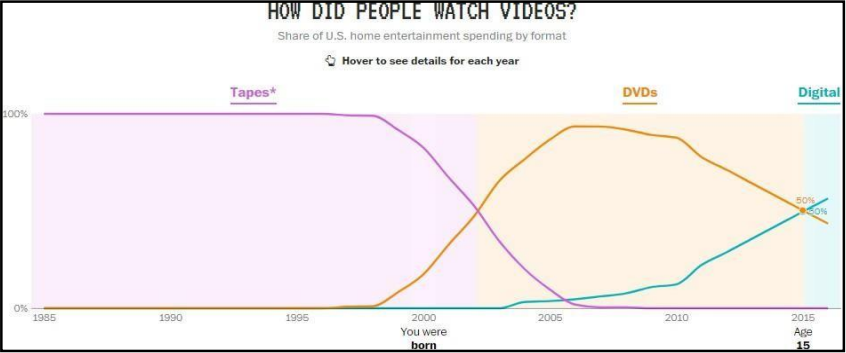
Blockbuster isn’t quite dead yet — as of April there were at least 10 U.S. locations still in operation, mostly in Alaska. But the era of physical videos is on its way out. Children today may never
know the swelling music of a DVD menu that’s looped back to the beginning. And they certainly
will never have to rewind a VHS tape.
[10] But this is just one slice of how home entertainment has changed over the past 30 years. Thanks
to plummeting prices, most Americans now own (large!) HD TVs that were once reserved for the
very wealthy. During the same era, cable overtook network television in profitability and prestige.
Both are now threatened by the twin specters of cord-cutting and streaming.
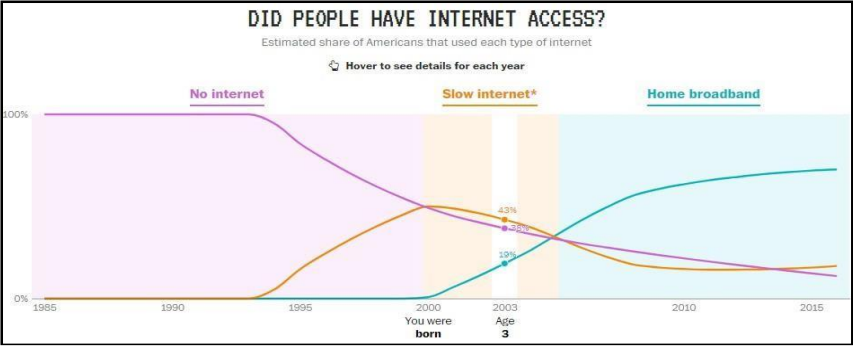
Twenty years ago the Internet was still mostly for play — Geocities was one of the most popular
[15] sites on the Web.
And it was slow! Dial-up — which uses pre-existing telephone lines to connect to the Internet
— was the primary internet technology throughout the ’90s, until faster Broadband services began
to take hold. Dial-up had a max speed of 56 kilobits per second, and could be interrupted by an
incoming phone call
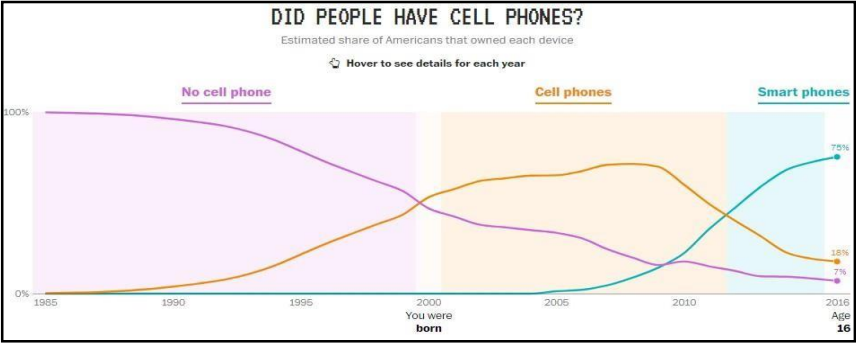
[20] While the first mobile phone call was made in 1973, it took the technology a while to reach the
masses. In the late ’80s, cellphones were still an extravagance, notably used by Gordon Gecko in
1987’s “Wall Street.”
A decade a half later, Nokia and other manufacturers had developed much cheaper models. In
particular, the nearly indestructible Nokia 3310 affectionately known as the “brick” — has a special
[25] place in U.S. mobile history as the first cell phone for many younger Americans.
(Fonte: https://www.washingtonpost.com/adaptado)
O texto é uma adaptação e contempla informações sobre a evolução e o consumo de tecnologias ao longo dos anos, principalmente, na América do Norte.
A alternativa que indica o título mais adequado ao texto é:
Questão 24 10759437
UFT Tarde 2019/2Read the following advertisement in order to answer QUESTION.

Available at: http://www.advertisingarchives.co.uk/detail/14356/1/MagazineAdvert/Kenwood-Chef/1960s
The 1961 Kenwood Chef advertisement suggests:
Questão 23 10759436
UFT Tarde 2019/2Read the text that follows in order to answer QUESTION.
High-risk areas downhill from mining dams in Brazil
More than 100,000 Brazilians live downhill from mining dams built like the one in Brumadinho that collapsed last month, our estimates found.
Brazil counts 87 mining dams built using the same method, known as upstream tailings construction, as the one that collapsed. That design is risky if not monitored carefully, and experts have warned that a collapse could happen again in a country where neither the mining industry nor regulators have the situation under control.
We looked at each of the 87 upstream dams to estimate if it could threaten populated areas, using geospatial analysis to estimate where the mud could flow if each of the dams failed. For at least 27 of those dams, more than 1,000 people live in high-risk areas. That means they are downhill from the dam and within eight kilometers — the distance the mud flowed after the Brumadinho collapse.
All of those dams were rated by the government at the same risk level, or worse, as the dam that failed in Brumadinho.
“I wouldn’t buy a home downstream of a tailings dam built in an upstream fashion,” said William F. Marcuson III, a former president of the American Society of Civil Engineers. “And I wouldn’t allow my mother to rent or live in a home downstream of a tailings dam built in an upstream fashion.”
Minas Gerais, a state whose name means “general mines”, has been the hub of Brazil’s mining industry for centuries. Today, it still produces 53 percent of the country’s mining output.
Available at: https://www.nytimes.com/interactive/2019/02/14/world/americas/brumadinho-brazildam-collapse.html?smid=pl-share
In agreement with the text, the word output in the sentence: “Today, it still produces 53 percent of the country’s mining output”, last paragraph, infers the idea of:
Questão 19 10742781
UFT Tarde 2019/2Read the text that follows in order to answer QUESTION.
PRAY WITH THE POPE, FROM YOUR IPHONE
"Click to pray" are not words you'd expect to come out of the pope's mouth.
But that's what onlookers heard during the traditional Sunday address from Pope Francis, as he introduced ClickToPray, an app for communal prayer aimed at young people.
"The Internet and social media are a resource of our time," the pope said. From a balcony overlooking St. Peter's Square, Francis then gestured to a tablet. Father Frédéric Fornos, international director of the pope's Worldwide Prayer Network, held up the device for the crowd to see.
"Here," Francis said, "I'll insert the intentions and the prayer requests for the mission of the Church."
He tapped the screen several times before glancing up at Fornos.
"Did I do it?" he asked.
The pope has made earnest efforts to embrace technology, tweeting frequently and calling the Web "a gift from God." Now he's given his followers a convenient way to turn on their smart devices and see what the leader of the Catholic Church is praying for at any given time.
"Pray every day," reads the app when it opens. "Pray together with others. Give to the community." More than 18,000 people have clicked on the pope's prayer intention for January. The prayer, "Young People and the Example of Mary," focuses on young Catholics, especially in Latin America.
But the app is more democratic than the pope's Sunday address, with a timeline of prayers from other users that you can scroll through, similar to a social media feed. People write prayers for weddings, celebrations, illnesses and more, and others can click to pray with them or leave a comment. A prayer in English asks for employment "where I can make a difference," while another in Italian seeks an end to international borders. Prayers in Spanish, French, Portuguese and German have also been posted to the app, ranging from precise requests to generic expressions of love and fraternity.
In his address, Pope Francis specifically called on young people to download the app. The pope has long sought to make the Church relevant for younger generations, as the proportion of Catholics declines across the world. […]
Available at: https://www.npr.org/2019/01/20/687001314/pray-with-the-pope-fromyour-iphone
According to the text, it is INCORRECT to affirm:
06