


![[Marketing] Questao Topo - deslogado](https://storage.estuda.com.br/banners/0_6b7ebee90b03af1c560c73bb8bcce34a_banner_deslogado_70_dias.png)
Questões de Inglês
19.971 Questões
Questão 23 124797
UPF Inverno 2013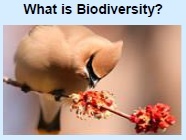
The term “biodiversity” refers to the variety of life forms in a
habitat, whether it‟s a local environment or an entire planet.
Most of the species making up our planetary biodiversity
are still poorly studied or completely unknown; experts
estimate that there may be at least four times as many
complex species alive on our planet as the 1.9 million that
have already been discovered and named, possibly more.
Even as we are becoming aware of the massive
biodiversity of Earth, we are also in the midst of a
biodiversity crisis, with species going extinct at rates
rivaling those of the major mass extinctions of Earth‟s
history. Therefore, while the definition of the term
“biodiversity” is simple, it in fact encompasses some of
humanity‟s (and science‟s) biggest challenges.
There are a number of reasons why understanding and
preserving biological diversity is important. Above all, every
species is unique in its combination of evolutionary history
and ecological role, so taken together they are a global
resource – like a library preserving the heritage of life
itself.
[… ]
Intrinsic value
Some believe in the philosophical and ethical principle that
nonhuman living things have intrinsic value in and of
themselves, independent of their usefulness to humans.
From a conservation standpoint, this means that humans
have a responsibility to protect the right of other species to
exist on our planet. From a scientific standpoint, it means
that other species are worthy of study simply because their
status as living things makes them relevant.
Photo credit: David Spier, Bombycilla cedrorum and Acer saccharinum, CC BY-NC-SA (Retrieved and adapted from http://eol.org/info/about_biodiversity. Access on May 02nd, 2013)
The expressions our (line 3), itself (line 20), them (line 30), respectively refer to:
Questão 21 124793
UPF Inverno 2013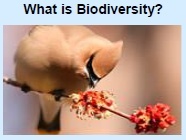
The term “biodiversity” refers to the variety of life forms in a
habitat, whether it‟s a local environment or an entire planet.
Most of the species making up our planetary biodiversity
are still poorly studied or completely unknown; experts
estimate that there may be at least four times as many
complex species alive on our planet as the 1.9 million that
have already been discovered and named, possibly more.
Even as we are becoming aware of the massive
biodiversity of Earth, we are also in the midst of a
biodiversity crisis, with species going extinct at rates
rivaling those of the major mass extinctions of Earth‟s
history. Therefore, while the definition of the term
“biodiversity” is simple, it in fact encompasses some of
humanity‟s (and science‟s) biggest challenges.
There are a number of reasons why understanding and
preserving biological diversity is important. Above all, every
species is unique in its combination of evolutionary history
and ecological role, so taken together they are a global
resource – like a library preserving the heritage of life
itself.
[… ]
Intrinsic value
Some believe in the philosophical and ethical principle that
nonhuman living things have intrinsic value in and of
themselves, independent of their usefulness to humans.
From a conservation standpoint, this means that humans
have a responsibility to protect the right of other species to
exist on our planet. From a scientific standpoint, it means
that other species are worthy of study simply because their
status as living things makes them relevant.
Photo credit: David Spier, Bombycilla cedrorum and Acer saccharinum, CC BY-NC-SA (Retrieved and adapted from http://eol.org/info/about_biodiversity. Access on May 02nd, 2013)
The main function of the text is:
Questão 19 124790
UPF Inverno 2013Global poverty is falling, so what\'s the problem?
By Global Public Square staff
Watching countries from around the world grow and
prosper, we tend to assume that global poverty is falling.
And in fact, the World Bank says that in 1981 nearly half of
the world\'s citizens were impoverished, that is, they lived
on less than $1.25 a day. And today, less than a fifth of the
world\'s population lives in poverty. In raw numbers, that
translates to a 40 percent drop from about 2 billion to 1.2
billion people.
But when we dig deeper, it‟s clear the picture is more
murky. Put simply, most of the reduction in global poverty
has to do with one country – China. Take it out of the
equation and the numbers look very different. Let\'s go
back to 1981. Back then, China accounted for 43 percent
of the world\'s poor. The other major contributors were
South Asia, with 29 percent, and sub-Saharan Africa, with
11 percent. Fast forward just a decade, and you\'ll see that
China\'s share of the world\'s poor began to drop. The trend
continues through the 2000s. By 2010, China accounted
for only 13 percent of the world\'s impoverished population.
South Asia\'s share had jumped to 42 percent, while sub-
Saharan Africa\'s share tripled, to 34 percent.
The World Bank data shows that the total number of
impoverished Chinese declined by nearly 680 million
people in the last three decades. That\'s about 95 percent
of the total global decline. By registering double digit
growth for three decades, Beijing has transformed the
fortunes of a poor nation within a generation. That\'s
amazing, but it tells you that in the rest of the world,
progress has been much, much slower – if there\'s been
progress at all.
(Retrieved and adapted from http://globalpublicsquare.blogs.cnn.com/2013/05/01/globalpoverty- is-falling-so-whats-the-problem/?hpt=hp_bn2. Access on May 01st, 2013)
The major contributors for global poverty by 2010 were, in a scale from the biggest to the smallest:
Questão 18 124789
UPF Inverno 2013Global poverty is falling, so what\'s the problem?
By Global Public Square staff
Watching countries from around the world grow and
prosper, we tend to assume that global poverty is falling.
And in fact, the World Bank says that in 1981 nearly half of
the world\'s citizens were impoverished, that is, they lived
on less than $1.25 a day. And today, less than a fifth of the
world\'s population lives in poverty. In raw numbers, that
translates to a 40 percent drop from about 2 billion to 1.2
billion people.
But when we dig deeper, it‟s clear the picture is more
murky. Put simply, most of the reduction in global poverty
has to do with one country – China. Take it out of the
equation and the numbers look very different. Let\'s go
back to 1981. Back then, China accounted for 43 percent
of the world\'s poor. The other major contributors were
South Asia, with 29 percent, and sub-Saharan Africa, with
11 percent. Fast forward just a decade, and you\'ll see that
China\'s share of the world\'s poor began to drop. The trend
continues through the 2000s. By 2010, China accounted
for only 13 percent of the world\'s impoverished population.
South Asia\'s share had jumped to 42 percent, while sub-
Saharan Africa\'s share tripled, to 34 percent.
The World Bank data shows that the total number of
impoverished Chinese declined by nearly 680 million
people in the last three decades. That\'s about 95 percent
of the total global decline. By registering double digit
growth for three decades, Beijing has transformed the
fortunes of a poor nation within a generation. That\'s
amazing, but it tells you that in the rest of the world,
progress has been much, much slower – if there\'s been
progress at all.
(Retrieved and adapted from http://globalpublicsquare.blogs.cnn.com/2013/05/01/globalpoverty- is-falling-so-whats-the-problem/?hpt=hp_bn2. Access on May 01st, 2013)
Read the statements bellow about global poverty in 1981:
I. The world‟s impoverished population was about 1.2 billion people.
II. China accounted for 43 percent of the world‟s poor.
III. Less than a fifth of the world‟s population lived in poverty.
IV. Poor citizens lived on less than $1.25 a day.
The only true statements are:
Questão 17 124788
UPF Inverno 2013Global poverty is falling, so what\'s the problem?
By Global Public Square staff
Watching countries from around the world grow and
prosper, we tend to assume that global poverty is falling.
And in fact, the World Bank says that in 1981 nearly half of
the world\'s citizens were impoverished, that is, they lived
on less than $1.25 a day. And today, less than a fifth of the
world\'s population lives in poverty. In raw numbers, that
translates to a 40 percent drop from about 2 billion to 1.2
billion people.
But when we dig deeper, it‟s clear the picture is more
murky. Put simply, most of the reduction in global poverty
has to do with one country – China. Take it out of the
equation and the numbers look very different. Let\'s go
back to 1981. Back then, China accounted for 43 percent
of the world\'s poor. The other major contributors were
South Asia, with 29 percent, and sub-Saharan Africa, with
11 percent. Fast forward just a decade, and you\'ll see that
China\'s share of the world\'s poor began to drop. The trend
continues through the 2000s. By 2010, China accounted
for only 13 percent of the world\'s impoverished population.
South Asia\'s share had jumped to 42 percent, while sub-
Saharan Africa\'s share tripled, to 34 percent.
The World Bank data shows that the total number of
impoverished Chinese declined by nearly 680 million
people in the last three decades. That\'s about 95 percent
of the total global decline. By registering double digit
growth for three decades, Beijing has transformed the
fortunes of a poor nation within a generation. That\'s
amazing, but it tells you that in the rest of the world,
progress has been much, much slower – if there\'s been
progress at all.
(Retrieved and adapted from http://globalpublicsquare.blogs.cnn.com/2013/05/01/globalpoverty- is-falling-so-whats-the-problem/?hpt=hp_bn2. Access on May 01st, 2013)
In the text, the authors are questioning:
Questão 43 113448
UFGD 2013Connie K. Ho for redOrbit.com – Your Universe Online As the air gets chillier and the leaves start to change colors, you know it’s flu season, and that can only mean one thing – flu shots. Various health groups are urging individuals in the U.S. to seek out flu vaccinations as a defense against getting sick this season.
In a report by Reuters, over 85 million doses of the vaccine have already been given out. There are a total of around 135 million doses available according to non-profit National Foundation for Infectious Diseases. Health organizations like the American Medical Association and the American Academy of Pediatrics are encouraging individuals to get vaccinated. They also recommend coughing into the elbow and hand washing as methods to reduce the risk of being infected by the flu.
Source: Connie K. Ho for redOrbit.com – Your Universe Online Topics: Health Medical Pharma, Medicine, Health, Vaccines, flu, FluMist, Influenza, Flu season, Flu pandemic, Vaccination, Prevention, Influenza vaccine (Flu Season Is Upon Us, Time To Get Vaccinated)

Esse texto faz parte de uma campanha de prevenção a uma doença sazonal veiculada na internet. Seu objetivo é chamar a atenção do leitor para
06