


![[Marketing] Questao Topo - deslogado](https://storage.estuda.com.br/banners/0_6b7ebee90b03af1c560c73bb8bcce34a_banner_deslogado_70_dias.png)
Questões de Inglês
19.971 Questões
Questão 38 142534
UPE 2° Fase / 1° Dia SSA 2013According to the cartoon below:
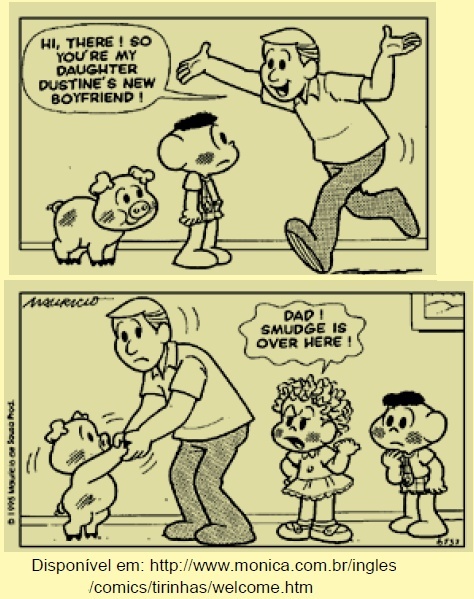
1. Dustine isn’t the man’s daughter.
2. The man is Dustine’s father.
3. Dustine’s very happy with her father.
4. Dustine is the guy’s girlfriend.
5. The guy’s name’s Smudge.
It is CORRECT only
Questão 34 142530
UPE 2° Fase / 1° Dia SSA 2013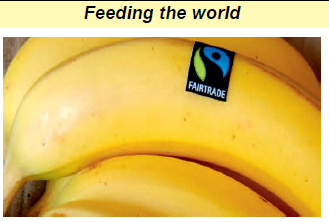
“We are indebted to half the world before we finished breakfast.”
(Martin Luther King)
The environment is about plants and animals – but it’s about humans, too. They need to work and earn money, and they also need to eat. Many people do not have enough food. So scientists and governments are always looking for new ways to feed them.
In many countries, farmers have to sell their fruit and vegetables for very low prices. If they increase these prices, supermarkets will not buy them. There are other problems, too. When there is a drought, or flood, farmers often lose their crops. Then they have no money.
In 1994, a new organization, Fairtrade, decided to help farmers. Their motto is “A fair price for good food”. This organization works with both producers and supermarkets, the different parts of the supply chain. They guarantee a good price to the farmers, and they contribute money to educational and social projects. The supermarkets sell the products at a higher price, but it’s a fair one. And the consumer gets good quality, at a fair price. Everyone in this supply chain benefits!
Ana and Jose are farmers in Ecuador, South America. They grow bananas. “We don’t use many chemicals – Fairtrade limits this. Some companies don’t care. Chemicals make the fruit grow quickly at first. But then they enter the soil, and it degenerates. But we need the Fairtrade price to support us.”
In 2004, Fairtrade worked with similar organizations in 17 other countries in Europe, North America and Asia. There are more and more countries every year. There are now more than 130 products with the Fairtrade logo. These include coffee, tea, chocolate, bananas, fruit juice, sugar and honey.
When a product carries the Fairtrade mark it means the producers and traders have met Fairtrade Standards. The standards are designed to address the imbalance of power in trading relationships, unstable markets and the injustices of conventional trade.
HOLDEN, Susan. Environment Portfolio Series. São Paulo: Macmillan, 2004. (Adaptado)
Qual das sentenças a seguir indica que “producers work under safety guidelines and environmental standards are maintained”?
Questão 33 142527
UPE 2° Fase / 1° Dia SSA 2013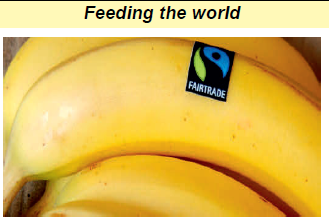
“We are indebted to half the world before we finished breakfast.”
(Martin Luther King)
The environment is about plants and animals – but it’s about humans, too. They need to work and earn money, and they also need to eat. Many people do not have enough food. So scientists and governments are always looking for new ways to feed them.
In many countries, farmers have to sell their fruit and vegetables for very low prices. If they increase these prices, supermarkets will not buy them. There are other problems, too. When there is a drought, or flood, farmers often lose their crops. Then they have no money.
In 1994, a new organization, Fairtrade, decided to help farmers. Their motto is “A fair price for good food”. This organization works with both producers and supermarkets, the different parts of the supply chain. They guarantee a good price to the farmers, and they contribute money to educational and social projects. The supermarkets sell the products at a higher price, but it’s a fair one. And the consumer gets good quality, at a fair price. Everyone in this supply chain benefits!
Ana and Jose are farmers in Ecuador, South America. They grow bananas. “We don’t use many chemicals – Fairtrade limits this. Some companies don’t care. Chemicals make the fruit grow quickly at first. But then they enter the soil, and it degenerates. But we need the Fairtrade price to support us.”
In 2004, Fairtrade worked with similar organizations in 17 other countries in Europe, North America and Asia. There are more and more countries every year. There are now more than 130 products with the Fairtrade logo. These include coffee, tea, chocolate, bananas, fruit juice, sugar and honey.
When a product carries the Fairtrade mark it means the producers and traders have met Fairtrade Standards. The standards are designed to address the imbalance of power in trading relationships, unstable markets and the injustices of conventional trade.
HOLDEN, Susan. Environment Portfolio Series. São Paulo: Macmillan, 2004. (Adaptado)
De acordo com o texto, pode-se afirmar que Fairtrade é uma organização
I. que apoia os fornecedores de alimentos em todo o mundo, atuando principalmente nos países da Ásia e da Europa, com o intuito de promover as vendas e o lucro dos fazendeiros e cooperados.
II. que apoia tanto os fazendeiros e produtores em geral como os supermercados, que vendem tais produtos, garantindo boa qualidade dos alimentos ao consumidor por um preço justo.
III. que se propõe a financiar os fazendeiros produtores de frutas e verduras, para que eles possam enfrentar os grandes empresários, como os donos de supermercados e restaurantes.
IV. com objetivos ambientais e econômicos, que apoia todos os que fazem parte da cadeia de abastecimento, sem perder de vista os incentivos para a educação e outros projetos sociais.
Estão CORRETOS
Questão 34 142351
UPE 3° Fase / 1° Dia SSA 2013
Youth unemployment represents an obvious waste of human capital with long-term negative consequences for the individuals concerned and for those around them. It is often associated with rising crime and the emergence of an underclass with its own subcultures and rules. But, in spite of these widely shared concerns, “it is clear” … “that in all countries, proportionally more young people are without a job today than two decades ago.”
SIQUEIRA, R. Context. Ed. Saraiva. São Paulo, 2000.
According to the text, the emergence of an underclass is provoked by
Questão 55 129778
UFPA 2013/1Japan harnesses fashion power of gals
By Mariko
Oi BBC News, Tokyo
29 August 2012 Last updated at 23:52 GMT
In every country, there are sub-cultures who define themselves through fashion. The West has goths, hippies and grunge, for example. Japan has gals.
They are young girls who look, act and speak very differently from the traditional image of Japanese women.
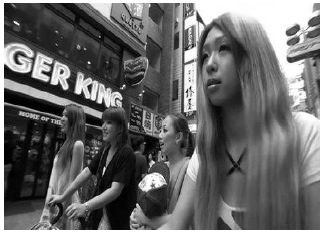
Since they emerged as a group in the mid-90s, their looks have evolved. But a few elements have remained constant - short skirts, massive heels and big, big eyes.
This type of rebellion has been frowned on in the past. But now these gals are being courted - for their spending power, their adventurous mindset and even as a cultural export.
Gals, named for the Japanese pronunciation of girl - gyaru, were the product of the boom years - urban teens with a disposable income who were keen to stand out.
Their fashion went through various stages - big socks, foot-high wedge heels, silver hair, deep bronze skin.
The wildest of all was a group called Yamamba, who wore large circles of unnaturally white eyeshadow, giving a reverse panda-eye effect.
Changing tastes
Gals\\' spending power has been in the spotlight before. Their desire to keep up with the latest fad meant that they spent a lot of money on clothes and shoes. "Their fashions changed very fast, and gals followed each trend religiously," said Nobuko Yabe of gals\\' magazine Popteen.
Their favourite shopping centre, Shibuya\\'s 109 store, saw its sales double between 1995 and 2008, as other department stores struggled with falling sales.
But gals could not shield 109 from the impact of the global financial crisis. As hard times hit, they started to shop at slightly cheaper global brands, such as H&M and Zara. And the economic crunch has curtailed their fashion ambitions to an extent.
"We are seeing a slowdown in gals\\' evolution and today we see fewer obvious gals," says Ms Yabe. But they remain an important sub-culture - and one that Japan\\'s government wants to exploit.
The cabinet has approved plans to recreate fashionable districts of Tokyo in foreign cities and it hopes to export four trillion yen ($51bn; £32bn) worth of "Cool Japan" fashion by 2020. So the one-time rebels have found their place in society.
"These gal-mama may look rebellious," said Ms Yamashita of I Love Mama magazine. "But the advice that they gave me when I became a mother myself really showed that they contribute to society no matter how they dress."
(http://www.bbc.co.uk/news/world-asia-19332694)
Yamashita (13º parágrafo) afirma que as gals
Questão 54 129776
UFPA 2013/1Japan harnesses fashion power of gals
By Mariko
Oi BBC News, Tokyo
29 August 2012 Last updated at 23:52 GMT
In every country, there are sub-cultures who define themselves through fashion. The West has goths, hippies and grunge, for example. Japan has gals.
They are young girls who look, act and speak very differently from the traditional image of Japanese women.
Since they emerged as a group in the mid-90s, their looks have evolved. But a few elements have remained constant - short skirts, massive heels and big, big eyes.
This type of rebellion has been frowned on in the past. But now these gals are being courted - for their spending power, their adventurous mindset and even as a cultural export.
Gals, named for the Japanese pronunciation of girl - gyaru, were the product of the boom years - urban teens with a disposable income who were keen to stand out.
Their fashion went through various stages - big socks, foot-high wedge heels, silver hair, deep bronze skin.
The wildest of all was a group called Yamamba, who wore large circles of unnaturally white eyeshadow, giving a reverse panda-eye effect.
Changing tastes
Gals\\' spending power has been in the spotlight before. Their desire to keep up with the latest fad meant that they spent a lot of money on clothes and shoes. "Their fashions changed very fast, and gals followed each trend religiously," said Nobuko Yabe of gals\\' magazine Popteen.
Their favourite shopping centre, Shibuya\\'s 109 store, saw its sales double between 1995 and 2008, as other department stores struggled with falling sales.
But gals could not shield 109 from the impact of the global financial crisis. As hard times hit, they started to shop at slightly cheaper global brands, such as H&M and Zara. And the economic crunch has curtailed their fashion ambitions to an extent.
"We are seeing a slowdown in gals\\' evolution and today we see fewer obvious gals," says Ms Yabe. But they remain an important sub-culture - and one that Japan\\'s government wants to exploit.
The cabinet has approved plans to recreate fashionable districts of Tokyo in foreign cities and it hopes to export four trillion yen ($51bn; £32bn) worth of "Cool Japan" fashion by 2020. So the one-time rebels have found their place in society.
"These gal-mama may look rebellious," said Ms Yamashita of I Love Mama magazine. "But the advice that they gave me when I became a mother myself really showed that they contribute to society no matter how they dress."
(http://www.bbc.co.uk/news/world-asia-19332694)
Com base na leitura do texto, infere-se que
06