


![[Marketing] Questao Topo - deslogado](https://storage.estuda.com.br/banners/0_6b7ebee90b03af1c560c73bb8bcce34a_banner_deslogado_70_dias.png)
Questões de Inglês
19.971 Questões
Questão 14 157671
CESGRANRIO 201310 Things You Didn’t Know About...Cars
by Corey S. Powell
1. Horsepower (hp) rates the engine performance
of cars and other motors. But what is the meaning of
horsepower? By its formal definition, it is the power
required to lift 33.000 pounds (15.000 kg) by one foot
(31 cm) in one minute. Note that, in spite of the horse
in the name of this measurement, the average horse
would have only about 0,7 hp.
2. In 1760, King George III, the English monarch
who nearly crushed the American Revolution, housed
around 30 horses in his Royal stables in London.
Today, a typical compact car packs a 150-horsepower
engine. So, any suburban commuter with his compact
car nowadays has instant access to at least five times
as much sheer muscle as King George III had.
3. The first documented auto fatality in the United
States was H. H. Bliss of New York City, who was
struck by a taxicab on September 13, 1899, while
exiting a trolley car.
4. Last year 32.310 Americans died in auto
accidents. If the 1962 fatality rate still held, there would
be an extra 150.000 deaths annually, equivalent to
losing the population of Pittsburgh every two years.
5. We can credit the diminishing rate of accidents
to a mix of improvements, including crash impact
standards, air bags, better tires, antilock brakes, and
stability control. Most importantly: seat belts. Eightyfour
percent of people now buckle up, compared with
14 percent three decades ago.
6. Lighting is one of the next frontiers in safety.
BMW is developing headlights that highlight nearby
people to help focus the driver’s attention, and side
and rear mirrors that block 80% of the light intensity
coming from the headlights of the cars behind. A
Carnegie Mellon University researcher team has
developed headlights that can track droplets and
avoid illuminating them, rendering rainfall nearly
invisible.
7. In 2004, Nevada hosted the first Grand
Challenge for self-driving cars. None of the contenders
finished the course, and one leaped menacingly at
spectators. Now Google’s fleet of self-driving cars has
completed 140.000 miles on the road with only two
small accidents—one of them caused by human error.
8. Many expensive vehicles are already partly
autonomous, with brakes that activate if sensors
indicate an impending crash, steering that prevents
drifting, a sonar system that navigates right into
parking spaces, and cruise control that prevents
following the next car too closely.
9. Going beyond with self-driving cars, soon
state-of-the-art research on transportation will give
government the tools to improve highway flow by
regulating distances between cars. It will also ease
urban congestion by automating the search for
parking, which causes up to three-quarters of city
traffic. Intelligent unified GPS systems will be able
to distribute cars along the concurrent highways and
streets which will avoid bottlenecks and, finally, traffic
lights will be synchronized for longer distances.
10. “Crashless is the goal. In the last 20 years the
car industry has worked a great deal in designing cars
that when crashing would protect their riders. In fact,
modern cars protect drivers and passengers in frontal,
rear and offset crashes by using crumple zones to
absorb crash energy. This means that the car structure
absorbs the impact of the crash, not the driver or
passengers. But this way we will never completely get
rid of accidents with casualties. The way to go is not to
crash. And we are very close to designing crashless
vehicles.” said John Maddox, head of the National
Highway Traffic Safety Administration.
Available at: <http://discovermagazine.com/2012/oct/16-things- -you-didnt-know-about-cars>. Retrieved on: 10 Oct. 2012. Adapted.
According to the text, if the 1962 fatality rate still held the same until last year,
Questão 69 155316
AFA 2013BRAZILIAN AIR FORCE ACADEMY
AFA (Air Force Academy), located at Pirassununga,
State of São Paulo, is responsible for the training of
Pilots, Administrative and Aeronautics Infantry Officers
for the Brazilian Air Force.
[5] The history of the Brazilian military pilots schools
goes back to 1913, when the Brazilian Aviation School
was founded, at Campo dos Afonsos, State of Rio de
Janeiro. Its mission was to provide instruction at similar
levels to those of the best European schools at the time;
[10] Blériot and Farman aircraft, made in France, were
available for the instruction of the pupils. The Great War
1914-1918, however, forced its instructors to leave and
the school was closed.
At that time, both the Brazilian Army and Navy had
[15] their own air arms, the Military Aviation and the Naval
Aviation. The Navy bought Curtiss F seaplanes in May
1916 to equip the latter, and in August of the same year,
the Naval Aviation School was created.
The Military Aviation, however, only activated
[20] its Military Aviation School after the Great War, on 10
July 1919. Among the aircrafts used at the school, one
could find the Sopwith 1A2, Bréguet 14A2, and Spad 7.
Until the beginning of the 1940s, both schools
continued with their activities. The Brazilian Government
[25] was concerned with the air war in Europe and decided to
concentrate under a single command the military aviation
activities. Thus, on 20 January 1941, the Air Ministry was
created and both the Army and Navy air arms were
disbanded, their personnel and equipment forming
[30] the Brazilian Air Force. On 25 March 1941,
the Aeronautics School was based at Campo dos
Afonsos, and its students became known as Aeronautics
Cadets from 1943 to the current days.
As early as 1942, it became clear that
[35] the Aeronautics School would need to be transferred to
another place, offering better climate and little
interference with the flight instruction of the future pilots.
The town of Pirassununga was chosen among
others, and, in 1952, the first buildings construction was
[40] initiated. The transfer of the School activities to
Pirassununga occurred from 1960 to 1971. The School
was redesigned as the Air Force Academy in 1969.
The motto of the Academy is the Latin expression
“Macte Animo! Generose Puer, sic itur ad astra”,
[45] extracted from the poem Thebaida, by the Roman poet
Tatius. It is an exhortation to the cadets, which can be
translated as Courage! This is the way, oh noble
youngster, to the stars.
The instruction of the Aeronautics Cadets, during
[50] the four-year-long course, has its activities centred in the
words COURAGE - LOYALTY - HONOUR - DUTY -
MOTHERLAND. The future officers take courses on
several subjects, including Calculus, Computer Science,
Mechanics, Portuguese and English, given by civilian
[55] lecturers, Air Force instructors and supervisors. The
military instruction itself is given on a daily basis, and the
Cadets are trained on different subjects, including
parachuting, and sea and jungle survival.
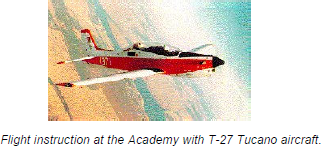
According to the chosen specialization, the Cadet will
[60] receive specific instruction:
Pilots: Instruction on precision maneuvering, aerobatics,
formation flying and by instruments, with 75 flying hours
on the primary/basic training aircraft T-25 Universal,
beginning on the 2nd term of the 1st year and completed
[65] in the 3rd year. Advanced training is given on T-27
Tucano aircraft, with 125 flying hours.
Administrative: Training on the scientific and
technological modern foundations of economics and
financial management, and logistics training.
[70] Aeronautics Infantry: Instruction on defense and
security techniques of military Aeronautics installations,
anti-aircraft measures, command of troops and firefighting
teams, military laws and regulations, armament
usage, military service and call-up procedures.
[75] During their leisure time, the Cadets participate on
the activities of seven different clubs: Aeromodelling,
Literature, Informatics, Firearms shooting, Gauchos
Heritage (for those coming from the South of Brazil),
Gerais Club and Sail Flying. The clubs are directed by
[80] the Cadets themselves, under supervision of Air Force
officers.
The Academy also houses the Brazilian Air
Force Air Demonstration Squadron - The Smoke
Squadron.
Flying as the eagles do!
Adapted from http://www.rudnei.cunha.nom.br/FAB/en/afa.html
According to the text, in 1941,
Questão 67 155036
AFA 2013BRAZILIAN AIR FORCE ACADEMY
AFA (Air Force Academy), located at Pirassununga,
State of São Paulo, is responsible for the training of
Pilots, Administrative and Aeronautics Infantry Officers
for the Brazilian Air Force.
[5] The history of the Brazilian military pilots schools
goes back to 1913, when the Brazilian Aviation School
was founded, at Campo dos Afonsos, State of Rio de
Janeiro. Its mission was to provide instruction at similar
levels to those of the best European schools at the time;
[10] Blériot and Farman aircraft, made in France, were
available for the instruction of the pupils. The Great War
1914-1918, however, forced its instructors to leave and
the school was closed.
At that time, both the Brazilian Army and Navy had
[15] their own air arms, the Military Aviation and the Naval
Aviation. The Navy bought Curtiss F seaplanes in May
1916 to equip the latter, and in August of the same year,
the Naval Aviation School was created.
The Military Aviation, however, only activated
[20] its Military Aviation School after the Great War, on 10
July 1919. Among the aircrafts used at the school, one
could find the Sopwith 1A2, Bréguet 14A2, and Spad 7.
Until the beginning of the 1940s, both schools
continued with their activities. The Brazilian Government
[25] was concerned with the air war in Europe and decided to
concentrate under a single command the military aviation
activities. Thus, on 20 January 1941, the Air Ministry was
created and both the Army and Navy air arms were
disbanded, their personnel and equipment forming
[30] the Brazilian Air Force. On 25 March 1941,
the Aeronautics School was based at Campo dos
Afonsos, and its students became known as Aeronautics
Cadets from 1943 to the current days.
As early as 1942, it became clear that
[35] the Aeronautics School would need to be transferred to
another place, offering better climate and little
interference with the flight instruction of the future pilots.
The town of Pirassununga was chosen among
others, and, in 1952, the first buildings construction was
[40] initiated. The transfer of the School activities to
Pirassununga occurred from 1960 to 1971. The School
was redesigned as the Air Force Academy in 1969.
The motto of the Academy is the Latin expression
“Macte Animo! Generose Puer, sic itur ad astra”,
[45] extracted from the poem Thebaida, by the Roman poet
Tatius. It is an exhortation to the cadets, which can be
translated as Courage! This is the way, oh noble
youngster, to the stars.
The instruction of the Aeronautics Cadets, during
[50] the four-year-long course, has its activities centred in the
words COURAGE - LOYALTY - HONOUR - DUTY -
MOTHERLAND. The future officers take courses on
several subjects, including Calculus, Computer Science,
Mechanics, Portuguese and English, given by civilian
[55] lecturers, Air Force instructors and supervisors. The
military instruction itself is given on a daily basis, and the
Cadets are trained on different subjects, including
parachuting, and sea and jungle survival.
According to the chosen specialization, the Cadet will
[60] receive specific instruction:
Pilots: Instruction on precision maneuvering, aerobatics,
formation flying and by instruments, with 75 flying hours
on the primary/basic training aircraft T-25 Universal,
beginning on the 2nd term of the 1st year and completed
[65] in the 3rd year. Advanced training is given on T-27
Tucano aircraft, with 125 flying hours.
Administrative: Training on the scientific and
technological modern foundations of economics and
financial management, and logistics training.
[70] Aeronautics Infantry: Instruction on defense and
security techniques of military Aeronautics installations,
anti-aircraft measures, command of troops and firefighting
teams, military laws and regulations, armament
usage, military service and call-up procedures.
[75] During their leisure time, the Cadets participate on
the activities of seven different clubs: Aeromodelling,
Literature, Informatics, Firearms shooting, Gauchos
Heritage (for those coming from the South of Brazil),
Gerais Club and Sail Flying. The clubs are directed by
[80] the Cadets themselves, under supervision of Air Force
officers.
The Academy also houses the Brazilian Air
Force Air Demonstration Squadron - The Smoke
Squadron.
Flying as the eagles do!
Adapted from http://www.rudnei.cunha.nom.br/FAB/en/afa.html
Read the statements about the informative text and mark the correct option.
I. In the beginning of the last century, Brazilian cadets were sent to the best European schools that provided them instruction.
II. In France, the youngsters had Blériot and Farman aircraft instruction.
III. Brazilian Aviation School had to be closed in 1913.
IV. The Brazilian Aviation School and the Naval Aviation School were created in the same year.
Questão 64 155031
AFA 2013BRAZILIAN AIR FORCE ACADEMY
AFA (Air Force Academy), located at Pirassununga,
State of São Paulo, is responsible for the training of
Pilots, Administrative and Aeronautics Infantry Officers
for the Brazilian Air Force.
[5] The history of the Brazilian military pilots schools
goes back to 1913, when the Brazilian Aviation School
was founded, at Campo dos Afonsos, State of Rio de
Janeiro. Its mission was to provide instruction at similar
levels to those of the best European schools at the time;
[10] Blériot and Farman aircraft, made in France, were
available for the instruction of the pupils. The Great War
1914-1918, however, forced its instructors to leave and
the school was closed.
At that time, both the Brazilian Army and Navy had
[15] their own air arms, the Military Aviation and the Naval
Aviation. The Navy bought Curtiss F seaplanes in May
1916 to equip the latter, and in August of the same year,
the Naval Aviation School was created.
The Military Aviation, however, only activated
[20] its Military Aviation School after the Great War, on 10
July 1919. Among the aircrafts used at the school, one
could find the Sopwith 1A2, Bréguet 14A2, and Spad 7.
Until the beginning of the 1940s, both schools
continued with their activities. The Brazilian Government
[25] was concerned with the air war in Europe and decided to
concentrate under a single command the military aviation
activities. Thus, on 20 January 1941, the Air Ministry was
created and both the Army and Navy air arms were
disbanded, their personnel and equipment forming
[30] the Brazilian Air Force. On 25 March 1941,
the Aeronautics School was based at Campo dos
Afonsos, and its students became known as Aeronautics
Cadets from 1943 to the current days.
As early as 1942, it became clear that
[35] the Aeronautics School would need to be transferred to
another place, offering better climate and little
interference with the flight instruction of the future pilots.
The town of Pirassununga was chosen among
others, and, in 1952, the first buildings construction was
[40] initiated. The transfer of the School activities to
Pirassununga occurred from 1960 to 1971. The School
was redesigned as the Air Force Academy in 1969.
The motto of the Academy is the Latin expression
“Macte Animo! Generose Puer, sic itur ad astra”,
[45] extracted from the poem Thebaida, by the Roman poet
Tatius. It is an exhortation to the cadets, which can be
translated as Courage! This is the way, oh noble
youngster, to the stars.
The instruction of the Aeronautics Cadets, during
[50] the four-year-long course, has its activities centred in the
words COURAGE - LOYALTY - HONOUR - DUTY -
MOTHERLAND. The future officers take courses on
several subjects, including Calculus, Computer Science,
Mechanics, Portuguese and English, given by civilian
[55] lecturers, Air Force instructors and supervisors. The
military instruction itself is given on a daily basis, and the
Cadets are trained on different subjects, including
parachuting, and sea and jungle survival.
According to the chosen specialization, the Cadet will
[60] receive specific instruction:
Pilots: Instruction on precision maneuvering, aerobatics,
formation flying and by instruments, with 75 flying hours
on the primary/basic training aircraft T-25 Universal,
beginning on the 2nd term of the 1st year and completed
[65] in the 3rd year. Advanced training is given on T-27
Tucano aircraft, with 125 flying hours.
Administrative: Training on the scientific and
technological modern foundations of economics and
financial management, and logistics training.
[70] Aeronautics Infantry: Instruction on defense and
security techniques of military Aeronautics installations,
anti-aircraft measures, command of troops and firefighting
teams, military laws and regulations, armament
usage, military service and call-up procedures.
[75] During their leisure time, the Cadets participate on
the activities of seven different clubs: Aeromodelling,
Literature, Informatics, Firearms shooting, Gauchos
Heritage (for those coming from the South of Brazil),
Gerais Club and Sail Flying. The clubs are directed by
[80] the Cadets themselves, under supervision of Air Force
officers.
The Academy also houses the Brazilian Air
Force Air Demonstration Squadron - The Smoke
Squadron.
Flying as the eagles do!
Adapted from http://www.rudnei.cunha.nom.br/FAB/en/afa.html
Mark the alternative that has the fragment from the text INCORRECTLY changed into Active Voice
Questão 63 155029
AFA 2013BRAZILIAN AIR FORCE ACADEMY
AFA (Air Force Academy), located at Pirassununga,
State of São Paulo, is responsible for the training of
Pilots, Administrative and Aeronautics Infantry Officers
for the Brazilian Air Force.
[5] The history of the Brazilian military pilots schools
goes back to 1913, when the Brazilian Aviation School
was founded, at Campo dos Afonsos, State of Rio de
Janeiro. Its mission was to provide instruction at similar
levels to those of the best European schools at the time;
[10] Blériot and Farman aircraft, made in France, were
available for the instruction of the pupils. The Great War
1914-1918, however, forced its instructors to leave and
the school was closed.
At that time, both the Brazilian Army and Navy had
[15] their own air arms, the Military Aviation and the Naval
Aviation. The Navy bought Curtiss F seaplanes in May
1916 to equip the latter, and in August of the same year,
the Naval Aviation School was created.
The Military Aviation, however, only activated
[20] its Military Aviation School after the Great War, on 10
July 1919. Among the aircrafts used at the school, one
could find the Sopwith 1A2, Bréguet 14A2, and Spad 7.
Until the beginning of the 1940s, both schools
continued with their activities. The Brazilian Government
[25] was concerned with the air war in Europe and decided to
concentrate under a single command the military aviation
activities. Thus, on 20 January 1941, the Air Ministry was
created and both the Army and Navy air arms were
disbanded, their personnel and equipment forming
[30] the Brazilian Air Force. On 25 March 1941,
the Aeronautics School was based at Campo dos
Afonsos, and its students became known as Aeronautics
Cadets from 1943 to the current days.
As early as 1942, it became clear that
[35] the Aeronautics School would need to be transferred to
another place, offering better climate and little
interference with the flight instruction of the future pilots.
The town of Pirassununga was chosen among
others, and, in 1952, the first buildings construction was
[40] initiated. The transfer of the School activities to
Pirassununga occurred from 1960 to 1971. The School
was redesigned as the Air Force Academy in 1969.
The motto of the Academy is the Latin expression
“Macte Animo! Generose Puer, sic itur ad astra”,
[45] extracted from the poem Thebaida, by the Roman poet
Tatius. It is an exhortation to the cadets, which can be
translated as Courage! This is the way, oh noble
youngster, to the stars.
The instruction of the Aeronautics Cadets, during
[50] the four-year-long course, has its activities centred in the
words COURAGE - LOYALTY - HONOUR - DUTY -
MOTHERLAND. The future officers take courses on
several subjects, including Calculus, Computer Science,
Mechanics, Portuguese and English, given by civilian
[55] lecturers, Air Force instructors and supervisors. The
military instruction itself is given on a daily basis, and the
Cadets are trained on different subjects, including
parachuting, and sea and jungle survival.
According to the chosen specialization, the Cadet will
[60] receive specific instruction:
Pilots: Instruction on precision maneuvering, aerobatics,
formation flying and by instruments, with 75 flying hours
on the primary/basic training aircraft T-25 Universal,
beginning on the 2nd term of the 1st year and completed
[65] in the 3rd year. Advanced training is given on T-27
Tucano aircraft, with 125 flying hours.
Administrative: Training on the scientific and
technological modern foundations of economics and
financial management, and logistics training.
[70] Aeronautics Infantry: Instruction on defense and
security techniques of military Aeronautics installations,
anti-aircraft measures, command of troops and firefighting
teams, military laws and regulations, armament
usage, military service and call-up procedures.
[75] During their leisure time, the Cadets participate on
the activities of seven different clubs: Aeromodelling,
Literature, Informatics, Firearms shooting, Gauchos
Heritage (for those coming from the South of Brazil),
Gerais Club and Sail Flying. The clubs are directed by
[80] the Cadets themselves, under supervision of Air Force
officers.
The Academy also houses the Brazilian Air
Force Air Demonstration Squadron - The Smoke
Squadron.
Flying as the eagles do!
Adapted from http://www.rudnei.cunha.nom.br/FAB/en/afa.html
The last sentence from the text connotes a
Questão 62 155028
AFA 2013BRAZILIAN AIR FORCE ACADEMY
AFA (Air Force Academy), located at Pirassununga,
State of São Paulo, is responsible for the training of
Pilots, Administrative and Aeronautics Infantry Officers
for the Brazilian Air Force.
[5] The history of the Brazilian military pilots schools
goes back to 1913, when the Brazilian Aviation School
was founded, at Campo dos Afonsos, State of Rio de
Janeiro. Its mission was to provide instruction at similar
levels to those of the best European schools at the time;
[10] Blériot and Farman aircraft, made in France, were
available for the instruction of the pupils. The Great War
1914-1918, however, forced its instructors to leave and
the school was closed.
At that time, both the Brazilian Army and Navy had
[15] their own air arms, the Military Aviation and the Naval
Aviation. The Navy bought Curtiss F seaplanes in May
1916 to equip the latter, and in August of the same year,
the Naval Aviation School was created.
The Military Aviation, however, only activated
[20] its Military Aviation School after the Great War, on 10
July 1919. Among the aircrafts used at the school, one
could find the Sopwith 1A2, Bréguet 14A2, and Spad 7.
Until the beginning of the 1940s, both schools
continued with their activities. The Brazilian Government
[25] was concerned with the air war in Europe and decided to
concentrate under a single command the military aviation
activities. Thus, on 20 January 1941, the Air Ministry was
created and both the Army and Navy air arms were
disbanded, their personnel and equipment forming
[30] the Brazilian Air Force. On 25 March 1941,
the Aeronautics School was based at Campo dos
Afonsos, and its students became known as Aeronautics
Cadets from 1943 to the current days.
As early as 1942, it became clear that
[35] the Aeronautics School would need to be transferred to
another place, offering better climate and little
interference with the flight instruction of the future pilots.
The town of Pirassununga was chosen among
others, and, in 1952, the first buildings construction was
[40] initiated. The transfer of the School activities to
Pirassununga occurred from 1960 to 1971. The School
was redesigned as the Air Force Academy in 1969.
The motto of the Academy is the Latin expression
“Macte Animo! Generose Puer, sic itur ad astra”,
[45] extracted from the poem Thebaida, by the Roman poet
Tatius. It is an exhortation to the cadets, which can be
translated as Courage! This is the way, oh noble
youngster, to the stars.
The instruction of the Aeronautics Cadets, during
[50] the four-year-long course, has its activities centred in the
words COURAGE - LOYALTY - HONOUR - DUTY -
MOTHERLAND. The future officers take courses on
several subjects, including Calculus, Computer Science,
Mechanics, Portuguese and English, given by civilian
[55] lecturers, Air Force instructors and supervisors. The
military instruction itself is given on a daily basis, and the
Cadets are trained on different subjects, including
parachuting, and sea and jungle survival.
According to the chosen specialization, the Cadet will
[60] receive specific instruction:
Pilots: Instruction on precision maneuvering, aerobatics,
formation flying and by instruments, with 75 flying hours
on the primary/basic training aircraft T-25 Universal,
beginning on the 2nd term of the 1st year and completed
[65] in the 3rd year. Advanced training is given on T-27
Tucano aircraft, with 125 flying hours.
Administrative: Training on the scientific and
technological modern foundations of economics and
financial management, and logistics training.
[70] Aeronautics Infantry: Instruction on defense and
security techniques of military Aeronautics installations,
anti-aircraft measures, command of troops and firefighting
teams, military laws and regulations, armament
usage, military service and call-up procedures.
[75] During their leisure time, the Cadets participate on
the activities of seven different clubs: Aeromodelling,
Literature, Informatics, Firearms shooting, Gauchos
Heritage (for those coming from the South of Brazil),
Gerais Club and Sail Flying. The clubs are directed by
[80] the Cadets themselves, under supervision of Air Force
officers.
The Academy also houses the Brazilian Air
Force Air Demonstration Squadron - The Smoke
Squadron.
Flying as the eagles do!
Adapted from http://www.rudnei.cunha.nom.br/FAB/en/afa.html
Read the statements in order to mark only the correct ones according to the text.
I. The military aviation work had to be controlled by Europe in the beginning of the 1940s because of a war.
II. Because of a war, the government resolved to unify the military aviation operation under a single command.
III. A single officer was chosen to concentrate the military aviation skills.
IV. As the Brazilian government got worried, it was decided to join the military aviation operations due to air European war.
06