


![[Marketing] Questao Topo - deslogado](https://storage.estuda.com.br/banners/0_6b7ebee90b03af1c560c73bb8bcce34a_banner_deslogado_70_dias.png)
Questões de Inglês
19.971 Questões
Questão 56 767767
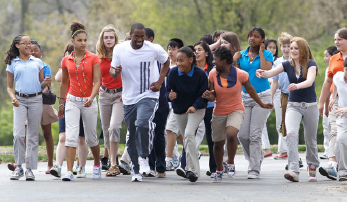
UFN Inverno 2013Olympians for Worldwide Fitness
©Lexington Herald-Leader
27/03/2013
[1] With an increase in sedentary lifestyles,
obesity amongst children has become a grow-
ing concern in many countries around the
world. In the United States, three time Olympic
[5] medalist in swimming and medical doctor Gary
Hall Sr, decided to do something about it.
He co-founded World Fit, a foundation which
encourages children in schools across America to
get active. Using his Olympic experience and net-
[10] work, a simple concept was developed: an Olym-
pian is paired with a school and challenges its stu-
dents and teachers to walk 60 miles in 40 days to
get them fit.
“Walking is an accessible, affordable way to
[15] exercise; you just need a pair of shoes and a goal,”
says Hall, now Executive Director of the founda-
tion. “As humans, we are designed to walk and it is
one of the best forms of exercise.”
Over 300 Olympians and Paralympians have
[20] registered so far to adopt a school. Once they are
assigned a school, they speak annually to its stu-
dents about the importance of physical fitness
activities and a healthy lifestyle and encourage the
students to participate in the World Fit Walk, held
[25] each spring.
“An Olympian, regardless of the year he/she
competed or whether or not he/she ever won a
medal, is a hero to every school student in Amer-
ica,” says Hall. “What better inspiration than to
[30] have an Olympian adopt your school and students
for life?”
Since the first World Fit Walk in 2009, 52,399
students from 75 different schools across the
United States have logged in a total of 5,033,919
[35] miles (8,101,307 kilometres) during the six-week
program.
World Fit is currently looking to introduce its
program into Europe in 2014 in partnership with
the International Academy of Sports Science and
[40] Technology (AISTS), a not-for-profit educational
institute based in Lausanne, Switzerland.
“We strongly believe that World Fit brings huge
value not only to children but also to the schools
and the community they live in,” says Geert
[45] Hendriks, AISTS Sports Development Manager.
“The great thing is that the program is also attrac-
tive and accessible for children who do not neces-
sarily enjoy sport or have physical barriers to over-
come.”
[50] What makes World Fit work is the right dy-
namics of motivation, inspiration and competition
that make it fun. Students can log their miles elec-
tronically on the World Fit website, which keeps
track for them and compares how they are doing
[55] with other students and schools in their region. A
“buddy” system lets them collect miles from outside
participants, for example teachers, parents or
siblings who walk along with them and the World
Fit social media sites allow them to upload their
[60] photos and share their efforts.
“The best time for us to try to establish a life-
long habit of good exercise is with children.
Students are still in their formative years when
encouragement and role models can make a life-
[65] long impact,” says Hall. “A little bit of exercise goes
a long way toward improving overall health.”
Source: http://www.olympic.org/news/olympians-for-worldwide-fitness/195314
Assinale V (Verdadeiro) ou F (Falso), de acordo com o texto.
( ) Os atletas que se inscrevem para adotar uma escola devem conversar com os alunos, pelo menos duas vezes ao ano, sobre a importância da atividade física e de um estilo de vida saudável, além de encorajá-los a participarem da World Fit Walk, que acontece a cada primavera.
( ) Na opinião de Hall, um atleta olímpico é um herói para qualquer estudante americano, independentemente do ano em que competiu e independentemente do fato de ter ganhado ou não uma medalha.
( ) Para Hendriks, um ótimo aspecto do programa é que ele também é atrativo e acessível a crianças que gostam de esportes, mas que têm barreiras físicas a serem superadas.
( ) Um sistema amigável permite aos estudantes colecionarem milhas de participantes externos, tais como professores, pais ou irmãos que caminham junto com eles.
( ) As páginas das mídias sociais do World Fit permitem aos estudantes postarem fotos e compartilharem seus esforços.
A sequência correta é
Questão 55 767752
UFN Inverno 2013Olympians for Worldwide Fitness
©Lexington Herald-Leader
27/03/2013
[1] With an increase in sedentary lifestyles,
obesity amongst children has become a grow-
ing concern in many countries around the
world. In the United States, three time Olympic
[5] medalist in swimming and medical doctor Gary
Hall Sr, decided to do something about it.
He co-founded World Fit, a foundation which
encourages children in schools across America to
get active. Using his Olympic experience and net-
[10] work, a simple concept was developed: an Olym-
pian is paired with a school and challenges its stu-
dents and teachers to walk 60 miles in 40 days to
get them fit.
“Walking is an accessible, affordable way to
[15] exercise; you just need a pair of shoes and a goal,”
says Hall, now Executive Director of the founda-
tion. “As humans, we are designed to walk and it is
one of the best forms of exercise.”
Over 300 Olympians and Paralympians have
[20] registered so far to adopt a school. Once they are
assigned a school, they speak annually to its stu-
dents about the importance of physical fitness
activities and a healthy lifestyle and encourage the
students to participate in the World Fit Walk, held
[25] each spring.
“An Olympian, regardless of the year he/she
competed or whether or not he/she ever won a
medal, is a hero to every school student in Amer-
ica,” says Hall. “What better inspiration than to
[30] have an Olympian adopt your school and students
for life?”
Since the first World Fit Walk in 2009, 52,399
students from 75 different schools across the
United States have logged in a total of 5,033,919
[35] miles (8,101,307 kilometres) during the six-week
program.
World Fit is currently looking to introduce its
program into Europe in 2014 in partnership with
the International Academy of Sports Science and
[40] Technology (AISTS), a not-for-profit educational
institute based in Lausanne, Switzerland.
“We strongly believe that World Fit brings huge
value not only to children but also to the schools
and the community they live in,” says Geert
[45] Hendriks, AISTS Sports Development Manager.
“The great thing is that the program is also attrac-
tive and accessible for children who do not neces-
sarily enjoy sport or have physical barriers to over-
come.”
[50] What makes World Fit work is the right dy-
namics of motivation, inspiration and competition
that make it fun. Students can log their miles elec-
tronically on the World Fit website, which keeps
track for them and compares how they are doing
[55] with other students and schools in their region. A
“buddy” system lets them collect miles from outside
participants, for example teachers, parents or
siblings who walk along with them and the World
Fit social media sites allow them to upload their
[60] photos and share their efforts.
“The best time for us to try to establish a life-
long habit of good exercise is with children.
Students are still in their formative years when
encouragement and role models can make a life-
[65] long impact,” says Hall. “A little bit of exercise goes
a long way toward improving overall health.”
Source: http://www.olympic.org/news/olympians-for-worldwide-fitness/195314
A partir da leitura de “Olympians for worldwide fitness”, pode-se afirmar que:
I. Gary Hall Sr, três vezes medalhista olímpico em maratonas, decidiu fazer algo contra a obesidade entre as crianças americanas.
II. Gary Hall Sr é médico.
III. Gary Hall Sr é cofundador da World Fit, uma entidade que encoraja a atividade física nas escolas americanas.
Está (ão) correta(s)
Questão 48 601954
UCPEL Inverno 2013Leia o texto e responda a pergunta.
[1] Google’s Social Network Gets Smarter
[2] With dozens of new features, Google’s social network
[3] is becoming more like a photo service and a news
[4] site.

[5] Despite the 190 million
[6] people that Google says use
[7] its social network every
[8] month, Google Plus has
[9] always struggled to escape
[10] Facebook’s shadow and
[11] seem like a hopping social
[12] destination.
[13] With the 41 new features the company announced
[14] would be rolling out this week, Google Plus is now
[15] morphing into something that makes greater use of
[16] what Google does best—anticipate the needs of its
[17] users, show them relevant news and information, and
[18] help them manage massive amounts of data. The new
[19] Google Plus will go so far as to auto-generate
[20] animated GIF files from photos that people upload
[21] from their devices or desktops.
[22] “We just put the Google into Google Plus,” says Vic
[23] Gundotra, a senior vice president for engineering at
[24] Google, who presented the features at the company’s
[25] annual conference for developers.
[26] Many people use social networks to hear about news
[27] or find information. But unless someone tags a post,
[28] it can be hard to drill down further into a topic,
[29] especially on Facebook. Google will run algorithms
[30] that automatically add hashtags to posts, links, and
[31] images in a redesigned social stream.
[32] Photos are fast becoming an important part of all social
[33] networks, and Google hopes it can lure more users to
[34] Google Plus by providing better ways to manage all
[35] the images people are taking on their devices. “We
[36] can do some of those labor-intensive tasks
[37] automatically for you,” says Gundotra.
[38] When you upload hundreds of new vacation photos,
[39] Google Plus will share the best ones with others,
[40] eliminating blurry or unfocused photos and even
[41] analyzing whether people look happy. Using
[42] Knowledge Graph, it might recognize where a person
[43] is located and prioritize photos taken at important
[44] landmarks. It will also prioritize photos of people
[45] recognized to be in a user’s close Google Plus circles,
[46] like family members. A photo rating system is being
[47] trained by hundreds of human raters, which will help
[48] the photo engine begin to account for “aesthetics and
[49] human tastes,” says Gundotra.
[50] The redesigned Google Plus also resembles an
[51] automated version of Photoshop. Google has
[52] implemented sophisticated facial recognition so it can
[53] more finely auto-tune images to fix a person’s blemishes
[54] or skin tones. Other fun features can generate GIFs
[55] from a series of photos or even create a mashup
[56] image—for example, from a sequence of photos of a
[57] group of people, so that everyone’s eyes are open and
[58] everyone is smiling. “We’re creating a new image that
[59] did not exist before,” Gundotra says.
[60] By Jessica Leber, Technology Review published by MIT,
[61] 15/05/2013
Adapted from http://www.technologyreview.com/news/ 514836/googles-social-network-gets-smarter/
Assinale a alternativa incorreta.
Questão 47 601942
UCPEL Inverno 2013Leia o texto e responda a pergunta.
[1] Google’s Social Network Gets Smarter
[2] With dozens of new features, Google’s social network
[3] is becoming more like a photo service and a news
[4] site.
[5] Despite the 190 million
[6] people that Google says use
[7] its social network every
[8] month, Google Plus has
[9] always struggled to escape
[10] Facebook’s shadow and
[11] seem like a hopping social
[12] destination.
[13] With the 41 new features the company announced
[14] would be rolling out this week, Google Plus is now
[15] morphing into something that makes greater use of
[16] what Google does best—anticipate the needs of its
[17] users, show them relevant news and information, and
[18] help them manage massive amounts of data. The new
[19] Google Plus will go so far as to auto-generate
[20] animated GIF files from photos that people upload
[21] from their devices or desktops.
[22] “We just put the Google into Google Plus,” says Vic
[23] Gundotra, a senior vice president for engineering at
[24] Google, who presented the features at the company’s
[25] annual conference for developers.
[26] Many people use social networks to hear about news
[27] or find information. But unless someone tags a post,
[28] it can be hard to drill down further into a topic,
[29] especially on Facebook. Google will run algorithms
[30] that automatically add hashtags to posts, links, and
[31] images in a redesigned social stream.
[32] Photos are fast becoming an important part of all social
[33] networks, and Google hopes it can lure more users to
[34] Google Plus by providing better ways to manage all
[35] the images people are taking on their devices. “We
[36] can do some of those labor-intensive tasks
[37] automatically for you,” says Gundotra.
[38] When you upload hundreds of new vacation photos,
[39] Google Plus will share the best ones with others,
[40] eliminating blurry or unfocused photos and even
[41] analyzing whether people look happy. Using
[42] Knowledge Graph, it might recognize where a person
[43] is located and prioritize photos taken at important
[44] landmarks. It will also prioritize photos of people
[45] recognized to be in a user’s close Google Plus circles,
[46] like family members. A photo rating system is being
[47] trained by hundreds of human raters, which will help
[48] the photo engine begin to account for “aesthetics and
[49] human tastes,” says Gundotra.
[50] The redesigned Google Plus also resembles an
[51] automated version of Photoshop. Google has
[52] implemented sophisticated facial recognition so it can
[53] more finely auto-tune images to fix a person’s blemishes
[54] or skin tones. Other fun features can generate GIFs
[55] from a series of photos or even create a mashup
[56] image—for example, from a sequence of photos of a
[57] group of people, so that everyone’s eyes are open and
[58] everyone is smiling. “We’re creating a new image that
[59] did not exist before,” Gundotra says.
[60] By Jessica Leber, Technology Review published by MIT,
[61] 15/05/2013
Adapted from http://www.technologyreview.com/news/ 514836/googles-social-network-gets-smarter/
O título do texto “Google’s Social Network Gets Smarter” transmite a ideia de a rede social do Google estar tornando-se
Questão 49 601846
UCPEL Verão 2013Leia o texto e responda a pergunta.
[1] GIVEN TABLETS BUT NO TEACHERS, ETHIOPIAN CHILDREN TEACH THEMSELVES
[2] A bold experiment by the One Laptop Per Child organization has shown “encouraging” results.
[3] With 100 million first-grade-aged children worldwide having no access to schooling, the One Laptop Per Child
[4] (OLPC) organization is trying something new in two remote Ethiopian villages−simply dropping off tablet computers
[5] with preloaded programs and seeing what happens.
[6] The goal: to see if illiterate kids with no previous exposure to written words can learn how to read all by themselves,
[7] by experimenting with the tablet and its preloaded alphabet-training games, e-books, movies, cartoons, paintings,
[8] and other programs. Early observations are encouraging, said Nicholas Negroponte, OLPC’s founder, at MIT Technology
[9] Review’s EmTech conference last week.
[10] The devices involved are Motorola Zoom tablets−used together with a solar charging system, which OLPC workers
[11] had taught adults in the village to use. Once a week, an OLPC worker visits the villages and swaps out memory cards
[12] so that researchers can study how the machines were actually used.
[13] After several months, the kids in both villages were still heavily engaged in using and recharging the machines, and
[14] had been observed reciting the “alphabet song,” and even spelling words. One boy, exposed to literacy games with
[15] animal pictures, opened up a paint program and wrote the word “Lion.”
[16] The experiment is being done in two isolated rural villages with about 20 first-grade-aged children each, about 50
[17] miles from Addis Ababa. One village is called Wonchi, on the rim of a volcanic crater at 11,000 feet; the other is
[18] called Wolonchete, in the Rift Valley. Children there had never previously seen printed materials, road signs, or even
[19] packaging that had words on them, Negroponte said.
[20] Earlier this year, OLPC workers dropped off closed boxes containing the tablets, taped shut, with no instruction. “I
[21] thought the kids would play with the boxes. Within four minutes, one kid not only opened the box, found the on-off
[22] switch… powered it up. Within five days, they were using 47 apps per child, per day. Within two weeks, they were
[23] singing ABC songs in the village, and within five months, they had hacked Android,” Negroponte said. “Some idiot
[24] in our organization or in the Media Lab had disabled the camera, and they figured out the camera, and had hacked
[25] Android.”
[26] Elaborating later on Negroponte’s hacking comment, ED McNierney, OLPC’s chief technology officer, said that the
[27] kids had gotten around OLPC’s effort to freeze desktop settings. “The kids had completely customized the desktop−so
[28] every kids’ tablet looked different. We had installed software to prevent them from doing that,” McNierney said. “And
[29] the fact they worked around it was clearly the kind of creativity, the kind of inquiry, the kind of discovery that we think
[30] is essential to learning.”
[31] “If they can learn to read, then they can read to learn,” Negroponte said (see “Emtech Preview: Another Way to Think
[32] About Learning”).
[33] In an interview after his talk, Negroponte said that while the early results are promising, reaching conclusions about
[34] whether children could learn to read this way would require more time. “If it gets funded, it would need to continue for
[35] another a year and a half to two years to come to a conclusion that the scientific community would accept,” Negroponte
[36] said. “We’d have to start with a new village and make a clean start.”
[37] Giving computers directly to poor kids without any instruction is even more ambitious than OLPC’s earlier pushes.
[38] “What can we do for these 100 million kids around the world who don’t go to school?” McNierney said. “Can we
[39] give them tool to read and learn−without having to provide schools and teachers and textbooks and all that?”
[40] Technology Review published by MIT, 29/10/2012
[41] Adapted from http://www.technologyreview.com/news/506466/given-tablets-but-no-teachers-ethiopian-children teach-themselves/
Após receberem os tablets, as crianças surpreenderam os pesquisadores porque
Questão 47 601841
UCPEL Verão 2013Leia o texto e responda a pergunta.
[1] GIVEN TABLETS BUT NO TEACHERS, ETHIOPIAN CHILDREN TEACH THEMSELVES
[2] A bold experiment by the One Laptop Per Child organization has shown “encouraging” results.
[3] With 100 million first-grade-aged children worldwide having no access to schooling, the One Laptop Per Child
[4] (OLPC) organization is trying something new in two remote Ethiopian villages−simply dropping off tablet computers
[5] with preloaded programs and seeing what happens.
[6] The goal: to see if illiterate kids with no previous exposure to written words can learn how to read all by themselves,
[7] by experimenting with the tablet and its preloaded alphabet-training games, e-books, movies, cartoons, paintings,
[8] and other programs. Early observations are encouraging, said Nicholas Negroponte, OLPC’s founder, at MIT Technology
[9] Review’s EmTech conference last week.
[10] The devices involved are Motorola Zoom tablets−used together with a solar charging system, which OLPC workers
[11] had taught adults in the village to use. Once a week, an OLPC worker visits the villages and swaps out memory cards
[12] so that researchers can study how the machines were actually used.
[13] After several months, the kids in both villages were still heavily engaged in using and recharging the machines, and
[14] had been observed reciting the “alphabet song,” and even spelling words. One boy, exposed to literacy games with
[15] animal pictures, opened up a paint program and wrote the word “Lion.”
[16] The experiment is being done in two isolated rural villages with about 20 first-grade-aged children each, about 50
[17] miles from Addis Ababa. One village is called Wonchi, on the rim of a volcanic crater at 11,000 feet; the other is
[18] called Wolonchete, in the Rift Valley. Children there had never previously seen printed materials, road signs, or even
[19] packaging that had words on them, Negroponte said.
[20] Earlier this year, OLPC workers dropped off closed boxes containing the tablets, taped shut, with no instruction. “I
[21] thought the kids would play with the boxes. Within four minutes, one kid not only opened the box, found the on-off
[22] switch… powered it up. Within five days, they were using 47 apps per child, per day. Within two weeks, they were
[23] singing ABC songs in the village, and within five months, they had hacked Android,” Negroponte said. “Some idiot
[24] in our organization or in the Media Lab had disabled the camera, and they figured out the camera, and had hacked
[25] Android.”
[26] Elaborating later on Negroponte’s hacking comment, ED McNierney, OLPC’s chief technology officer, said that the
[27] kids had gotten around OLPC’s effort to freeze desktop settings. “The kids had completely customized the desktop−so
[28] every kids’ tablet looked different. We had installed software to prevent them from doing that,” McNierney said. “And
[29] the fact they worked around it was clearly the kind of creativity, the kind of inquiry, the kind of discovery that we think
[30] is essential to learning.”
[31] “If they can learn to read, then they can read to learn,” Negroponte said (see “Emtech Preview: Another Way to Think
[32] About Learning”).
[33] In an interview after his talk, Negroponte said that while the early results are promising, reaching conclusions about
[34] whether children could learn to read this way would require more time. “If it gets funded, it would need to continue for
[35] another a year and a half to two years to come to a conclusion that the scientific community would accept,” Negroponte
[36] said. “We’d have to start with a new village and make a clean start.”
[37] Giving computers directly to poor kids without any instruction is even more ambitious than OLPC’s earlier pushes.
[38] “What can we do for these 100 million kids around the world who don’t go to school?” McNierney said. “Can we
[39] give them tool to read and learn−without having to provide schools and teachers and textbooks and all that?”
[40] Technology Review published by MIT, 29/10/2012
[41] Adapted from http://www.technologyreview.com/news/506466/given-tablets-but-no-teachers-ethiopian-children teach-themselves/
O objetivo da Organização One Laptop per Child é
06