


![[Marketing] Questao Topo - deslogado](https://storage.estuda.com.br/banners/0_6b7ebee90b03af1c560c73bb8bcce34a_banner_deslogado_70_dias.png)
Questões de Inglês
19.971 Questões
Questão 26 76058
ESPM 2014/1Emerging economies
The Great Deceleration
The emerging-market slowdown is not the beginning of a bust. But it is a turning-point for the world economy
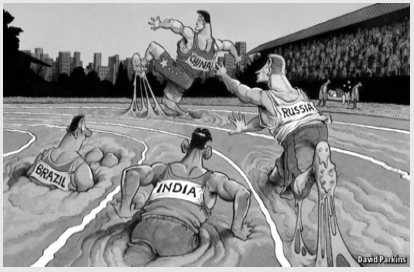
WHEN a champion sprinter falls short of his best speeds, it takes a while to determine whether he is temporarily on poor form or has permanently lost his edge. The same is true with emerging markets, the world economy’s 21st-century sprinters. After a decade of surging growth, in which they led a global boom and then helped pull the world economy forwards in the face of the financial crisis, the emerging giants have slowed sharply.
China will be lucky if it manages to hit its official target of 7.5% growth in 2013, a far cry from the doubledigit rates that the country had come to expect in the 2000s. Growth in India (around 5%), Brazil and Russia (around 2.5%) is barely half what it was at the height of the boom. Collectively, emerging markets may (just) match last year’s pace of 5%. That sounds fast compared with the sluggish rich world, but it is the slowest emerging-economy expansion in a decade, barring 2009 when the rich world slumped.
This marks the end of the dramatic first phase of the emerging-market era, which saw such economies jump from 38% of world output to 50% (measured at purchasing-power parity, or PPP) over the past decade. Over the next ten years emerging economies will still rise, but more gradually. The immediate effect of this deceleration should be manageable. But the longer-term impact on the world economy will be profound.
Running out of puff
In the past, periods of emerging-market boom have tended to be followed by busts (which helps explain why so few poor countries have become rich ones). A determined pessimist can find reasons to fret today, pointing in particular to the risks of an even more drastic deceleration in China or of a sudden global monetary tightening. But this time a broad emerging-market bust looks unlikely.
China is in the midst of a precarious shift from investment-led growth to a more balanced, consumption-based model. Its investment surge has prompted plenty of bad debt. But the central government has the fiscal strength both to absorb losses and to stimulate the economy if necessary. That is a luxury few emerging economies have ever had. It makes disaster much less likely. And with rich-world economies still feeble, there is little chance that monetary conditions will suddenly tighten. Even if they did, most emerging economies have better defences than ever before, with flexible exchange rates, large stashes of foreign-exchange reserves and relatively less debt (much of it in domestic currency).
That’s the good news. The bad news is that the days of record-breaking speed are over. China’s turbocharged investment and export model has run out of puff. Because its population is ageing fast, the country will have fewer workers, and because it is more prosperous, it has less room for catch-up growth. Ten years ago China’s per person GDP measured at PPP was 8% of America’s; now it is 18%. China will keep on catching up, but at a slower clip.
That will hold back other emerging giants. Russia’s burst of speed was propelled by a surge in energy prices driven by Chinese growth. Brazil sprinted ahead with the help of a boom in commodities and domestic credit; its current combination of stubborn inflation and slow growth shows that its underlying economic speed limit is a lot lower than most people thought. The same is true of India, where near-double-digit annual rises in GDP led politicians, and many investors, to confuse the potential for rapid catch-up (a young, poor population) with its inevitability. India’s growth rate could be pushed up again, but not without radical reforms—and almost certainly not to the peak pace of the 2000s
Jul 27th 2013/www.economist.com
The underlined word but in the excerpt of the third paragraph of the text: “The immediate effect of this deceleration should be manageable. But the longer-term impact on the world economy will be profound.”, could be rewritten, without changing its meaning, as
Questão 25 76057
ESPM 2014/1Emerging economies
The Great Deceleration
The emerging-market slowdown is not the beginning of a bust. But it is a turning-point for the world economy
WHEN a champion sprinter falls short of his best speeds, it takes a while to determine whether he is temporarily on poor form or has permanently lost his edge. The same is true with emerging markets, the world economy’s 21st-century sprinters. After a decade of surging growth, in which they led a global boom and then helped pull the world economy forwards in the face of the financial crisis, the emerging giants have slowed sharply.
China will be lucky if it manages to hit its official target of 7.5% growth in 2013, a far cry from the doubledigit rates that the country had come to expect in the 2000s. Growth in India (around 5%), Brazil and Russia (around 2.5%) is barely half what it was at the height of the boom. Collectively, emerging markets may (just) match last year’s pace of 5%. That sounds fast compared with the sluggish rich world, but it is the slowest emerging-economy expansion in a decade, barring 2009 when the rich world slumped.
This marks the end of the dramatic first phase of the emerging-market era, which saw such economies jump from 38% of world output to 50% (measured at purchasing-power parity, or PPP) over the past decade. Over the next ten years emerging economies will still rise, but more gradually. The immediate effect of this deceleration should be manageable. But the longer-term impact on the world economy will be profound.
Running out of puff
In the past, periods of emerging-market boom have tended to be followed by busts (which helps explain why so few poor countries have become rich ones). A determined pessimist can find reasons to fret today, pointing in particular to the risks of an even more drastic deceleration in China or of a sudden global monetary tightening. But this time a broad emerging-market bust looks unlikely.
China is in the midst of a precarious shift from investment-led growth to a more balanced, consumption-based model. Its investment surge has prompted plenty of bad debt. But the central government has the fiscal strength both to absorb losses and to stimulate the economy if necessary. That is a luxury few emerging economies have ever had. It makes disaster much less likely. And with rich-world economies still feeble, there is little chance that monetary conditions will suddenly tighten. Even if they did, most emerging economies have better defences than ever before, with flexible exchange rates, large stashes of foreign-exchange reserves and relatively less debt (much of it in domestic currency).
That’s the good news. The bad news is that the days of record-breaking speed are over. China’s turbocharged investment and export model has run out of puff. Because its population is ageing fast, the country will have fewer workers, and because it is more prosperous, it has less room for catch-up growth. Ten years ago China’s per person GDP measured at PPP was 8% of America’s; now it is 18%. China will keep on catching up, but at a slower clip.
That will hold back other emerging giants. Russia’s burst of speed was propelled by a surge in energy prices driven by Chinese growth. Brazil sprinted ahead with the help of a boom in commodities and domestic credit; its current combination of stubborn inflation and slow growth shows that its underlying economic speed limit is a lot lower than most people thought. The same is true of India, where near-double-digit annual rises in GDP led politicians, and many investors, to confuse the potential for rapid catch-up (a young, poor population) with its inevitability. India’s growth rate could be pushed up again, but not without radical reforms—and almost certainly not to the peak pace of the 2000s
Jul 27th 2013/www.economist.com
According to the text,
Questão 24 76056
ESPM 2014/1Report: There Are 3,000 Child Soldiers in India
Last year, suspected insurgents in northeast India’s Manipur state abducted three teenage boys. Despite a missingpersons complaint and a police search, they were never found. In Manipur, as well as several other Indian states, it is not uncommon for children to be kidnapped by insurgent groups to be turned into child soldiers. Indeed, around the same time as the boys went missing, five teenage girls laid down arms in front of police in the eastern Indian state of Orissa, a stronghold of Maoist rebels. They had been kidnapped from their village in 2008.
Stories like these have been circulating for years, but officials have largely chosen to ignore or downplay the problem. A new study may shake them out of silence: a report released last week by the New Delhi–based Asian Centre for Human Rights (ACHR) found that there are currently as many as 3,000 child soldiers in India. “The recruitment of child soldiers is rampant, and hundreds of children remain involved in the conflicts,” the report says.
The ACHR findings suggest that the problem is particularly severe in India’s long-running Maoist insurgency, but that children have also been recruited by insurgent groups in Jammu and Kashmir and parts of northeast India like Manipur, where separatist groups have clashed with Indian forces for decades. “In certain areas in eastern India, it is mandatory for families to give at least one of their children to Maoist rebels,” says Suhas Chakma, director of the ACHR.
And yet, the country seems loath to face, let alone address, the problem. India ratified a U.N. Optional Protocol on children in armed conflict in 2005. As of March, a total 197 out of 640 Indian districts are affected by insurgency, according to the report. In 2011, the Indian government submitted its first Periodic Report on the status of implementation of the Optional Protocol to the Convention on the Rights of the Child on the Involvement of Children in Armed Conflict. The document, prepared by the Ministry of Women and Child Development, was devoid of any factual information on child soldiers. The Indian government denied the existence of any armed conflict in India, saying "India does not face either international or noninternational armed-conflict situations," therefore there is no question of involvement of children in it. "The Indian government’s reaction is embarrassing," says Chakma. "They don’t want to acknowledge the problem because they don’t want international monitoring groups in the country."
The ACHR report, submitted last Thursday to the U.N. Committee on the Rights of the Child, recommends government-sponsored rehabilitation schemes for these children and a need for greater awareness. It also asked the National Human Rights Commission to intervene to help address the issue. New Delhi can start by admitting there’s a problem.
May 15, 2013 /www.time.com
The underlined word yet in the fourth paragraph of the text conveys an idea of
Questão 23 76055
ESPM 2014/1Report: There Are 3,000 Child Soldiers in India
Last year, suspected insurgents in northeast India’s Manipur state abducted three teenage boys. Despite a missingpersons complaint and a police search, they were never found. In Manipur, as well as several other Indian states, it is not uncommon for children to be kidnapped by insurgent groups to be turned into child soldiers. Indeed, around the same time as the boys went missing, five teenage girls laid down arms in front of police in the eastern Indian state of Orissa, a stronghold of Maoist rebels. They had been kidnapped from their village in 2008.
Stories like these have been circulating for years, but officials have largely chosen to ignore or downplay the problem. A new study may shake them out of silence: a report released last week by the New Delhi–based Asian Centre for Human Rights (ACHR) found that there are currently as many as 3,000 child soldiers in India. “The recruitment of child soldiers is rampant, and hundreds of children remain involved in the conflicts,” the report says.
The ACHR findings suggest that the problem is particularly severe in India’s long-running Maoist insurgency, but that children have also been recruited by insurgent groups in Jammu and Kashmir and parts of northeast India like Manipur, where separatist groups have clashed with Indian forces for decades. “In certain areas in eastern India, it is mandatory for families to give at least one of their children to Maoist rebels,” says Suhas Chakma, director of the ACHR.
And yet, the country seems loath to face, let alone address, the problem. India ratified a U.N. Optional Protocol on children in armed conflict in 2005. As of March, a total 197 out of 640 Indian districts are affected by insurgency, according to the report. In 2011, the Indian government submitted its first Periodic Report on the status of implementation of the Optional Protocol to the Convention on the Rights of the Child on the Involvement of Children in Armed Conflict. The document, prepared by the Ministry of Women and Child Development, was devoid of any factual information on child soldiers. The Indian government denied the existence of any armed conflict in India, saying "India does not face either international or noninternational armed-conflict situations," therefore there is no question of involvement of children in it. "The Indian government’s reaction is embarrassing," says Chakma. "They don’t want to acknowledge the problem because they don’t want international monitoring groups in the country."
The ACHR report, submitted last Thursday to the U.N. Committee on the Rights of the Child, recommends government-sponsored rehabilitation schemes for these children and a need for greater awareness. It also asked the National Human Rights Commission to intervene to help address the issue. New Delhi can start by admitting there’s a problem.
May 15, 2013 /www.time.com
According to the text,
Questão 22 76054
ESPM 2014/1Report: There Are 3,000 Child Soldiers in India
Last year, suspected insurgents in northeast India’s Manipur state abducted three teenage boys. Despite a missingpersons complaint and a police search, they were never found. In Manipur, as well as several other Indian states, it is not uncommon for children to be kidnapped by insurgent groups to be turned into child soldiers. Indeed, around the same time as the boys went missing, five teenage girls laid down arms in front of police in the eastern Indian state of Orissa, a stronghold of Maoist rebels. They had been kidnapped from their village in 2008.
Stories like these have been circulating for years, but officials have largely chosen to ignore or downplay the problem. A new study may shake them out of silence: a report released last week by the New Delhi–based Asian Centre for Human Rights (ACHR) found that there are currently as many as 3,000 child soldiers in India. “The recruitment of child soldiers is rampant, and hundreds of children remain involved in the conflicts,” the report says.
The ACHR findings suggest that the problem is particularly severe in India’s long-running Maoist insurgency, but that children have also been recruited by insurgent groups in Jammu and Kashmir and parts of northeast India like Manipur, where separatist groups have clashed with Indian forces for decades. “In certain areas in eastern India, it is mandatory for families to give at least one of their children to Maoist rebels,” says Suhas Chakma, director of the ACHR.
And yet, the country seems loath to face, let alone address, the problem. India ratified a U.N. Optional Protocol on children in armed conflict in 2005. As of March, a total 197 out of 640 Indian districts are affected by insurgency, according to the report. In 2011, the Indian government submitted its first Periodic Report on the status of implementation of the Optional Protocol to the Convention on the Rights of the Child on the Involvement of Children in Armed Conflict. The document, prepared by the Ministry of Women and Child Development, was devoid of any factual information on child soldiers. The Indian government denied the existence of any armed conflict in India, saying "India does not face either international or noninternational armed-conflict situations," therefore there is no question of involvement of children in it. "The Indian government’s reaction is embarrassing," says Chakma. "They don’t want to acknowledge the problem because they don’t want international monitoring groups in the country."
The ACHR report, submitted last Thursday to the U.N. Committee on the Rights of the Child, recommends government-sponsored rehabilitation schemes for these children and a need for greater awareness. It also asked the National Human Rights Commission to intervene to help address the issue. New Delhi can start by admitting there’s a problem.
May 15, 2013 /www.time.com
According to the text,
Questão 21 76053
ESPM 2014/1Report: There Are 3,000 Child Soldiers in India
Last year, suspected insurgents in northeast India’s Manipur state abducted three teenage boys. Despite a missingpersons complaint and a police search, they were never found. In Manipur, as well as several other Indian states, it is not uncommon for children to be kidnapped by insurgent groups to be turned into child soldiers. Indeed, around the same time as the boys went missing, five teenage girls laid down arms in front of police in the eastern Indian state of Orissa, a stronghold of Maoist rebels. They had been kidnapped from their village in 2008.
Stories like these have been circulating for years, but officials have largely chosen to ignore or downplay the problem. A new study may shake them out of silence: a report released last week by the New Delhi–based Asian Centre for Human Rights (ACHR) found that there are currently as many as 3,000 child soldiers in India. “The recruitment of child soldiers is rampant, and hundreds of children remain involved in the conflicts,” the report says.
The ACHR findings suggest that the problem is particularly severe in India’s long-running Maoist insurgency, but that children have also been recruited by insurgent groups in Jammu and Kashmir and parts of northeast India like Manipur, where separatist groups have clashed with Indian forces for decades. “In certain areas in eastern India, it is mandatory for families to give at least one of their children to Maoist rebels,” says Suhas Chakma, director of the ACHR.
And yet, the country seems loath to face, let alone address, the problem. India ratified a U.N. Optional Protocol on children in armed conflict in 2005. As of March, a total 197 out of 640 Indian districts are affected by insurgency, according to the report. In 2011, the Indian government submitted its first Periodic Report on the status of implementation of the Optional Protocol to the Convention on the Rights of the Child on the Involvement of Children in Armed Conflict. The document, prepared by the Ministry of Women and Child Development, was devoid of any factual information on child soldiers. The Indian government denied the existence of any armed conflict in India, saying "India does not face either international or noninternational armed-conflict situations," therefore there is no question of involvement of children in it. "The Indian government’s reaction is embarrassing," says Chakma. "They don’t want to acknowledge the problem because they don’t want international monitoring groups in the country."
The ACHR report, submitted last Thursday to the U.N. Committee on the Rights of the Child, recommends government-sponsored rehabilitation schemes for these children and a need for greater awareness. It also asked the National Human Rights Commission to intervene to help address the issue. New Delhi can start by admitting there’s a problem.
May 15, 2013 /www.time.com
The main idea of the text is
06