


![[Marketing] Questao Topo - deslogado](https://storage.estuda.com.br/banners/0_6b7ebee90b03af1c560c73bb8bcce34a_banner_deslogado_70_dias.png)
Questões de Inglês
19.971 Questões
Questão 33 76125
UDESC Matutino 2014/1
Mark the correct alternative.
Sign nº 1 means:
Questão 31 76123
UDESC Matutino 2014/1Archaeologists use drones to study Peru's ruins
[1] To get a bird's-eye view of ancient sites, archaeologists often turn to planes, helicopters
and even hot air balloons. But today researchers have access to more agile and less
expensive technology to map, explore and protect archaeological treasures: tiny
airborne drones.
[5] In Peru – the home of Machu Picchu and other amazing ruins – the government is
planning to purchase several drones to quickly and cheaply conduct archaeological
surveys in areas targeted for building or development, according to Reuters.
Archaeologists working in the country have already been using small flying robots to
study ancient sites, including the colonial Andean town Machu Llacta, and the San José
[10] de Moro burial grounds, which contain the tombs of Moche priestesses. Some
researchers have even built their own drones for less than $ 2,000, Reuters reported.
"It's like having a scalpel instead of a club," Jeffrey Quilter, an archaeologist at Harvard
University, told the news agency. "You can control it to a very fine degree. You can go
up 3 meters and photograph a room, 300 meters and photograph a site, or you can go
[15] up 3,000 meters and photograph the entire valley."
Cheap and effective drones could be a boon for Peru's culture ministry, which has a
modest budget and is tasked with protecting more than 13,000 archaeological sites that
are threatened by looters, squatters and illegal mining, according to Reuters.
Elsewhere robots have enabled archaeological discovery. A remote-controlled robot the
[20] size of a lawn mower recently found burial chambers inside the Temple of the Feathered
Serpent, an ancient pyramid in Mexico. And in Russia, researchers used a miniature
airborne drone to capture images that could be used to create a 3-D model of an ancient
burial mound.
www.foxnews.com/tech/2013.
Accessed on: 26/08/2013.
Some of the English grammar points which are present in line 16 are:
Questão 30 76063
ESPM 2014/1
Calvin’s words in the last strip, could be replaced, without changing their meaning, by
Questão 29 76062
ESPM 2014/1
One may infer from the comic strip that
Questão 28 76061
ESPM 2014/1Emerging economies
The Great Deceleration
The emerging-market slowdown is not the beginning of a bust. But it is a turning-point for the world economy
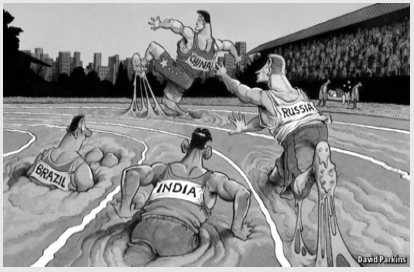
WHEN a champion sprinter falls short of his best speeds, it takes a while to determine whether he is temporarily on poor form or has permanently lost his edge. The same is true with emerging markets, the world economy’s 21st-century sprinters. After a decade of surging growth, in which they led a global boom and then helped pull the world economy forwards in the face of the financial crisis, the emerging giants have slowed sharply.
China will be lucky if it manages to hit its official target of 7.5% growth in 2013, a far cry from the doubledigit rates that the country had come to expect in the 2000s. Growth in India (around 5%), Brazil and Russia (around 2.5%) is barely half what it was at the height of the boom. Collectively, emerging markets may (just) match last year’s pace of 5%. That sounds fast compared with the sluggish rich world, but it is the slowest emerging-economy expansion in a decade, barring 2009 when the rich world slumped.
This marks the end of the dramatic first phase of the emerging-market era, which saw such economies jump from 38% of world output to 50% (measured at purchasing-power parity, or PPP) over the past decade. Over the next ten years emerging economies will still rise, but more gradually. The immediate effect of this deceleration should be manageable. But the longer-term impact on the world economy will be profound.
Running out of puff
In the past, periods of emerging-market boom have tended to be followed by busts (which helps explain why so few poor countries have become rich ones). A determined pessimist can find reasons to fret today, pointing in particular to the risks of an even more drastic deceleration in China or of a sudden global monetary tightening. But this time a broad emerging-market bust looks unlikely.
China is in the midst of a precarious shift from investment-led growth to a more balanced, consumption-based model. Its investment surge has prompted plenty of bad debt. But the central government has the fiscal strength both to absorb losses and to stimulate the economy if necessary. That is a luxury few emerging economies have ever had. It makes disaster much less likely. And with rich-world economies still feeble, there is little chance that monetary conditions will suddenly tighten. Even if they did, most emerging economies have better defences than ever before, with flexible exchange rates, large stashes of foreign-exchange reserves and relatively less debt (much of it in domestic currency).
That’s the good news. The bad news is that the days of record-breaking speed are over. China’s turbocharged investment and export model has run out of puff. Because its population is ageing fast, the country will have fewer workers, and because it is more prosperous, it has less room for catch-up growth. Ten years ago China’s per person GDP measured at PPP was 8% of America’s; now it is 18%. China will keep on catching up, but at a slower clip.
That will hold back other emerging giants. Russia’s burst of speed was propelled by a surge in energy prices driven by Chinese growth. Brazil sprinted ahead with the help of a boom in commodities and domestic credit; its current combination of stubborn inflation and slow growth shows that its underlying economic speed limit is a lot lower than most people thought. The same is true of India, where near-double-digit annual rises in GDP led politicians, and many investors, to confuse the potential for rapid catch-up (a young, poor population) with its inevitability. India’s growth rate could be pushed up again, but not without radical reforms—and almost certainly not to the peak pace of the 2000s
Jul 27th 2013/www.economist.com
According to the text,
Questão 27 76060
ESPM 2014/1Emerging economies
The Great Deceleration
The emerging-market slowdown is not the beginning of a bust. But it is a turning-point for the world economy
WHEN a champion sprinter falls short of his best speeds, it takes a while to determine whether he is temporarily on poor form or has permanently lost his edge. The same is true with emerging markets, the world economy’s 21st-century sprinters. After a decade of surging growth, in which they led a global boom and then helped pull the world economy forwards in the face of the financial crisis, the emerging giants have slowed sharply.
China will be lucky if it manages to hit its official target of 7.5% growth in 2013, a far cry from the doubledigit rates that the country had come to expect in the 2000s. Growth in India (around 5%), Brazil and Russia (around 2.5%) is barely half what it was at the height of the boom. Collectively, emerging markets may (just) match last year’s pace of 5%. That sounds fast compared with the sluggish rich world, but it is the slowest emerging-economy expansion in a decade, barring 2009 when the rich world slumped.
This marks the end of the dramatic first phase of the emerging-market era, which saw such economies jump from 38% of world output to 50% (measured at purchasing-power parity, or PPP) over the past decade. Over the next ten years emerging economies will still rise, but more gradually. The immediate effect of this deceleration should be manageable. But the longer-term impact on the world economy will be profound.
Running out of puff
In the past, periods of emerging-market boom have tended to be followed by busts (which helps explain why so few poor countries have become rich ones). A determined pessimist can find reasons to fret today, pointing in particular to the risks of an even more drastic deceleration in China or of a sudden global monetary tightening. But this time a broad emerging-market bust looks unlikely.
China is in the midst of a precarious shift from investment-led growth to a more balanced, consumption-based model. Its investment surge has prompted plenty of bad debt. But the central government has the fiscal strength both to absorb losses and to stimulate the economy if necessary. That is a luxury few emerging economies have ever had. It makes disaster much less likely. And with rich-world economies still feeble, there is little chance that monetary conditions will suddenly tighten. Even if they did, most emerging economies have better defences than ever before, with flexible exchange rates, large stashes of foreign-exchange reserves and relatively less debt (much of it in domestic currency).
That’s the good news. The bad news is that the days of record-breaking speed are over. China’s turbocharged investment and export model has run out of puff. Because its population is ageing fast, the country will have fewer workers, and because it is more prosperous, it has less room for catch-up growth. Ten years ago China’s per person GDP measured at PPP was 8% of America’s; now it is 18%. China will keep on catching up, but at a slower clip.
That will hold back other emerging giants. Russia’s burst of speed was propelled by a surge in energy prices driven by Chinese growth. Brazil sprinted ahead with the help of a boom in commodities and domestic credit; its current combination of stubborn inflation and slow growth shows that its underlying economic speed limit is a lot lower than most people thought. The same is true of India, where near-double-digit annual rises in GDP led politicians, and many investors, to confuse the potential for rapid catch-up (a young, poor population) with its inevitability. India’s growth rate could be pushed up again, but not without radical reforms—and almost certainly not to the peak pace of the 2000s
Jul 27th 2013/www.economist.com
The pronoun they in the underlined sentence of the fifth paragraph of the text: “Even if they did, …” refers to
06