


![[Marketing] Questao Topo - deslogado](https://storage.estuda.com.br/banners/0_6b7ebee90b03af1c560c73bb8bcce34a_banner_deslogado_70_dias.png)
Questões de Inglês
19.971 Questões
Questão 82 94509
UFG 2014/2ELIF BILGIN GOES BANANAS
Sep 25 2013 Bloggers, People
By Chiara Spagnoli Gabardi
Turkish teen Elif Bilgin has thrilled her teachers, parents and those who care about the planet by discovering a way to make bio-plastic from an item commonly found in our waste bins: banana peels. The 16 year old prodigy always showed promise academically. From the 4th grade, she was put into a school for gifted children, where she was encouraged to develop her already advanced skills and talents. Since then, the teen has excelled at her studies and learned more about climate change and the environment. Somewhat alarmed at what she was discovering, she was determined to find an alternative to petroleum produced plastics.
When Elif found that potatoes and mango peels are already used to make bio-plastic, that fact, combined with the knowledge that Thailand alone discards 200 tons of banana peels per day motivated Elif to work on extracting the starch and cellulose needed for bio-plastic production out of banana peels.
Elif's research took a couple of years, and her trials initially failed: the plastics created weren't strong enough and decayed too quickly. But her persistence paid off, since she obtained the result she was pursuing and this discovery made her win the 2013 Science in Action award, Google's third $50,000 annual competition. Now she'll continue competing as a finalist in the Google Science Fair for the 15-16-year-old category, and will travel, along with 14 other contenders, to the company's Mountain View campus in California.
Disponível em: . Acesso em: 18 fev. 2014. (Adaptado).
Glossário:
has thrilled: emocionou
peels: cascas
environment: meio ambiente
starch: amido
decayed: deterioraram
paid off: compensou
range of use: gama de uso
The second and third paragraphs present some information about the research conducted by Elif Bilgin.
Among the facts presented, it is learned that
Questão 81 94508
UFG 2014/2ELIF BILGIN GOES BANANAS
Sep 25 2013 Bloggers, People
By Chiara Spagnoli Gabardi
Turkish teen Elif Bilgin has thrilled her teachers, parents and those who care about the planet by discovering a way to make bio-plastic from an item commonly found in our waste bins: banana peels. The 16 year old prodigy always showed promise academically. From the 4th grade, she was put into a school for gifted children, where she was encouraged to develop her already advanced skills and talents. Since then, the teen has excelled at her studies and learned more about climate change and the environment. Somewhat alarmed at what she was discovering, she was determined to find an alternative to petroleum produced plastics.
When Elif found that potatoes and mango peels are already used to make bio-plastic, that fact, combined with the knowledge that Thailand alone discards 200 tons of banana peels per day motivated Elif to work on extracting the starch and cellulose needed for bio-plastic production out of banana peels.
Elif's research took a couple of years, and her trials initially failed: the plastics created weren't strong enough and decayed too quickly. But her persistence paid off, since she obtained the result she was pursuing and this discovery made her win the 2013 Science in Action award, Google's third $50,000 annual competition. Now she'll continue competing as a finalist in the Google Science Fair for the 15-16-year-old category, and will travel, along with 14 other contenders, to the company's Mountain View campus in California.
Disponível em: <http://eluxemagazine.com/people/elifbilgin/# sthash.kWg4Muw3.dpuf>. Acesso em: 18 fev. 2014. (Adaptado).
Glossário:
has thrilled: emocionou
peels: cascas
environment: meio ambiente
starch: amido
decayed: deterioraram
paid off: compensou
range of use: gama de uso
In the introductory paragraph, readers are given an overview of Elif Bilgin\'s story. Regarding the information given, it is understood that she
Questão 88 94426
UFG 2014/1
Toronto wants the world to discover what our city has to offer. And how better to do that than by putting the world in touch with the people who know and love Toronto the best – the people who live here.
How does TAP into TO! work?
We have lined up an array of energetic, knowledgeable volunteer Torontonians, who are ready, willing and able to show you their favourite parts of Toronto.
Tell us when you'll be visiting, when you have two to four hours of free time and what neighbourhood you would like to see.
We'll match you up with a greeter who shares your area of interest and you'll be set to go.
Please give us at least one week notice to make the match. It is also important to note that the greeter visits cannot be arranged for the first day of arrival in the city – just in case you are unavoidably delayed on your arrival.
Disponível em: <http://www.toronto.ca/tapto/about.htm>. Acesso em: 9 set. 2013. (Adaptado).
According to the text, it is possible to state that a greeter is someone who
Questão 89 94425
UFG 2014/1
Toronto wants the world to discover what our city has to offer. And how better to do that than by putting the world in touch with the people who know and love Toronto the best – the people who live here.
How does TAP into TO! work?
We have lined up an array of energetic, knowledgeable volunteer Torontonians, who are ready, willing and able to show you their favourite parts of Toronto.
Tell us when you'll be visiting, when you have two to four hours of free time and what neighbourhood you would like to see.
We'll match you up with a greeter who shares your area of interest and you'll be set to go.
Please give us at least one week notice to make the match. It is also important to note that the greeter visits cannot be arranged for the first day of arrival in the city – just in case you are unavoidably delayed on your arrival.
Disponível em: <http://www.toronto.ca/tapto/about.htm>. Acesso em: 9 set. 2013. (Adaptado).
The phrasal verb in the title, “Tap Into TO!”, is best expressed by the phrase
Questão 87 94424
UFG 2014/1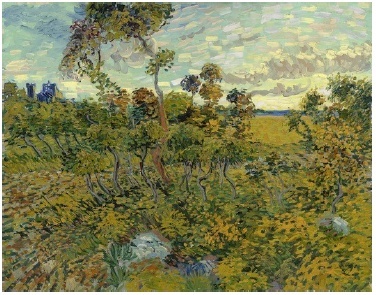
Long-Lost Van Gogh Painting Discovered
by Megan Gannon, September 09, 2013
A major new painting by Vincent van Gogh has been discovered. It is called, “Sunset at Montmajour”.
The Van Gogh Museum in Amsterdam unveiled the long-lost landscape painting today (Sept. 9) following an investigation that showed the style, technique, paint, canvas and subject matter matched with other works from the peak of the Dutch artist's career.
The painting originally belonged to the collection of Theo van Gogh, the artist's brother, and was sold in 1901. Shortly thereafter, the artwork ended up in the hands of a Norwegian collector who tucked it away in his attic after it was declared a fake.
As recently as the 1990s, the painting's authenticity was rejected by the museum. But now the researchers say, “Stylistically and technically speaking, there are plenty of parallels with other paintings by van Gogh from the summer of 1888”.
The newly identified painting also shows signs of the same discoloration that has come to characterize van Gogh's work in recent years. The bright yellows in many of his paintings have been turning into muddy browns.
The researchers even found two references to the work in van Gogh's letters, in which he is critical of the painting and declared it unsuccessful.
Disponível em: <http://LiveScience.htm>. Acesso em: 12 set. 2013. (Adaptado).
“Muddy” refers to a colour that is
Questão 86 94423
UFG 2014/1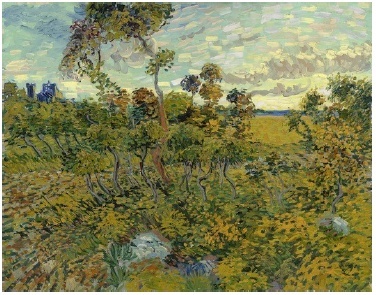
Long-Lost Van Gogh Painting Discovered
by Megan Gannon, September 09, 2013
A major new painting by Vincent van Gogh has been discovered. It is called, “Sunset at Montmajour”.
The Van Gogh Museum in Amsterdam unveiled the long-lost landscape painting today (Sept. 9) following an investigation that showed the style, technique, paint, canvas and subject matter matched with other works from the peak of the Dutch artist's career.
The painting originally belonged to the collection of Theo van Gogh, the artist's brother, and was sold in 1901. Shortly thereafter, the artwork ended up in the hands of a Norwegian collector who tucked it away in his attic after it was declared a fake.
As recently as the 1990s, the painting's authenticity was rejected by the museum. But now the researchers say, “Stylistically and technically speaking, there are plenty of parallels with other paintings by van Gogh from the summer of 1888”.
The newly identified painting also shows signs of the same discoloration that has come to characterize van Gogh's work in recent years. The bright yellows in many of his paintings have been turning into muddy browns.
The researchers even found two references to the work in van Gogh's letters, in which he is critical of the painting and declared it unsuccessful.
Disponível em: <http://LiveScience.htm>. Acesso em: 12 set. 2013. (Adaptado).
In the context of this text, “discovered” means
06