


![[Marketing] Questao Topo - deslogado](https://storage.estuda.com.br/banners/0_6b7ebee90b03af1c560c73bb8bcce34a_banner_deslogado_70_dias.png)
Questões de Inglês
19.971 Questões
Questão 16 106974
UNIVAG 2014/1
Esse anúncio
Questão 15 106973
UNIVAG 2014/1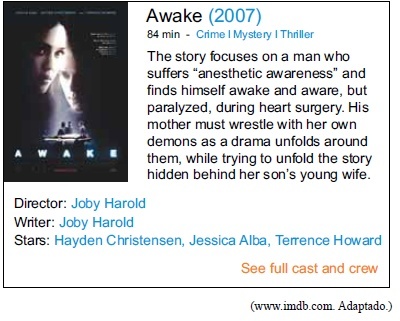
De acordo com a sinopse do filme Awake, é correto afirmar que
Questão 13 106971
UNIVAG 2014/1Near-death experiences may not be figment of imagination
Danielle Elliot
August 12, 2013
The brain remains conscious after the heart stops beating, according to University of Michigan researchers. It may even function higher in the moments immediately following cardiac arrest* than it does when the body is in a normal state.
The finding supports the shared experience of nearly 20 percent of people who have survived cardiac arrest. These survivors report having internal visions and heightened perception, known as near-death experiences, but the scientific reality of the experience has long been debated.
In a study published Monday in the Proceedings of the National Academy of Science, the team explains that in a study of nine rats, they observed continued brain activity even after the heart stopped beating and blood flow ceased. Compared to anesthesized and walking states, brain activity and coherence actually increased immediately following cardiac arrest. While the sample size is small, the results were observed in all nine of the rats studied.
“This study, performed in animals, is the first dealing with what happens to the neurophysiological state of the dying brain,” lead study author Jimo Borjigin, Ph.D., associate professor of molecular and integrative physiology and associate professor of neurology at the University of Michigan Medical School, said in a statement.
“It will form the foundation for future human studies investigating mental experiences occurring in the dying brain, including seeing light during cardiac arrest,” she added.(www.cbsnews.com. Adaptado.)
Segundo o texto, 20% das pessoas que sobreviveram a uma parada cardíaca relatam que, durante o ocorrido,
Questão 12 106970
UNIVAG 2014/1Near-death experiences may not be figment of imagination
Danielle Elliot
August 12, 2013
The brain remains conscious after the heart stops beating, according to University of Michigan researchers. It may even function higher in the moments immediately following cardiac arrest* than it does when the body is in a normal state.
The finding supports the shared experience of nearly 20 percent of people who have survived cardiac arrest. These survivors report having internal visions and heightened perception, known as near-death experiences, but the scientific reality of the experience has long been debated.
In a study published Monday in the Proceedings of the National Academy of Science, the team explains that in a study of nine rats, they observed continued brain activity even after the heart stopped beating and blood flow ceased. Compared to anesthesized and walking states, brain activity and coherence actually increased immediately following cardiac arrest. While the sample size is small, the results were observed in all nine of the rats studied.
“This study, performed in animals, is the first dealing with what happens to the neurophysiological state of the dying brain,” lead study author Jimo Borjigin, Ph.D., associate professor of molecular and integrative physiology and associate professor of neurology at the University of Michigan Medical School, said in a statement.
“It will form the foundation for future human studies investigating mental experiences occurring in the dying brain, including seeing light during cardiac arrest,” she added.
(www.cbsnews.com. Adaptado.)
No trecho do primeiro parágrafo – It may even function higher in the moments immediately following cardiac arrest than it does when the body is in a normal state. –, a palavra em destaque estabelece entre as frases uma relação de
Questão 16 106912
UNIVAG 2014/2
É correto afirmar que o anúncio traz uma mensagem que
Questão 32 105176
FAMEVAÇO Tipo A 2014/1What is hepatitis?
The term 'hepatitis' simply means inflammation of the liver. Hepatitis may be caused by a virus or a toxin such as alcohol. Other viruses that can cause injury to liver cells include the hepatitis A and hepatitis C viruses. These viruses are not related to each other or to hepatitis B virus and differ in their structure, the ways they are spread among individuals, the severity of symptoms they can cause, the way they are treated, and the outcome of the infection.
What is the scope of the problem?
Hepatitis B is an infection of the liver caused by the hepatitis B virus (HBV). It is estimated that 350 million individuals worldwide are infected with the virus, which causes 620,000 deaths worldwide each year. According to the Centers for Disease Control (CDC), approximately 46,000 new cases of hepatitis B occurred in the United States in 2006.
In the United States, rates of new infection were highest among people aged 25 to 44 years (3.1 cases per 100,000 population) and lowest among those younger than 15 years of age (0.02 per 100,000). This reflects the major modes of transmission of hepatitis B (sexual transmission, illicit drug use, exposure to infected blood) and the effect of universal vaccination of infants. In the United States, there has been a 75% decrease in newly diagnosed cases of hepatitis B during the past decade. This decrease is attributed to increased vaccination and to heightened public awareness of HIV/AIDS and the resulting safer sexual practices.
When a person first gets hepatitis B, they are said to have an 'acute' infection. Most people are able to eliminate the virus and are cured of the infection. Some are not able to clear the virus and have 'chronic' infection with hepatitis B that is usually life-long. In the United States an estimated 800,000 to 1.4 million people are chronically infected with hepatitis B.
Hepatitis B is found throughout the world. Some countries have much higher rates of infection than the United States; for example, in Southeast Asia and Sub-Saharan Africa, as many as 15% to 20% of adults are chronically infected with hepatitis B.
What kind of a virus is hepatitis B?
The hepatitis B virus is a DNA virus, meaning that its genetic material is made up of deoxyribonucleic acids. It belongs to a family of viruses known as Hepadnaviridae. The virus is primarily found in the liver but is also present in the blood and certain body fluids. Hepatitis B virus consists of a core particle (central portion) and a surrounding envelope (outer coat). The core is made up of DNA and the core antigen (HBcAg). The envelope contains the surface antigen (HBsAg). These antigens are present in the blood and are markers that are used in the diagnosis and evaluation of patients with suspected viral hepatitis.
How does hepatitis B virus cause liver injury?
The hepatitis B virus reproduces in liver cells, but the virus itself is not the direct cause of damage to the liver. Rather, the presence of the virus triggers an immune response from the body as the body tries to eliminate the virus and recover from the infection. This immune response causes inflammation and may seriously injure liver cells. Therefore, there is a balance between the protective and destructive effects of the immune response to the hepatitis B virus.
http://www.medicinenet.com/hepatitis_b/article.htm
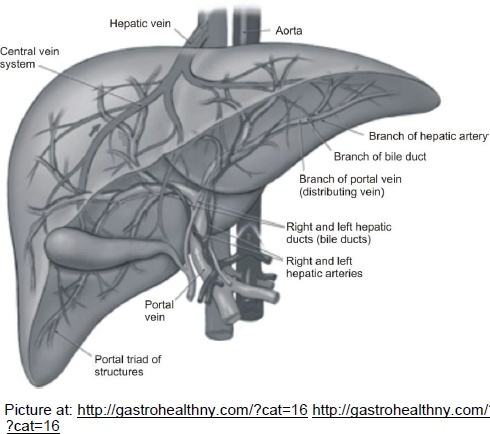
Hepatitis B causes liver injury
06