


![[Marketing] Questao Topo - deslogado](https://storage.estuda.com.br/banners/0_6b7ebee90b03af1c560c73bb8bcce34a_banner_deslogado_70_dias.png)
Questões de Inglês
19.971 Questões
Questão 17 124476
UPF Prova de verão 2014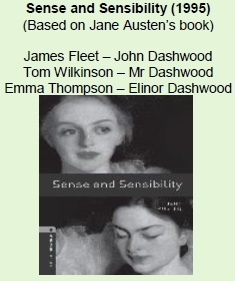
Sometimes the Dashwood girls do not seem like sisters.
Elinor is all calmness and reason, and can be relied upon
for practical, common sense opinions. Marianne, on the
other hand, is all sensibility, full of passionate and romantic
feeling. True love can only be felt by the young, of course.
And if your heart is broken at the age of seventeen, how
can you ever expect to recover?
(Retrieved and adapted from http://www.oupbookworms. com/downloads/pdf/movie_links/BOOKWORMSMovies- 5.pdf. Access on September 23rd, 2013)
According to the synopsis, it is possible to infer that:
Questão 44 113365
UFGD 2014Alzheimer's breakthrough hailed as 'turning point'
The discovery of the first chemical to prevent the death of brain tissue in a neurodegenerative disease has been hailed as the "turning point" in the fight against Alzheimer's disease.
More work is needed to develop a drug that could be taken by patients (…). In tests on mice, the Medical Research Council showed all brain cell death from prion disease could be prevented.
Prof Roger Morris, from King's College London, said: "This finding, I suspect, will be judged by history as a turning point in the search for medicines to control and prevent Alzheimer's disease." He told the BBC a cure for Alzheimer's was not imminent but: "I'm very excited, it's the first proof in any living animal that you can delay neurodegeneration.
The research team at the Medical Research Council Toxicology Unit, based at the University of Leicester, focused on the natural defence mechanisms built into brain cells. When a virus hijacks a brain cell it leads to a build-up of viral proteins. Cells respond by shutting down nearly all protein production in order to halt the virus's spread.
However, many neurodegenerative diseases involve the production of faulty or "misfolded" proteins. These activate the same defences, but with more severe consequences. The misfolded proteins linger and the brain cells shut down protein production for so long that they eventually starve themselves to death. This process, repeated in neurons throughout the brain, can destroy movement or memory or even kill, depending on the disease (…)
The researchers used a compound which prevented those defence mechanisms kicking in and in turn halted neurodegeneration (…)the compound offered a "new pathway that may well give protective drugs" and the next step was for drug companies to develop a medicine for use in humans
Disponível em: http://www.bbc.co.uk/news/health-24462699
According to the text:
Questão 42 113363
UFGD 2014Snowden Says He Took No Secret Files to Russia
By JAMES RISEN
Mr. Snowden said he gave all of the classified documents he had obtained to journalists he met in Hong Kong, before flying to Moscow, and did not keep any copies for himself. He did not take the files to Russia “because it wouldn’t serve the public interest,” he said. “What would be the unique value of personally carrying another copy of the materials onward?” he added.
He also asserted that he was able to protect the documents from China’s spies because he was familiar with that nation’s intelligence abilities, saying that as an N.S.A. contractor he had targeted Chinese operations and had taught a course on Chinese cybercounterintelligence.
“There’s a zero percent chance the Russians or Chinese have received any documents,” he said.
American intelligence officials have expressed grave concern that the files might have fallen into the hands of foreign intelligence services, but Mr. Snowden said he believed that the N.S.A. knew he had not cooperated with the Russians or the Chinese. He said he was publicly revealing that he no longer had any agency documents to explain why he was confident that Russia had not gained access to them. He had been reluctant to disclose that information previously, he said, for fear of exposing the journalists to greater scrutiny.
In a wide-ranging interview over several days in the last week, Mr. Snowden offered detailed responses to accusations that have been leveled against him by American officials and other critics, provided new insights into why he became disillusioned with the N.S.A. and decided to disclose the documents, and talked about the international debate over surveillance that resulted from the revelations. The interview took place through encrypted online communications.
Mr. Snowden, 30, has been praised by privacy advocates and assailed by government officials as a traitor who has caused irreparable harm, and he is facing charges under the Espionage Act for leaking the N.S.A. documents to the news media. In the interview, he said he believed he was a whistle-blower who was acting in the nation’s best interests by revealing information about the N.S.A.’s surveillance dragnet and huge collections of communications data, including that of Americans.
He argued that he had helped American national security by prompting a badly needed public debate about the scope of the intelligence effort. “The secret continuance of these programs represents a far greater danger than their disclosure,” he said. He added that he had been more concerned that Americans had not been told about the N.S.A.’s reach than he was about any specific surveillance operation. “So long as there’s broad support amongst a people, it can be argued there’s a level of legitimacy even to the most invasive and morally wrong program, as it was an informed and willing decision,” he said. “However, programs that are implemented in secret, out of public oversight, lack that legitimacy, and that’s a problem. It also represents a dangerous normalization of ‘governing in the dark,’ where decisions with enormous public impact occur without any public input.”
Mr. Snowden said he had never considered defecting while in Hong Kong, nor in Russia, where he has been permitted to stay for one year. He said he felt confident that he had kept the documents secure from Chinese spies, and that the N.S.A. knew he had done so. His last target while working as an agency contractor was China, he said, adding that he had had “access to every target, every active operation” mounted by the N.S.A. against the Chinese. “Full lists of them,” he said.
“If that was compromised,” he went on, “N.S.A. would have set the table on fire from slamming it so many times in denouncing the damage it had caused. Yet N.S.A. has not offered a single example of damage from the leaks. They haven’t said boo about it except ‘we think,’ ‘maybe,’ ‘have to assume’ from anonymous and former officials. Not ‘China is going dark.’ Not ‘the Chinese military has shut us out.’ ”
An N.S.A. spokeswoman did not respond Thursday to a request for comment on Mr. Snowden’s assertions.
Disponível em: http://www.nytimes.com/2013/10/18/world/snowden-says-he-took-no-secret-files-to-russia.html?adxnnl=1&hpw=&adxnnlx=1382102551- ++nosbxAAmeClFGNr135GQ Acesso: 23 out. 2013
Judge the sentences according to the text
I – The word argue in the sentence “He argued that he had helped American national security” means give reasons why you think something is right.
II – We can state that the expression took place in the sentence “The interview took place through encrypted online communications” has the same meaning in “Iraq has seen a marked rise in the level of violence this year. In the latest attack, a car bomb killed 12 people. The attack took place near a checkpoint on a busy street in the centre of Ramadi.”
III – According to the article we can state Snowden’s actions were a revenge against the Government of US and NSA. Hebelieves that made a great damage to the National Security disclosing the documents.
IV – The conjunction however in “However, programs that are implemented in secret, out of public oversight, lack that legitimacy, and that’s a problem” can be replaced, without changing the meaning by nevertheless.
V – Snowden declared that one of the reasons that he disclosed the documents was because he felt disappointed with N.S.A.
Mark the correct answer.
Questão 40 113361
UFGD 2014Syria: The story of the conflict: Chemical attack
On 21 August 2013, footage emerged of victims of an suspected chemical weapons attack on several Damascus suburbs. Hundreds were killed, foreign governments and activists said.
Both sides blamed each other for the incident, potentially the deadliest of the conflict so far.
However, the US and its allies made it clear they believed the Syrian government used chemical weapons on its own people on a large scale, raising the possibility of punitive military strikes.
Disponível em: http://www.bbc.co.uk/news/world-middle-east-19331551
According to the text it´s correct to say:
Questão 38 113359
UFGD 2014These Protests Will Accomplish Very Little
By Carlos Pio
The world has been optimistic about Brazil for the past decade. Productivity has risen as trade has been liberalized, state-owned companies have been sold and many industries deregulated. Hyperinflation has been controlled and the exchange rate has been floated. Social policies, called conditional cash transfers, have targeted the poor. And commodity exports to China soared. The economy grew stronger and many became richer.
But the country has one of the highest levels of social inequality in the world. Many of the rich live in bubbles of prosperity, like Brasilia and beachfront avenues in major cities. The poor are almost invisible, forgotten in rural areas or marginalized in urban slums.
Unfortunately Brazil will remain socially unequal, attached to failed ideologies -- economically stagnate but still democratic.
And the policies that led to Brazil’s growth have been undermined since the 2003 inauguration of President Luiz Inácio Lula da Silva, who, along with all the left-wing parties, opposed those policies while out of power. On the positive side, Lula increased the scope of "bolsa família" (the umbrella name for all cash-transfer benefits) until it reached 12 million families. But he slowly discontinued the programs that had produced economic gains — a process that accelerated under President Dilma Rousseff, who took office in 2011.
Private investors were scared off by zigzag regulatory changes. Government finances were stressed by the rising cost of developmental projects like the 2014 World Cup and the 2016 Summer Olympics, as well as by generous wage concessions for public employees. After growing 7.5 percent in 2010, Brazil's gross domestic product growth has stalled as the Chinese economy has slowed. Simultaneously, inflation and interest rates are rising.
The first protest was aimed at a bus fare increase decreed by the mayor of São Paulo, who is aligned with Lula and Rousseff. But responsibility for crowd control fell under the governor of São Paulo state, who is a leading force in the opposition to President Rousseff. Soon the protestors were crowded out by waves of upper-middle-class and wealthy citizens touched by strong images depicting police violence. The protestors called for solidarity marches in other cities.
But spontaneous crowds -- everywhere, not just in Brazil -- lack a consistent agenda and a leadership that can enact reform. The protesters will not win much and will soon recede. And unfortunately Brazil will remain socially unequal, attached to failed ideologies -- economically stagnate but still democratic.
Disponível em: http://www.nytimes.com/roomfordebate/2013/06/19/will-the-protests-in-brazil-lead-to-change/the-protests-in-brazil-will-accomplish-verylittle. Acesso: 19 out. 2013
It is correct to say that the main Idea of the article deals with.
Questão 66 111265
UFRR Módulo 3 2014
In the clause “Bilateral trade between the two countries reached a record $661m last year”, the word ‘reached’ can be substituted by:
06