


![[Marketing] Questao Topo - deslogado](https://storage.estuda.com.br/banners/0_6b7ebee90b03af1c560c73bb8bcce34a_banner_deslogado_70_dias.png)
Questões de Inglês
19.971 Questões
Questão 49 160527
UFSM 2014/1Brazilian Food - a Mix of Influences
For Sunday Times Extra, 6 July 2014
In a country as geographically expansive as
Brazil, it isn't easy to define the cuisine. Native
Indians and colonisation by the Portuguese,
who brought over African slaves, have all
played their part in the culinary culture. There
is a mix of influences that have endured and
intermingled in Brazil.
There seems to be an understanding that
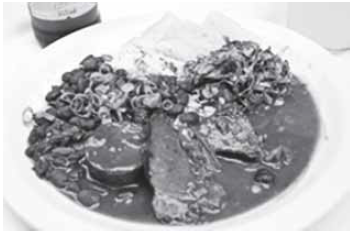
feijoada, the black bean stew made with
various pork cuts, with its roots in Africa, is the
national dish. Unctuous and hearty, it's served
with pork crackling, orange slices and collard
greens and enjoyed on Saturdays.
Just as many Asians rely on rice as a staple,
Brazilians look to the starchy tuber cassava
(known as manioc or yuca) – boiled, fried,
stewed, ground into flour and toasted with
butter, as their daily bread.
The South East (São Paulo and Rio fall here)
tends to serve a mix from around the country.
Coxinha (chicken croquettes), tapioca pancakes,
salt cod pasteis (deep-fried pastries)
and pão de queijo (cheese rolls) are popular
city snacks.
Other Brazilian foods to try:
1. The North: Influenced by the Amazon Indians,
the food here is as close to what it was
before colonisation. Try:
• Açaí: A superfruit and Guaraná, a berry
used to make energy drinks.
• Pimenta: spicy peppers.
• Pudim de Tambaqui: A soufflé-like fish
dish with shrimp sauce.
• Tacacá: A soup with salted dry jumbo
prawns and local watercress.
2. The North East: slaves on the sugar cane
plantations used palm oil, coconut milk and
okra, popular in some African countries.
Try:
• Acarajé: A fritter made with beans and
fried in palm oil.
• Bobó de Camarão: Hearty shrimp stew,
made with manioc, coconut milk, and
palm oil.
• Caruru: A stew of okra, dried shrimp and
toasted cashews.
3. South Brazil: A melting pot of cultural
influences from German to Lebanese can be
found here. Try:
• Arroz de Carreteiro: Fried rice with
rehydrated charque – South American
biltong.
• Churrasco: Brazilian braai. Meat
marinated in salt and milk or cachaça –
distilled sugar-cane spirits.
Fonte: Disponível em: http://www.foodandthefabulous.com/recipes/brazilian-food-mix-influences. Acesso em: 15 set. 2014. (adaptado)
Sobre a mandioca (ℓ.14-18), indique se as afirmações a seguir estão em acordo (A) ou desacordo (D) com o texto.
( ) Na forma de farinha, é ingrediente básico do pão diário.
( ) Pode ser cozida, frita, ensopada.
( ) Temorigem asiática.
( ) Significa para o brasileiro o que o arroz significa para o asiático.
A sequência correta é
Questão 48 160526
UFSM 2014/1Brazilian Food - a Mix of Influences
For Sunday Times Extra, 6 July 2014
In a country as geographically expansive as
Brazil, it isn't easy to define the cuisine. Native
Indians and colonisation by the Portuguese,
who brought over African slaves, have all
played their part in the culinary culture. There
is a mix of influences that have endured and
intermingled in Brazil.
There seems to be an understanding that
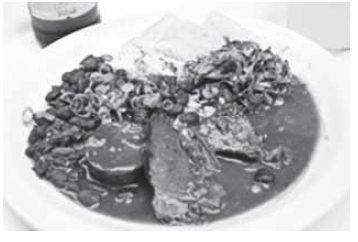
feijoada, the black bean stew made with
various pork cuts, with its roots in Africa, is the
national dish. Unctuous and hearty, it's served
with pork crackling, orange slices and collard
greens and enjoyed on Saturdays.
Just as many Asians rely on rice as a staple,
Brazilians look to the starchy tuber cassava
(known as manioc or yuca) – boiled, fried,
stewed, ground into flour and toasted with
butter, as their daily bread.
The South East (São Paulo and Rio fall here)
tends to serve a mix from around the country.
Coxinha (chicken croquettes), tapioca pancakes,
salt cod pasteis (deep-fried pastries)
and pão de queijo (cheese rolls) are popular
city snacks.
Other Brazilian foods to try:
1. The North: Influenced by the Amazon Indians,
the food here is as close to what it was
before colonisation. Try:
• Açaí: A superfruit and Guaraná, a berry
used to make energy drinks.
• Pimenta: spicy peppers.
• Pudim de Tambaqui: A soufflé-like fish
dish with shrimp sauce.
• Tacacá: A soup with salted dry jumbo
prawns and local watercress.
2. The North East: slaves on the sugar cane
plantations used palm oil, coconut milk and
okra, popular in some African countries.
Try:
• Acarajé: A fritter made with beans and
fried in palm oil.
• Bobó de Camarão: Hearty shrimp stew,
made with manioc, coconut milk, and
palm oil.
• Caruru: A stew of okra, dried shrimp and
toasted cashews.
3. South Brazil: A melting pot of cultural
influences from German to Lebanese can be
found here. Try:
• Arroz de Carreteiro: Fried rice with
rehydrated charque – South American
biltong.
• Churrasco: Brazilian braai. Meat
marinated in salt and milk or cachaça –
distilled sugar-cane spirits.
Fonte: Disponível em: http://www.foodandthefabulous.com/recipes/brazilian-food-mix-influences. Acesso em: 15 set. 2014. (adaptado)
O segmento que apresenta o mesmo conteúdo do título em outras palavras e com mais detalhes é
Questão 83 158249
FMJ 2014Neuron growth in children ‘leaves no room for memories’
25 May 2013
The reason we struggle to recall memories from our early childhood is down to high levels of neuron production during the first years of life, say Canadian researchers. The formation of new brain cells increases the capacity for learning but also clears the mind of old memories. This could be behind the absence of long-term memory events from early childhood, known as infantile amnesia. The findings were presented to the Canadian Association of Neuroscience.
Neurogenesis, or the formation of new neurons in the hippocampus - a region of the brain known to be important for learning and remembering, reaches its peak before and after birth. It then declines steadily during childhood and adulthood. Dr Paul Frankland and Dr Sheena Josselyn, from the Hospital for Sick Children in Toronto and the University of Toronto, wanted to find out how the process of new neuron generation impacted on memory storage. They carried out their research on younger and older mice in the lab.
Early amnesia
In adult mice, they found that increasing neurogenesis after memory formation was enough to bring about forgetting. In infant mice, they discovered that decreasing neurogenesis after memory formation meant that the normal forgetting observed at this age did not occur. Their research suggests a direct link between a reduction in neuron growth and increased memory recall. They found the opposite to be true also - a decreased ability to remember when neurogenesis is increased (as happens during infancy).
The researchers said this provided an explanation for the absence of long-term memory events from early childhood, known as infantile amnesia. Previous studies have shown that although young children can remember events in the short term, these memories do not persist.
Dr Frankland, senior scientist in neuroscience and mental health, at the hospital, said: “Why infantile amnesia exists has long 84 a mystery. We think our new studies begin to explain 85 we have no memories from our earliest years. Before the ages of four or five, we have a highly dynamic hippocampus which can’t stably store information. As new neurons are generated, memory may be compromised by that process.”
(www.bbc.co.uk. Adaptado.)
No trecho do quarto parágrafo – Previous studies have shown that although young children can remember events in the short term, these memories do not persist. –, a palavra although pode ser corretamente substituída, sem alteração de sentido, por
Questão 78 158238
FMJ 2014Neuron growth in children ‘leaves no room for memories’
25 May 2013
The reason we struggle to recall memories from our early childhood is down to high levels of neuron production during the first years of life, say Canadian researchers. The formation of new brain cells increases the capacity for learning but also clears the mind of old memories. This could be behind the absence of long-term memory events from early childhood, known as infantile amnesia. The findings were presented to the Canadian Association of Neuroscience.
Neurogenesis, or the formation of new neurons in the hippocampus - a region of the brain known to be important for learning and remembering, reaches its peak before and after birth. It then declines steadily during childhood and adulthood. Dr Paul Frankland and Dr Sheena Josselyn, from the Hospital for Sick Children in Toronto and the University of Toronto, wanted to find out how the process of new neuron generation impacted on memory storage. They carried out their research on younger and older mice in the lab.
Early amnesia
In adult mice, they found that increasing neurogenesis after memory formation was enough to bring about forgetting. In infant mice, they discovered that decreasing neurogenesis after memory formation meant that the normal forgetting observed at this age did not occur. Their research suggests a direct link between a reduction in neuron growth and increased memory recall. They found the opposite to be true also - a decreased ability to remember when neurogenesis is increased (as happens during infancy).
The researchers said this provided an explanation for the absence of long-term memory events from early childhood, known as infantile amnesia. Previous studies have shown that although young children can remember events in the short term, these memories do not persist.
Dr Frankland, senior scientist in neuroscience and mental health, at the hospital, said: “Why infantile amnesia exists has long 84 a mystery. We think our new studies begin to explain 85 we have no memories from our earliest years. Before the ages of four or five, we have a highly dynamic hippocampus which can’t stably store information. As new neurons are generated, memory may be compromised by that process.”
(www.bbc.co.uk. Adaptado.)
The research mentioned in the text intends to
Questão 20 157596
CESGRANRIO 2014Do young people care about privacy?
We seem to be moving closer to a world where
every aspect of our lives is recorded, whether we like
it or not. And once our data is shared on the internet,
we lose control over it…
Facebook CEO Mark Zuckerberg thinks the age
of privacy is over…but a team of Italian researchers is
not so sure about that…They’re working on a mobile
application that will allow users to regain control of
their personal data.
Mattia Pasolli, Application Developer at the
project, known as the ‘Mobile Territorial Laboratory’
(MTL), reports that “All the people who don’t use
Facebook because of privacy issues might use it,
because they will know they have a sort of firewall that
precisely tells them what information is being shared
with external services.”
The application is being tested with 80 families in
the Northern Italian city of Trento. Every family has a
smartphone that collects data about their lives.
Fabrizio Antonelli, Director of the Mobile
Territorial Laboratory, explains that “The instrument
we used is called personal data store. It represents
a sort of security box for data, where we keep all the
information we collect about the person. Here, each
person can see the life cycle of his or her own data,
and see who has used that data, when, and for what
purpose.”
The research has been developed through the
principle of “participatory design”. The application
is developed through the participation of the 80
families taking part. It’s a real community and they
knew each other before the research.
Community Manager of MTL Erica Paris says
it could be a learning experience for users. “People
can learn a lot from this initiative, because through
this project they realise the amount of data that is
collected about them, including data from applications
other than ours. It’s something that they did not know
before”.
Mattia Pasolli says Europe has a long way to
go to emulate America. “In the United States, there
are cultural factors that facilitate the creation of very
innovative small start-ups. But in Europe the mentality
of ‘trial, failure and trying again’ is not still totally
accepted or part of our culture”.
One of the goals of the project is to improve
people’s quality of life through information and
communication technologies. The researchers hope
to anticipate the future trends in society.
Available at: <http://www.euronews.com/2013/06/03/do-young-people-care-about-privacy/> Retrieved on: Sept. 7th, 2013. Adapted.
80 families in the Northern Italian city of Trento are mentioned in Text II because they have
Questão 17 157593
CESGRANRIO 2014Do young people care about privacy?
We seem to be moving closer to a world where
every aspect of our lives is recorded, whether we like
it or not. And once our data is shared on the internet,
we lose control over it…
Facebook CEO Mark Zuckerberg thinks the age
of privacy is over…but a team of Italian researchers is
not so sure about that…They’re working on a mobile
application that will allow users to regain control of
their personal data.
Mattia Pasolli, Application Developer at the
project, known as the ‘Mobile Territorial Laboratory’
(MTL), reports that “All the people who don’t use
Facebook because of privacy issues might use it,
because they will know they have a sort of firewall that
precisely tells them what information is being shared
with external services.”
The application is being tested with 80 families in
the Northern Italian city of Trento. Every family has a
smartphone that collects data about their lives.
Fabrizio Antonelli, Director of the Mobile
Territorial Laboratory, explains that “The instrument
we used is called personal data store. It represents
a sort of security box for data, where we keep all the
information we collect about the person. Here, each
person can see the life cycle of his or her own data,
and see who has used that data, when, and for what
purpose.”
The research has been developed through the
principle of “participatory design”. The application
is developed through the participation of the 80
families taking part. It’s a real community and they
knew each other before the research.
Community Manager of MTL Erica Paris says
it could be a learning experience for users. “People
can learn a lot from this initiative, because through
this project they realise the amount of data that is
collected about them, including data from applications
other than ours. It’s something that they did not know
before”.
Mattia Pasolli says Europe has a long way to
go to emulate America. “In the United States, there
are cultural factors that facilitate the creation of very
innovative small start-ups. But in Europe the mentality
of ‘trial, failure and trying again’ is not still totally
accepted or part of our culture”.
One of the goals of the project is to improve
people’s quality of life through information and
communication technologies. The researchers hope
to anticipate the future trends in society.
Available at: <http://www.euronews.com/2013/06/03/do-young-people-care-about-privacy/> Retrieved on: Sept. 7th, 2013. Adapted.
According to Fabrizio Antonelli, in Text II, the personal data store allows people to
06